

Afghan Acting PM urges world to recognize Taliban government
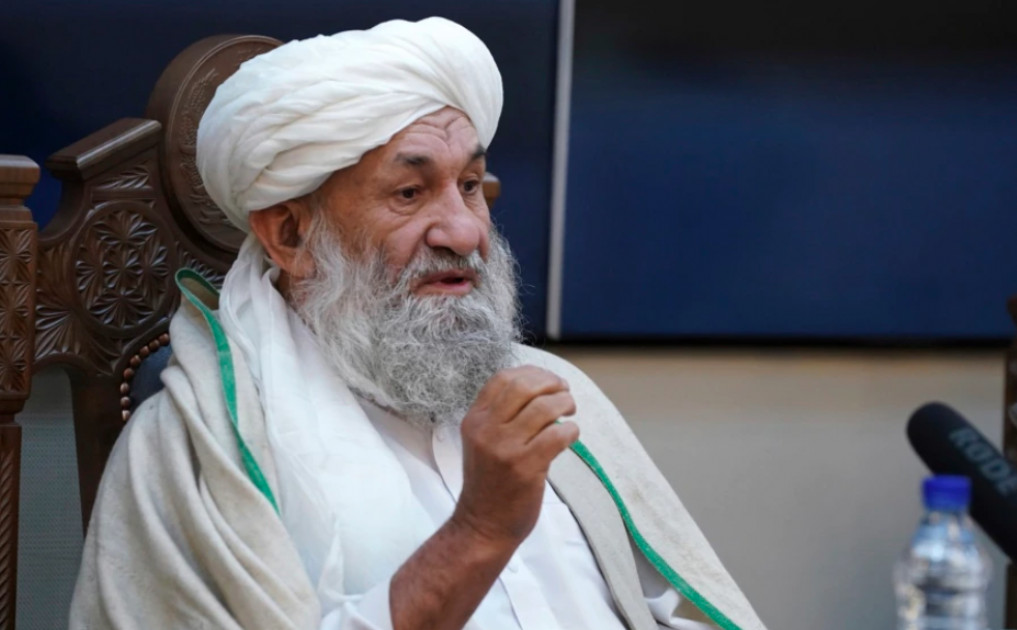
Taliban Prime Minister Mohammad Hassan Akhund speaks during an economic conference at the former Presidential Palace in Kabul, Afghanistan, Jan. 19, 2022.

Audio By Vocalize
The Taliban’s acting prime minister asked the
global community Wednesday to grant legitimacy to Afghanistan’s new government,
insisting it has met all conditions required for the official recognition.
Mohammad Hassan Akhund spoke at a conference
in Kabul where his interim administration convened to discuss massive economic
upheavals facing the country since the Taliban seized power last August. The
event was also attended by United Nations officials.
“I call especially on Islamic countries to
not wait for others and take the lead in officially recognizing our Islamic
Emirate,” Akhund said.
This would help expedite efforts aimed at
addressing dire economic and humanitarian problems facing Afghanistan, he
argued.
No country has yet recognized the new
government, which the Taliban officially refer to as the Islamic Emirate of
Afghanistan. Foreign governments are watching to see how the ultra-conservative
group will govern the country this time around.
Akhund blamed the current economic crisis on
international sanctions and the freezing of roughly $9.5 billion in
Afghanistan’s foreign cash reserves by Western nations led by the United
States.
Deborah Lyons, the head of the U.N. mission
in Kabul, told the conference the global body was working to “revitalize” the
Afghan economy and “fundamentally” address the economic problems.
“The economic crisis is not the only problem
facing Afghanistan. But it is one of the most urgent and above all is one where
action is possible and must be taken quickly by all of us,” Lyons said.
She praised some of the steps the Taliban
administration has taken to contain economic deterioration.
“Foremost among these is the adoption
recently of a national budget that, for the first time, is totally financed by
national revenues and not dependent on any donor grants,” Lyons noted. “In
addition, revenue generation has been growing, despite the economic slowdown,
in large part because of efforts to address corruption.”
Lyons, however, stressed the importance of
women’s participation in economic activities, saying stable societies and
economic progress require inclusion, respect for human rights and equality
among all citizens.
Other senior Taliban Cabinet members also
addressed Wednesday’s conference and called for ending international economic
sanctions.
Acting Foreign Minister Amir Khan Muttaqi
said the Taliban government was seeking to establish close economic relations
with international partners.
“Humanitarian aid is the short-term solution
to economic problems but what is needed to solve problems in the long run is
the implementation of infrastructure projects,” Muttaqi said.
“I again avail this opportunity to call on
the United States of America to unfreeze the assets of Afghanistan’s Central
Bank and to remove all impediments for relief organizations and Afghans in
money transfers to Afghanistan,” the foreign minister added.
Taliban officials said representatives of 20
foreign nations attended the conference, while dozens more participated
virtually.
Since the Taliban took over the government
five months ago, the suspension of most international development funding to
aid-dependent Afghanistan, the imposition of financial restrictions and
long-running terrorism-related sanctions on Taliban leaders, have led to a
breakdown in many basic services, including electricity, health services and
education.
Inflation is rampant, and the price of
ordinary goods is beyond the reach of most Afghans.
Under the previous Taliban government from
1996 to 2001, women were excluded from public life, girls’ education was
banned, human rights abuses were rampant, and transnational terrorists were
active on Afghan soil, triggering international sanctions and the diplomatic
isolation of the country.
Although Taliban leaders have pledged to
govern the country differently, they have not yet allowed most women to return
to public sector jobs. While schoolboys were allowed to resume classes in
September, secondary schools for girls across Afghanistan have mostly remained
shuttered.
Women are not allowed to travel beyond 72
kilometers without a male relative and taxi drivers are ordered to refuse a
ride to women not wearing an Islamic hijab or veil.
The International Labour Organization said
Wednesday in a new report that Afghanistan had lost more than half-a-million
jobs since the Taliban took control of the country. That number could rise to
more than 900,000 by the middle of this year, the report said. The ILO noted women
were hit hardest, estimating that female employment dropped by 16% in July,
August and September.
Leave a Comment