
Africa seeks partnership, not patronage - Mudavadi
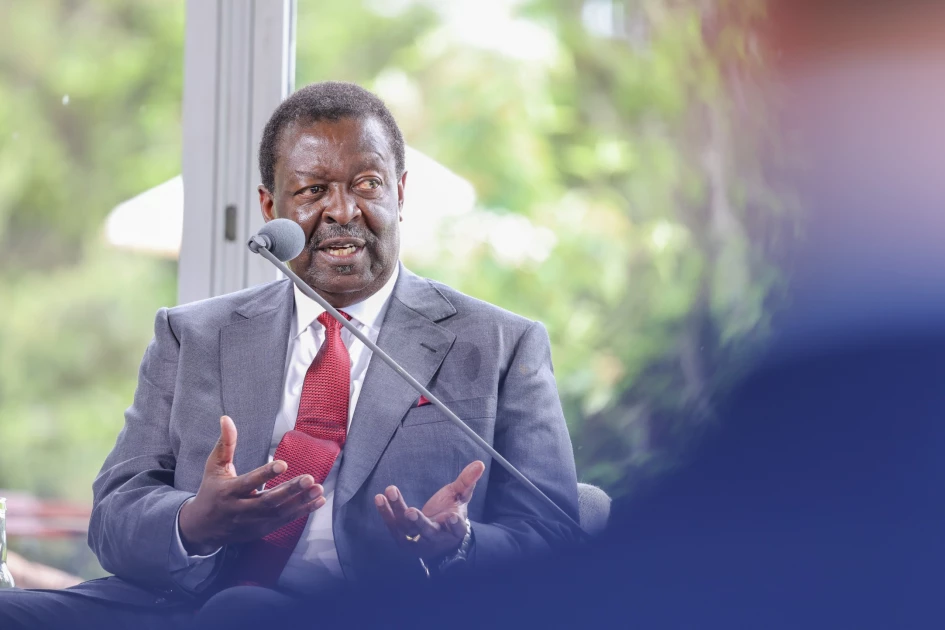
Prime Cabinet Secretary Musalia Mudavadi speaks at the 13th Edition of the Kultaranta Talks in Naantali, Finland on June 26.2025. | PHOTO: OPCS

Audio By Vocalize
Africa is not a passive recipient of aid or
a battleground for influence but a continent at the threshold of intra-Africa
trade and economic independence, Prime Cabinet Secretary Musalia Mudavadi has
said.
According to Mudavadi, at the heart of
Africa’s journey is the principle of “African solutions to African problems,” a
concept championed by the African Union (AU) and rooted in the belief that
Africans are best positioned to address their own challenges.
He said this principle is not a mere slogan
but a call to action.
This he said is reflected in initiatives
like African Union Support and Stabilisation Mission in Somalia (AUSSOM),
which, since January 2025, has supported Somali forces in combating Al-Shabaab
and transitioning security responsibilities.
"The AU’s peace missions, from AMISOM
to AUSSOM, demonstrate Africa’s commitment to fostering stability, yet too
often, the heavy lifting done by African troops and mediators is overshadowed
by external actors claiming credit," he said.
Much as international support is valuable,
he said it should amplify, not eclipse, African leadership.
Mudavadi said Africa is making efforts to
drive its own resilience against debilitating global shocks and the narrative
about Africa must shift from fragility to potential and from victim to a
positive contributor to global governance.
He said the continent is playing a
significant role in spheres like global climate action, including green energy
and critical minerals needed for the global clean energy transition.
The Prime CS noted that strategic
investments in youth, education, and technology are also positioning Africa as
a future global growth engine.
“Africa’s international partners must ask:
Are all external engagements aligned with Africa’s development aspirations? Do
they strengthen or undermine African institutions? And crucially, do they allow
the continent to assert its agency and chart its own course?” posed Mudavadi.
“Africa must dissuade itself from the hope
that some other state or actor will come to develop the continent. We have to
take ownership and chart our development path so that support from Africa’s
partners can make meaningful transformations of our societies.” he noted.
He gave an example of the lessons of
COVID-19 vaccine nationalism, including delays in essential medication
supplies, growing indifference to humanitarian crises such as the Sudan case,
signaling of drastic reduction in external aid for health, education, and other
socio-economic must move Africans to a serious soul searching.
Mudavadi has affirmed that time has come
for a new partnership to be crafted based on mutual respect, where Africa is
not seen as a geopolitical playground.
“There is an urgent need for the West to
reframe its engagement with Africa by aligning economic cooperation, trade, and
investment with the evolving priorities of developing nations.” said Mudavadi.
“The West must engage with Africa not
through the lens of charity or risk management, but through strategic
solidarity, fairness, and a shared commitment to global public goods. Africa
seeks partnership rather than patronage or master-slave relations.” he added.
The Prime Cabinet Secretary was speaking on
Monday when he represented President William Ruto at the 13th Edition of the
Kultaranta Talks in Naantali, Finland, an annual high-level forum engaging with
today’s shifting geopolitical landscape, global security and emerging foreign
policy trends under the theme “The Changing World Order – Old Meets New.”
Mudavadi who participated in a panel
discussion on “Accumulation of Shocks at the Global Level – What the West
Should Understand,” that featured insightful contributions from Foreign
Ministers Ms. Elina Valtonen (Finland), Dr. Arnoldo André Tinoco (Costa Rica),
S.E.M. Olushegun Adjadi Bakari (Benin), and Vice Minister Russ Jalichandra
(Thailand) emphasized on respect for African institutions tasked with resolving
internal conflicts.
In the session that also included
Presidents of Finland (Alexander Stubb), Estonia (Alar Karis) and Republic of
Latvia (Edgars Rinkevics) on the topical issue on Europe in the shockwaves and
moderated by seasoned and renowned media personalities Fareed Zakaria of CNN
and Francine Lacqua of Bloomberg Mudavadi stressed that unilateralism is
undermining and weakening regional mechanisms actively working to secure
lasting peace, particularly in the Horn of Africa and the Great Lakes region.
“We need to reassert the global rule of
law. We cannot have a situation where we are seeing multilateralism on the
retreat taking a very heavy beating because of unilateral positions where might
is now beginning to be interpreted as being the correct thing while it is not
necessarily the correct thing. Internationally we must work together to restore
the respect for multilateralism because it is where more common solutions to
the global challenges will be found” Mudavadi challenged the West.
He further explained that Africa is getting
it difficult to resolve its internal conflicts due to too much international
involvement with some Western nations taking sides thus prolonging the
mediation processes and making the exercise costly.
Mudavadi said it is only through shared
responsibility, due democratic processes and wholistically adhering to a
rules-based international landscape and desisting from any form of aggression
where a nation thrives to destabilize another nation genuine multilateralism
can be restored to foster a more stable and equitable world.
“Part of the challenge we face is the
resources bound in the conflict prone regions. When you talk of the new
scramble for Africa it is precisely that. Africa is beginning to face a lot of
proxy battles for critical minerals and other resources that are being sought
for.” he regretted.
“I strongly feel that the global community
need to take this extremely seriously because we will not be able to move and
face the challenges on the African continent with this continued instability.
Over 500 million people in Africa are facing a challenge in way or the other
arising from these conflicts. Whether you are looking at Sudan, Somalia, South
Sudan, Eastern DRC, the Sahel region, we are having a real crisis on our hands.
More mouths to feed with an estimated 60% of global population facing insecurity
the African population is accounts for a significant portion, children are not
going to school, there is no medical support and so forth.” he noted.
Join the Discussion
Share your perspective with the Citizen Digital community.
No comments yet
This discussion is waiting for your voice. Be the first to share your thoughts!