

At 80, Paulin J. Hountondji is one of Africa’s greatest modern thinkers
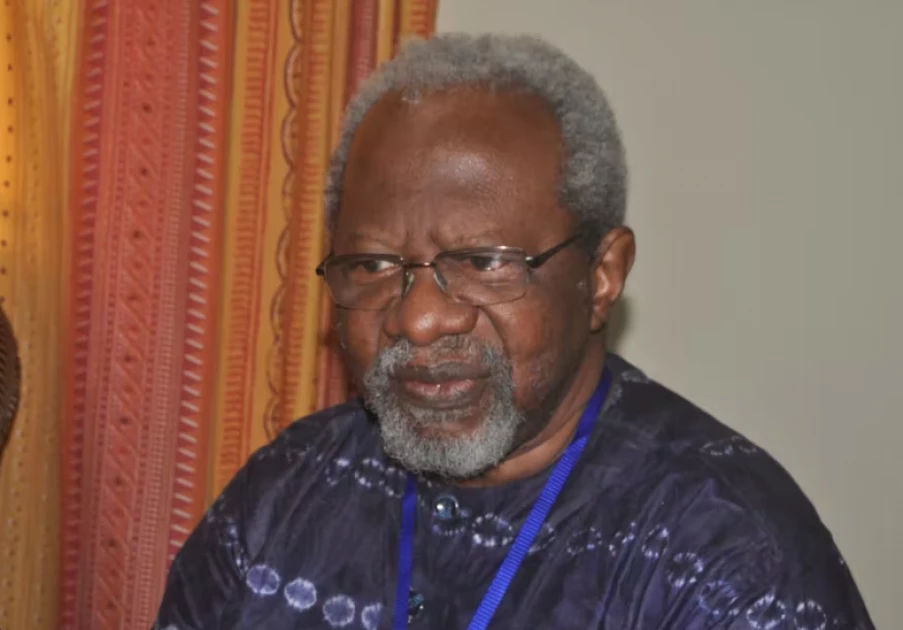
Paulin Hountondji….the anointed enfant terrible of African philosophy. Hountondji's personal collection

Audio By Vocalize
When
renowned Ghanaian philosopher Kwasi Wiredu passed
on in early 2022, Paulin J. Hountondji was left alone to adopt the mantle of
“Africa’s greatest living philosopher”. With one possible exception – Congolese
philosopher and historian of ideas, V.Y. Mudimbe.
Hountondji’s
long and gallant campaign to establish and disseminate an African philosophical
voice is noteworthy.
His
first book was 'African Philosophy: Myth and Reality' published
in 1976. It introduced an unapologetic and counter-intuitive African presence
into the supposedly scientific annals of world philosophy. This paradigmatic
entry includes a generous critique of the work of the hitherto forgotten 18th
century Ghanaian philosopher, Anton Wilhelm Amo. It is also an intricate
metaphilosophical critique and a strident evaluation of Kwame Nkrumah and Nkrumaist ideology.
His second book, published in 2002, was 'The Struggle for Meaning: Reflections on Philosophy, Culture and Democracy in Africa.' It revisits his earlier doctoral dissertation on the German philosopher, Edmund Husserl. It examines his engrossing trajectory as an African engaged in philosophy on the global stage.
Much
of the work is also devoted to replying to critics. This includes the late Olabiyi Yai. But Hountondji has nothing but
affection for the contributions of Congolese-born philosopher Valentin-Yves Mudimbe and Kwame Anthony Appiah.
Hountondji
comes across as the anointed enfant terrible of African philosophy. This is
even more so than Wiredu and the equally revered Mudimbe. He has criss-crossed
various metropolitan capitals spreading the mantra of African philosophy. He paradoxically
denounced the discourse of ethnophilosophy as a colonialist (pseudo)
disciplinary invention. At the same time he promoted philosophy’s innate
scientism and universalism.
Establishing
modern philosophy within the continent
His
academic career began in the early 1970s in Mobutu Sese Seko’s Zaire in the
cities of Kinshasa and Lubumbashi. He then returned to his country, Dahomey
(now Benin Republic) in 1972.
The
following year he was instrumental, alongside other continental colleagues, in
founding the Inter-African Philosophy Council. He was also crucial in
establishing early important journals on philosophy within the continent. They
include the _African Philosophical Notebook_s. And the council-affiliated
_Consequence: Review of Inter-African Council of Philosophy.
Part
of the effort in establishing modern philosophy on the continent entailed
forming trans-regional organisations. Sadly, these have withered with the
exception of the African Philosophy Society. Hountondji has supported it by
granting it legitimacy and serving as a keynote speaker at its events.
Ideologically
and theoretically, Hountondji’s version of philosophical universalism and
Africanity would have been a very hard sell for any other philosopher – except
for Hountondji himself. His stature has only seemed to rise. Indeed his support
for a Euro-Amer-defined philosophical universalism did not seem emancipatory in
an age of decolonisation and postcolonial despair. Philosophers were expected
to reveal there ideological stances. These were meant to be anti-imperialist
and pro-masses in orientation.
During
this period African philosophers were also expected to get their hands dirty.
This meant getting off the high horse of theory and abstraction to partake in
the onerous and messy task of nation-building.
In
other words, they had to take concrete measures to justify their sociopolitical
existence and relevance.
Hountondji
did eventually become a nation-builder. He held two ministerial portfolios in
the early 1990s in Benin Republic. After emerging from the torrid political
battles geared at consolidating Benin’s fledgling democracy, he returned to
academia. There he resumed his unfinished investigations into strictly
philosophical matters.
The
enfant terrible of yore had transformed into part of the venerable old guard.
This comprised Wiredu, Peter O. Bodunrin and late Kenyan
philosopher Henry Odera Oruka.
He
also became a highly sought and favoured guest at philosophical gatherings all
over the world.
He
has continued to publish his research on the state of scientific and
philosophical knowledge in Africa. And his stutter has not prevented him from
sharing his invaluable insights on his diverse areas of expertise.
Franziska
Dubgen and Stefan Skupien in their book (2019) on Hountondji argue
for his acceptance as a universal thinker. This is fair enough. But it is
always useful to remember that Hountondji popularised a few vital concepts and
subjects with a distinctly African flavour.
Notable
among them are the inevitable critique of ethnophilosophy, a repudiation of
unanimism, an assessment of Nkrumaism, the rehabilitation of Amo and the
searing indictment of scientific dependency. There is also the recent concept
of endogenous knowledge. This might indeed be considered as an endorsement of
the ethnographic potentials of philosophy, on the one hand, and the
valorisation of local knowledges, on the other.
Universalism
versus particularism
Philosophically,
Hountondji’s work is characterised by an ever-present contestation between
universalism (epistemic) and particularism (endogeneity). He avoids a neat
resolution simply because it is a tension that animates what is considered to
be philosophical.
The
source of the particular is invariably African. For its part, the universal is
ostensibly defined as Western. This equation has the possibility of
inaugurating an evident relativism which stands to be repudiated. This is
particularly true given the transcendent dimension of Hountondji’s thought. Indeed
the philosophical transcends the limitations of the particular.
The
relation of Hountondji’s work to decolonial thought was re-emphasised at a
recent workshop at the University of Cape Town. In an era of decolonial
theorising, Hountondji finds himself conveniently lumped with a range of
contemporary thinkers. These include Walter Mignolo, Andre Lorde, Gayatri
Spivak, Hamid Dabashi, Dipesh Chakrabarty and Achille Mbembe.
Undoubtedly,
this diversifies the canon of critical theory. It also ensures Hountondji’s
continuing relevance.
In view of these varied insights and contributions, Hountondji can congratulate himself for a life well-spent, thus far. And on attaining the ripe old age of 80 on April 11, 2022.
[The
writer, Sanya Osha, is a Senior Research Fellow,
Institute for Humanities in Africa, University of Cape Town. He does not
work for, consult, own shares in or receive funding from any company or
organisation that would benefit from this article, and has disclosed no
relevant affiliations beyond their academic appointment.]
Leave a Comment