
Condemnation and applause in Latin America after US seizes Venezuela's Maduro
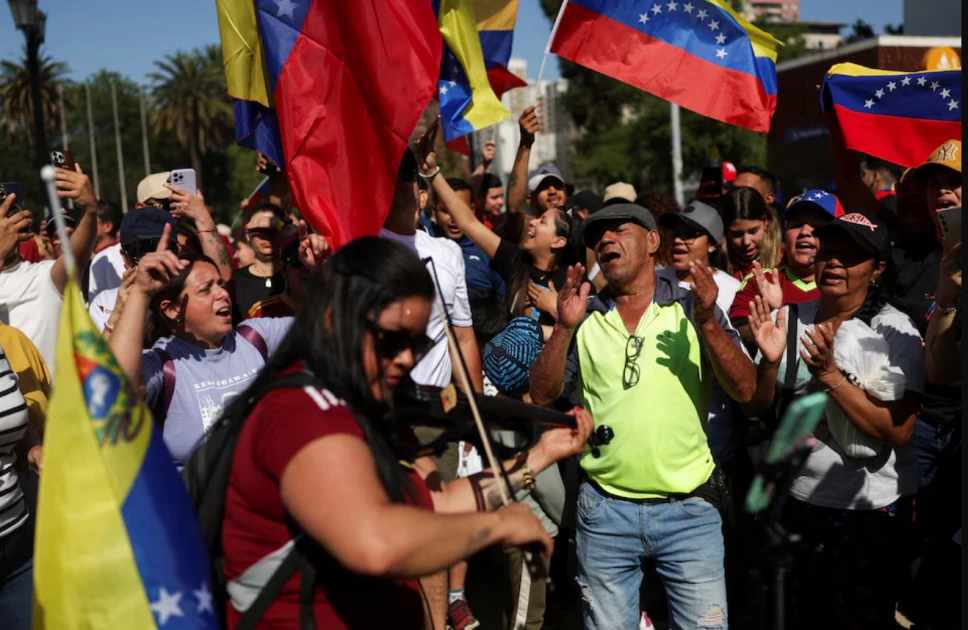
Venezuelans gather to celebrate, after U.S. President Donald Trump said that the U.S. attacked Venezuela and deposed its President Nicolas Maduro, in Santiago, Chile January 3, 2026. REUTERS/Pablo Sanhueza

Audio By Vocalize
Latin American
leaders were divided between condemnation and jubilation in the wake of a
surprise attack on Venezuela early on Saturday that U.S. President Donald Trump
said resulted
in the capture of Venezuelan leader Nicolas Maduro.
While much of the
region has long been wary of a return to U.S. interventions throughout the 20th
century that helped install authoritarian governments from Chile to Honduras,
Maduro - who presided over his country’s social and economic collapse - was an
increasingly unpopular and isolated leader.
Many Latin
American countries have also experienced a shift in recent elections to more
right-leaning governments, many of whose leaders view the U.S.-backed military
regimes of the last century as necessary bulwarks against socialism.
In a sign of the
economic pain faced under Maduro, nearly 8 million Venezuelans have fled the
country since 2018, with 85% of them migrating to neighbors in Latin America
and the Caribbean, according to the UN's International Organization for
Migration.
Many countries in
the region have experienced surges in organized crime in recent years and the
specter of Venezuela's Tren de Aragua gang has loomed large over voters' minds,
leading to a rise in politicians vowing to crack down on crime and immigration.
While few leaders
will shed serious tears about Maduro's ousting, governments in the region will
react along political lines, said Steven Levitsky, a professor and director of
Harvard's David Rockefeller Center for Latin American Studies.
"I think
you'll see right-wing governments applaud because that's what they do. You'll
see left-wing governments criticize because how could they not?" Levitsky
said.
REACTIONS SPLIT
ALONG IDEOLOGY
The strongest
condemnation of the attack came in a string of posts on X from neighboring
Colombia's President Gustavo Petro, a leftist who has frequently clashed with
Trump and has also been threatened by the U.S. president.
“The Colombian
government rejects the aggression against the sovereignty of Venezuela and
Latin America,” Petro said in one message, while calling for an immediate
meeting of the United Nations Security Council, of which Colombia is a member.
His Brazilian
counterpart, Luiz Inacio Lula da Silva, echoed Petro's comments.
“The bombings on
Venezuela’s territory and the capture of its president cross an unacceptable
line,” Lula said in a statement.
Chile’s outgoing
President Gabriel Boric condemned the attack but President-elect Jose Antonio
Kast, who rose to power by promising to crack down on migration and crime, said
in a post on X that Maduro's arrest was great news for the region.
"Now begins a
greater task. The governments of Latin America must ensure that the entire
apparatus of the regime abandons power and is held accountable," Kast, who
will be sworn in on March 11, said.
ARGENTINA, ECUADOR
BACK ACTION
Argentina’s
President Javier Milei, Trump’s closest ally in the region, has long criticized
Maduro and posted videos and statements on X in favor of the attack.
In Ecuador,
right-wing President Daniel Noboa said Venezuelans opposed to Maduro and his
political godfather Hugo Chavez have an ally in Ecuador.
“All the criminal
narco-Chavistas will have their moment,” Noboa said on X. “Their structure will
finally collapse across the continent.”
Protests both in
favor and against the strikes in Venezuela have been scheduled in Buenos Aires
and other cities across the region.
The capture of
Maduro by U.S. forces “is one of the most momentous decisions in the history of
U.S.-Latin America relations,” said Brian Winter, editor-in-chief of Americas
Quarterly and vice president of policy at Americas Society/Council of the
Americas.
“The operation
confirms return of Washington as policeman in its 'sphere of influence,' an
idea that defined much of 19th and 20th centuries but had faded since (the) end
of the Cold War,” Winter said in a post on LinkedIn.
Join the Discussion
Share your perspective with the Citizen Digital community.
No comments yet
This discussion is waiting for your voice. Be the first to share your thoughts!