
From Tata Chemicals to foreign hawkers; Ruto’s ‘pack and go’ order causes regional jitters
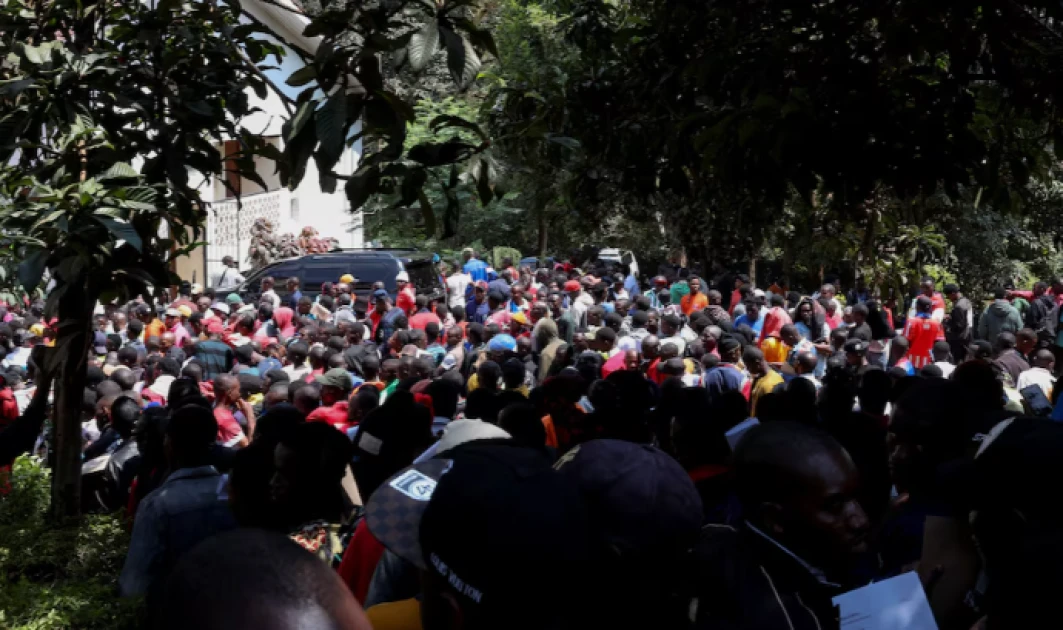
Burundi nationals gather at their country's embassy as they seek travel documents to return to Burundi after Kenyan President William Ruto ordered a crackdown on small-scale traders from abroad, in Nairobi, Kenya, September 7, 2026. REUTERS/Monicah Mwangi

Audio By Vocalize
In the past week, President William Ruto delivered two ultimatums that could hardly have looked more different on paper.
One aimed at a century-old Indian industrial conglomerate -Tata
Chemicals, the other at regional countries nationals’ selling peanuts on the streets
of major urban centers.
Yet both landed with the same
underlying argument: foreigners in Kenya, whether multinational or
micro-trader, must now justify their place in the economy on the president's
terms, or leave.
With an election several months
away, and public frustration mounting over jobs, a high-handed administration,
escalating cost of living and a host of unfulfilled promises.
President Ruto has found in
"economic sovereignty" a theme that unites a festering land right cum
corporate social responsibility dispute in Kajiado with a street-corner
grievance in urban spaces.
Whether the substance behind the
rhetoric holds up is a separate question, and on the available evidence, a
messier one than the applause lines suggest.
President Ruto has ordered Tata
Chemicals to leave Lake Magadi after Kenya suspended its operations over
alleged regulatory non-compliance and value-addition concerns.
Speaking during a development
tour of Kajiado County, Ruto said the company has extracted the region's
mineral resources for more than a century without creating enough local
industry, jobs or economic value, and that his government now wants new
investors to develop soda ash processing, glass manufacturing and other
downstream industries in the county.
Tata Chemicals Magadi has
operated around Lake Magadi since 1911 under the Magadi Soda Company, which later
got absorbed into the Tata group, and has been in Kenya under its current
corporate structure since 2005.
Its operations were suspended by
Kenya's ministry of mining in July, pending a "compliance review,"
which was issued by the Mining, Blue Economy and Maritime Affairs Cabinet
Secretary Hassan Ali Joho issued on July 29 under Kenya's Mining Act.
CS Joho cited unresolved issues
around royalties, value addition, local employment, procurement, community
development and environmental requirements among others.
The commercial stakes are real.
Kenya's exports of soda ash came to 254,779 tons, valued at $56.9 million, in the
year to July 2025.
Soda ash, which is extracted from
trona, a mineral that occurs in unusually pure surface deposits at Lake Magadi,
feeds glass, soap and detergent manufacturing both domestically and for export,
and the company's departure could mean job losses and a loss of revenue for the
local and national economy.
Tata's response has been measured
rather than combative. In its statement, the company said it "respects the
authority of the government of Kenya" and remains committed to
"constructive engagement through the appropriate legal and regulatory
channels to resolve the outstanding matters.”
The soda ash manufacturer added
that that its Kenyan unit had given regulators a comprehensive response on its
compliance.
In a communication to the
National Stock Exchange of India, Tata Chemicals Magadi said it is "fully
compliant" in Kenya and is awaiting formal communication from the
government on the review of its operations, without confirming it had received
a direct order to leave.
That gap, a president telling a
rally the company should "pack and go," and the company telling its
own stock exchange regulator that no such order has formally arrived, is worth
sitting with.
It suggests a dispute still being
fought partly in public and partly through channels neither side has fully
disclosed, with Ruto using the political stage to pressure a company that,
whatever its regulatory failings, remains one of the few large industrial
employers in Kajiado County.
Two days earlier, at State House,
Ruto had delivered a parallel message to a very different audience. Meeting
small-scale traders and hawkers, he ordered a crackdown on foreigners operating
small-scale businesses, arguing local traders needed protection amid growing
debate about African migrants in Kenya's informal economy.
"From next week, all foreign
traders doing those small businesses should close them," he said,
promising to fast-track legislation barring foreigners from certain trades.
“Next week Monday,” the President
alluded to, is today, September 7, 2026.
He insisted Kenya remained open
to foreign investment, but argued that investors, including Chinese traders,
should create jobs and expand production rather than compete with Kenyans for
hawking and small shops, asking rhetorically: "It cannot be that a person
comes from China or elsewhere to be a hawker or open a small shop."
The remarks arrived against a
backdrop of rising resentment, especially against regional countries nationals,
in parts of Nairobi's low-income labor market.
In June, Dagoretti North MP
Beatrice Elachi accused employers of hiring Burundian construction workers over
Kenyans because they would accept lower pay, saying she intended to stop people
being hired at Ksh.400 a day when Kenyans were paid Ksh.700 and above.
Following these pronouncements,
Kenyans in some areas, openly using social media platforms, begun giving
foreigners from neighboring countries notice to vacate the country and stop
trading, citing Ruto's directive and deadline.
Many were indeed seen queuing in
cyber-cafes over the weekend in a bid to print out border passes to travel out
the country.
The scale of what is actually
being threatened remains unclear. It is unclear how many foreign nationals are
involved in small-scale trading or how many would be affected by the crackdown;
Kenya hosts a large refugee population, and government figures show roughly
857,000 registered refugees and asylum seekers by the end of June 2026, with
nearly 14% living in urban areas.
Kenyan law already recognizes
refugees' right to work and run businesses, though it requires appropriate documentation.
That legal baseline, indicates work
is permitted, but conditional on paperwork many refugees and migrants struggle
to obtain.
In practice, is precisely what
makes "close your business" and "get proper documents" two
different instructions that Ruto's rally language blurred into one.
Within days, the government
itself began walking back the starkest reading of the president's words.
Responding to international
coverage, the Principal Secretary for the State Department for Foreign Affairs
in Kenya, Dr. Abraham Korir Sing'Oei
said small or large traders and employees of all nationalities, with the
requisite documentation of work permits and licenses, are legally protected to
operate in Kenya.
Sing’oei said that Burundian
nationals and other East Africans and Africans are free to live in Kenya as
long as they conduct their businesses according to Kenyan law.
The clarification came after a
French newspaper's September 5 report headlined that Ruto had demanded the closure
of small businesses run by foreigners, based on his September 2 comments to
traders at State House.
The reaction beyond Kenya's
borders has been diplomatically careful but unmistakably anxious. Burundian
lawmakers raised concerns in their National Assembly about African states
tightening rules on foreign traders and workers, with one MP warning that
African countries were closing themselves off, particularly around employment.
Burundi's Foreign Minister told
parliament the government was monitoring reports of foreigners being mistreated
in Kenya and a possibly similar measure in Tanzania, and said he had asked
Kenya's ambassador to Burundi to ensure no Burundian national was mistreated,
while stressing respect for Kenya's sovereign right to set its own policy.
The deeper problem is legal, not
just diplomatic. A directive banning an entire economic activity by nationality
sits awkwardly against the EAC Common Market's right of establishment, which was
meant to be fully realized by 2015, a deadline the bloc missed but has
continued working toward.
Ruto has directed his Trade
Cabinet Secretary, Lee Kinyanjui and the National Assembly's Majority Leader,
Kimani Ichung’wa, to fast-track legislation reserving certain businesses for
Kenyan citizens, saying the government would act administratively rather than
wait on Parliament.
The move carries particular
weight for citizens of Burundi, Rwanda, Uganda and Tanzania, whose free
movement and establishment rights are supposed to be guaranteed under the
Common Market framework, which Kenya itself signed.
Set side by side, the Tata
ultimatum and the trader crackdown reveal the same political logic; a
government under pressure to show it is fighting for Kenyan jobs, reaching for
the most visible lever rather than the most structural one.
A century-old soda ash concession
that has not built a promised glass factory is an easy villain. A Burundian
hawker undercutting a Kenyan stallholder is an even easier one, because unlike
Tata Chemicals, hawkers cannot lobby, litigate, or issue stock-exchange
statements.
But the rhetoric strains against
the government's own record in both cases. Kenya has spent years courting
foreign direct investment and has, in the same period, built one of the
continent's largest diaspora economies precisely because other countries let
Kenyans trade, work and settle within their borders, an argument Kenyan
officials make constantly when defending their own citizens' presence abroad.
Kenya's own Shirika Plan,
launched in March 2025 to integrate refugees into the formal economy through
identity documents, bank accounts and business permits, points toward documentation
and inclusion as the fix, the opposite of a blanket closure order issued
eighteen months later.
None of that erases the
underlying grievance. Kenyan traders genuinely are being squeezed, by expensive
credit, cascading market fees, import cartels and a tax system that catches
small operators while larger, better-connected players find room to maneuver.
Closing foreign-owned kiosks does
nothing to any of that. Nor does ordering an Indian conglomerate to "pack
and go" automatically produce the glass factory and chemical plant Ruto
promised Kajiado; suspension and rhetoric are not the same as a functioning
replacement investor with capital in hand.
What both episodes share, in the
end, is a preference for the dramatic gesture over the slower, more contested
work of fixing licensing enforcement, credit access and regulatory compliance.
This, indeed, is an ultimatum that plays well at a rally several months before Kenyans vote again while it does not fix the environment that will make business thrive for both locals and foreigners.
Join the Discussion
Share your perspective with the Citizen Digital community.
No comments yet
This discussion is waiting for your voice. Be the first to share your thoughts!