
Galaxy cluster observed forming surprisingly early in universe's history
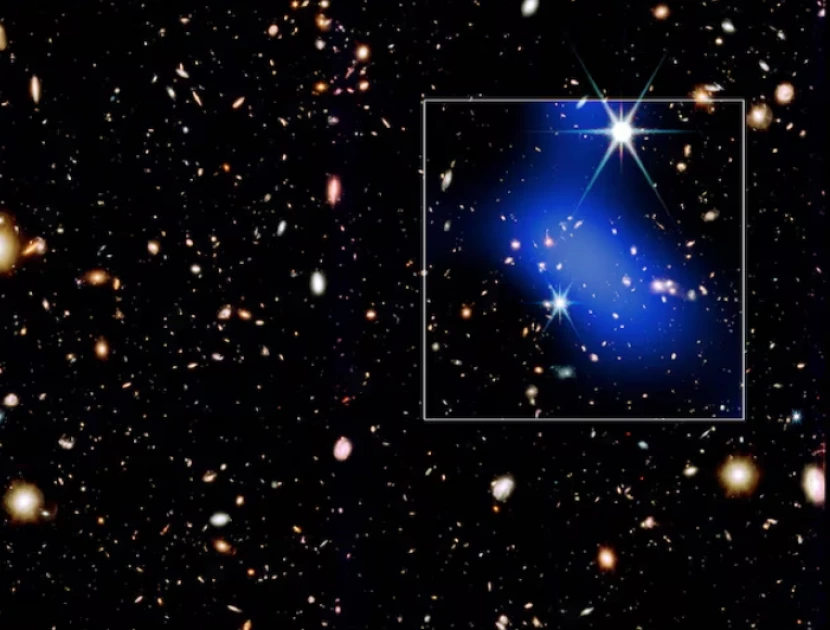
A developing galaxy cluster dating to about 1 billion years after the Big Bang is shown in this handout image released on January 28, 2026. The white box marks the field of view of the Chandra X-ray Observatory data (blue) that is overlaid on an infrared image from the James Webb Space Telescope showing the location of galaxies. NASA Chandra/STScI, Bodgan et al./Handout via REUTERS

Audio By Vocalize
Observations by NASA's James Webb Space Telescope and
Chandra X-ray Observatory are providing fresh evidence that the universe grew
up a lot more quickly than previously known, with observations of a galaxy
cluster forming sooner after the Big Bang than once thought possible.
Researchers said these observations show an emerging galaxy
cluster containing at least 66 potential member galaxies, with a total cluster
mass of about 20 trillion stars the size of our sun, dating to about one
billion years after the Big Bang event that initiated the universe roughly 13.8
billion years ago.
Galaxy clusters are among the largest structures in the
cosmos and were thought to have needed much more time to come together in the
early universe. Our Milky Way is part of a galaxy cluster.
"A galaxy cluster is, as the name suggests, an assembly
of galaxies, typically hundreds to several thousands. These galaxies are
embedded in a halo of hot gas heated to millions of degrees, and the whole
system is bound together by dark matter," said astrophysicist Akos
Bogdan of the Harvard and Smithsonian Center for Astrophysics, lead author of
the study published in the journal Nature.
Dark matter, which does not emit or reflect light,
represents about 85% of the universe's matter. Ordinary matter - like stars,
planets and everything else that is visible - accounts for the rest. Scientists
infer the existence of dark matter based on the gravitational effects it exerts
on a large scale such as how galaxy clusters are held together.
Spotting a nascent galaxy cluster that was beginning to
reach maturity when the universe was roughly 7% its current age was a surprise
to scientists. They said the structure, which they called a protocluster,
exhibited all the signatures of a mature galaxy cluster such as the halo of
superheated gas and a centrally peaked brightness distribution in X-ray
emissions.
Under most models, the universe should not have been at a
mature enough state with a sufficient density of galaxies for an emerging
galaxy cluster of this size to form at this early juncture in its history.
Until now, the earliest similar structure observed dated to about three billion
years post-Big Bang.
"Our findings provide further evidence for a more rapid
growth of cosmic structure than is predicted by current cosmological
models," said astrophysicist and study co-author Gerrit Schellenberger of
the Center for Astrophysics.
"Together with the recent James Webb Space Telescope
discoveries of unexpectedly luminous galaxies in the early universe, as well as
supermassive black holes already in place just 500 million years after the Big
Bang, our results strengthen the case that key elements of our understanding of
the universe may be incomplete," Schellenberger said.
Since Webb was launched in 2021 and became operational in
2022, its observations have revolutionized the understanding of the early
universe, showing how things got off to a much quicker start than previously
believed.
The galaxies of the protocluster were found using Webb. The
X-ray emission from the protocluster was confirmed using the Chandra
observatory.
"The combination of Chandra and Webb observations
provides a uniquely powerful window into the early universe, enabling
transformative discoveries," Schellenberger said.
Join the Discussion
Share your perspective with the Citizen Digital community.
No comments yet
This discussion is waiting for your voice. Be the first to share your thoughts!