

Gov't reports major gains in Nyanza development projects
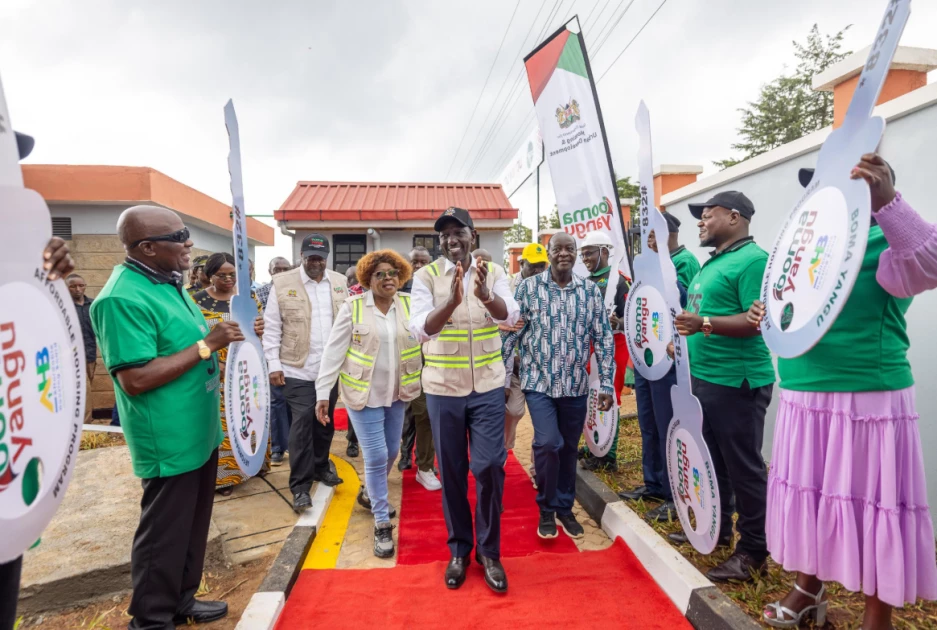
President William Ruto presides over the handover of over keys to new owners of Vihiga Affordable Housing Project on March 19, 2026. PHOTO | PCS

Audio By Vocalize
The government has reported significant progress in the implementation of development projects across the Nyanza region, citing advancements in key sectors including housing, water and sanitation, markets, transport, and the blue economy.
According to a
press statement by the Ministry of Interior released on March 21, 2026, the
projects span six counties - Kisumu, Homa Bay, Siaya, Migori, Kisii, and
Nyamira - and are part of a broader national strategy aimed at reducing
regional inequalities and accelerating economic transformation.
Nyanza Regional
Commissioner Flora Mworoa said the scale of ongoing projects reflects a
deliberate push by President William Ruto’s administration to bridge
infrastructure gaps between urban centres and historically underserved areas.
Housing has
emerged as the largest investment sector in the region, generating more than
1,000 jobs daily. In Kisumu, the Lumumba Affordable Housing Programme is 56 per
cent complete, with over 9,000 units under construction.
Migori’s Mabera
project is nearing completion at 98 per cent, while Homa Bay has already
completed its housing programme.
Siaya and Kisii
counties also have thousands of units underway, although Nyamira lags behind
with projects at early stages.
Market
infrastructure under the Economic Stimulus Programme has also shown strong
performance, with several markets nearing completion in Homa Bay, Siaya, and
Kisii.
These projects are
providing traders with access to clean water and electricity. However, Nyamira
remains behind, with most market projects below 20 per cent completion.
In education, the
government is expanding Technical and Vocational Education and Training (TVET)
facilities and student hostels to support skills development.
Kisumu and Siaya
are leading with plans for more than 10,000 student beds, while other counties
are at varying stages of implementation.
Water and
sanitation projects have recorded the strongest performance, with several
achieving full completion.
These include the
Kendu Bay and Oyugis water projects in Homa Bay and the Ugunja Water Project in
Siaya. The Lake Victoria Water and Sanitation project in Kisumu is 85 per cent
complete, although the Soin-Koru Dam project remains stalled due to legal and
funding challenges.
Transport
infrastructure, despite being one of the most capital-intensive sectors, has
faced setbacks due to contractor disputes, pending payments, and land
compensation issues.
While the Rusinga
Ring Road in Homa Bay is nearly complete at 98 per cent, many road projects
across the region remain between six and 25 per cent complete. Airport upgrades
in Kisumu and Kabunde are, however, progressing steadily.
Industrial park
development—seen as key to long-term job creation—has recorded mixed progress.
The Homa Bay Aggregation and Industrial Park is about 59 per cent complete,
while the Siaya project has stalled due to contractor and financing issues.
In the energy
sector, last-mile electricity connectivity has been slower than expected,
though major transmission projects such as the Sondu line in Kisumu are nearing
completion at 94 per cent.
The government
also highlighted gains in the Blue Economy, pointing to completed projects such
as the Homa Bay Pier and Fish Market, as well as the establishment of the
Kisumu Maritime Rescue Centre.
These initiatives
are aimed at unlocking the economic potential of Lake Victoria and improving
livelihoods in surrounding communities.
Despite the
progress, the government acknowledged challenges in financing, contractor
performance, and legal disputes, noting that efforts are underway to address
bottlenecks and accelerate project completion across the region.
Leave a Comment