
Here’s what you may not know about the signs on Thika Superhighway

Audio By Vocalize
For
all road users, pedestrians and motorists alike, plying the major Kenyan
highways - especially the Thika Superhighway - it is a norm for someone to call
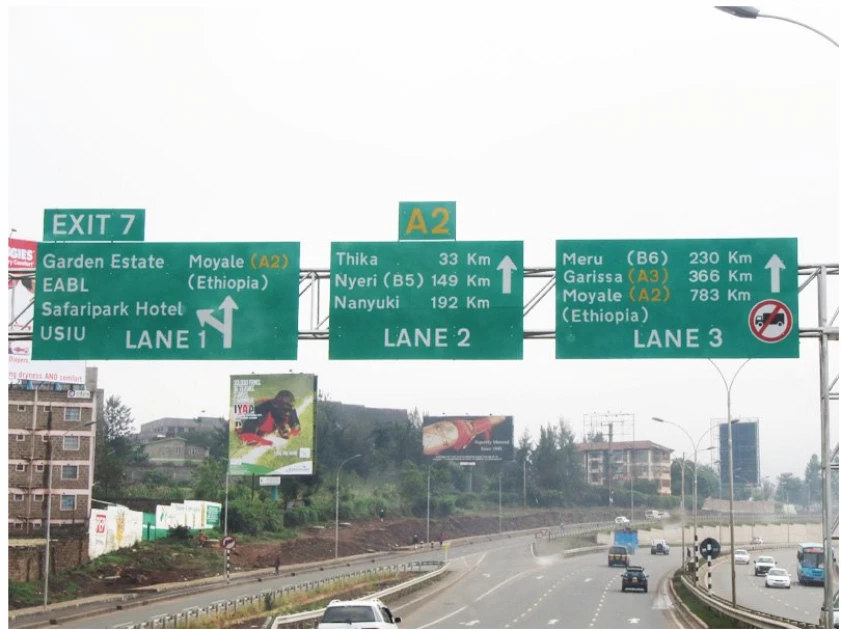
and say ‘pick me up at Exit Number 7’, or give directions as, ‘the USIU Campus
is after EXIT 6.'
Have
you ever stopped to wonder why these numbers? Those of you who know, thank you
for reading upto this point. Those of you that don’t, you may want to stay on a
little bit longer.
As
the cortege of the late former President Mwai Kibaki made its way through the
Thika Superhighway on Saturday, questions arose as to why the procession managed
to put up a moderate to slow pace despite the expectation of the burial
scheduled to begin in Othaya, Nyeri County by 10am.
Here
is how; the large rectangular green signboards indicating EXIT 10 or EXIT 11
along the highways, which many know as ‘mile markers’, are an actual
representation of distance.
This
means 10 and 11, for instance as in the example above, are not just random
numbers, but rather a precise approximation of distance from the beginning of
the interstate to the next.
The Thika Superhighway, interestingly, was built at international standards with
specific exits at the desired venues.
Superhighways
are originally built for military use so that the military can get to the
closest town very quickly in case of an emergency or an eventuality, and in
that case, every exit has a number by international code.
Military ETA
(Estimated Time of Arrival) is important and thus the mile markers serve as an
anchor in predicting foretelling when one arrives at their destination.
EXIT
7 for instance, across the globe, would mean six miles from the city in a
decreasing manner so that when you actually get to EXIT 2, you will actually be
two miles from the city.
Mile
markers, therefore, help a road user to estimate how far you are to the next
major city and the direction.
So
that the next time you are stranded and in the middle of nowhere then you see
the next marker is 11, you will know you are 10 miles to the next city.
Similarly,
as you move away from the city, the same applies in an ascending manner.
However,
one should be careful to consider the country of origin since the mile markers
in some countries such as Kenya where the standard measurement of distance in
kilometres, may represent the latter in place of miles.
Join the Discussion
Share your perspective with the Citizen Digital community.
No comments yet
This discussion is waiting for your voice. Be the first to share your thoughts!