
How KU Hospital manages waste, reduces emissions and protects environment
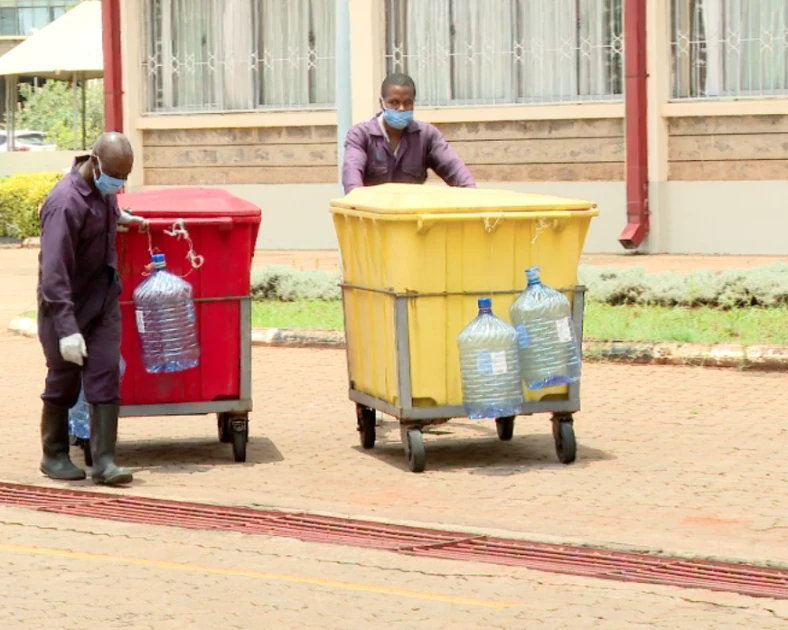
Workers at Kenyatta University Teaching, Referral and Research Hospital (KUTRRH) handle segregated waste. Photo: Susan Ndunda

Audio By Vocalize
The hospital’s lush green environment blends seamlessly with its modern infrastructure. The scenery reflects the unfiltered beauty of nature, with trees swaying gently to the rhythm of the morning breeze.
However, while medical equipment, tools, and drugs are used to treat and care for patients, they also pose a danger through the waste they generate.
Statistics from the World Health Organization (WHO) show the health sector contributes about 5 per cent of global greenhouse gas emissions, equivalent to 2 to 3 billion metric tonnes of CO₂ equivalent per year.
Additionally, about 15 per cent of medical waste, approximately 800,000 to 900,000 metric tonnes, is classified as highly hazardous, posing significant risks to both human health and the environment.
Each year, hospitals worldwide use an estimated 16 billion injections, many of which are not disposed of safely.
A 2024 scientific study published on the Scientific Research Publishing platform found that hospitals in Kenya generate between 0.61 and 1.03 kilograms of waste per hospital bed each day.
Against this backdrop, KUTRRH has taken decisive measures to address medical waste. Through this initiative, the hospital has embraced a zero-waste strategy that incorporates both energy efficiency and sustainable waste management, efforts that protect not only human lives but also the planet.
Felix Karani, Head of Public Health at KUTRRH explains that it all started with a simple behavioural change.
Along the hospital corridors, posters on the walls carry a subtle but powerful reminder: switch off lights when not in use. These messages play an important role in reducing electricity consumption and significantly cutting energy costs.
“Behavioural change is one of the strategies we have used to reduce energy waste. We encourage both our clients and staff to switch off lights when they are not in use,” he said.
He added, “As you walk through our corridors, you will see stickers encouraging everyone in the facility to switch off lights, especially during the daytime. This has helped us save energy, much of which is generated from fossil fuels that are harmful to the environment.”
KUTRRH adheres strictly to guidelines set by the Ministry of Health Kenya to ensure that hazardous waste is handled safely and responsibly.
Colour-coded bins enable patients and staff to separate waste at the source, making disposal and treatment more efficient in line with Kenya’s Sustainable Waste Management Act of 2022.
Rhoda Jepotip, a Public Health Officer at the KUTRRH, explained that waste segregation is done at the source.
“We train patients in the wards, clients and our staff to segregate waste at the source. General waste is placed in black bins, infectious waste in yellow bins, highly infectious waste in red bins and cytotoxic waste in purple bins,” she said.
She added that segregated waste is then transported to an incinerator, where medical waste is exposed to temperatures of between 800 and 1,000 degrees Celsius, allowing it to burn completely and become harmless to both human health and the environment.
Rhoda warned that poor waste management can lead to flooding due to blocked drainage systems.
“Especially during extreme weather conditions, such as heavy rains, this can cause floods. We encourage community members to keep their environment clean, and around here, we have never experienced flooding,” she explained.
She encouraged proper waste disposal, because it not only protects the environment but also helps prevent the spread of diseases.
“Proper waste management benefits the environment in many ways. Most importantly, it reduces exposure to pathogens that can cause lung cancer, tuberculosis, and other respiratory diseases, especially for the communities around us,” she said.
WHO indicates that poor waste management contributes to approximately 5 percent of airborne diseases. Improper handling also releases carbon emissions, which form harmful fossil fuel gases. Rhoda explained that inhaling these gases can cause upper respiratory infections, a leading cause of death worldwide.
Overlooking the scenic environment, a modern incinerator stands tall, handling the final stage of waste management at the facility every day.
On a typical day, the incinerator burns 1.6 tonnes of medical waste, saving the hospital approximately Ksh 48,000 daily compared to outsourcing waste collection to external companies.
John Wakahora, Facility Manager at the KUTRRH, confirmed that the incinerator chamber is used to burn medical waste. Temperatures inside the chamber average 700 degrees Celsius and are carefully controlled through both heat and air supply to ensure complete combustion.
He added that the system is also equipped with advanced pollution control mechanisms.
“The pollution control system extracts particulate matter and other pollutants to prevent them from entering the atmosphere. We use what we call a wet scrubber, which captures all pollutants and particulates,” said Wakahora.
The excess heat generated during incineration is captured and used to heat water for the hospital wards.
John Wakahora explained, “We are substituting the fuel normally used in the boilers to heat water by recovering heat from the waste. The incinerator now serves as part of our utility system, displacing the fuel we would otherwise consume. We estimate this save about 4,800 litres of fossil fuel per month, which also helps reduce greenhouse gas emissions and mitigates climate change effects.”
Kenya’s revised Air Quality Regulations of 2024, under the National Environment Management Authority (NEMA), mandate strict monitoring of air quality, particularly in high-risk areas.
Rhoda explained that the hospital has numerous plants and systems to monitor air quality around the facility, ensuring a healthy and habitable environment and helping prevent diseases such as cardiovascular conditions, which affect many patients in the area.
“We have also created a healthy environment by planting trees that help absorb pathogens from the air. Additionally, we continuously monitor the air to detect and control any carcinogenic substances, since many emissions can lead to lung cancer. By doing this, we protect both the public and the environment,” she said.
Kenya is among the countries committed, under its second Nationally Determined Contributions (NDCs), to reducing greenhouse gas emissions by 35 percent by 2035 while simultaneously strengthening its resilience to climate change.
Karani said that addressing climate change and promoting sustainability in hospitals not only improves patient outcomes but also reduces operational costs.
He explained, “We have ensured that the hospital aligns with the goals of the national government, particularly those of the Ministry of Health Kenya, by going green. In doing so, we also comply with and support the Sustainable Development Goals 3, 12, and 13.”
As the world marked Zero Waste Day in March, a day dedicated to promoting proper waste disposal, the United Nations Environment Programme reported that humanity generates approximately 2.3 billion tonnes of waste annually. Without decisive action, this figure could rise to 3.8 billion tonnes by 2050.
The agency’s latest data shows waste contributes an estimated 10 percent of global greenhouse gas emissions.
Join the Discussion
Share your perspective with the Citizen Digital community.
No comments yet
This discussion is waiting for your voice. Be the first to share your thoughts!