

How laundromats are expanding client-base as Nairobians seeking convenience ditch 'mama fua'
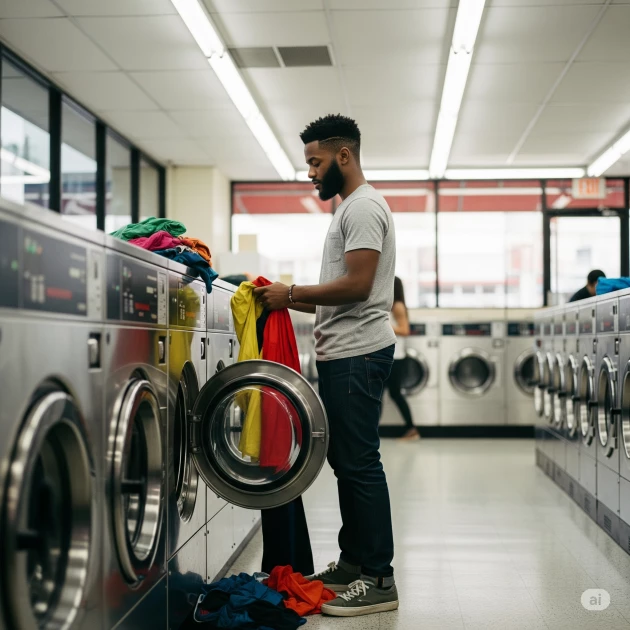
An AI-generated image shows a man working in a laundromat. Photo/Gemini

Audio By Vocalize
There has been a rise in demand for convenience, time-saving solutions and professional-level cleanliness, which has led people to abandon traditional cleaning methods, whether it is doing laundry themselves or hiring a ‘Mama Fua’.
Professional laundry services are praised for saving time, the energy of washing the clothes and also the consistency in quality.
“Since I don't have help at home, it saves me a lot of time and effort,” says Lee Mugambi, a 23-year-old IT specialist who lives alone.
Customers also appreciate the flexibility and reliability of these formal services.
“With a Mama Fua, there is a bit of a downside to having them do my laundry because they're not as efficient as laundry services. If I go for a Mama Fua, I'll have to wait for the time when she's available but with laundry services, I can always just take my laundry when they are open,” shares Leakin Tola, a quality analyst.
In addition to convenience, professionalism and quick turnaround times are major selling points.
Some customers say they specifically look for services that are fast, clean and have good customer service.
“First of all, their place, the environment, has to be clean. The person attending to me has to be professional, good customer service, and then the speed, like, if I take my laundry in the morning, I expect them to be done by evening,” adds Tola.
Still, not all clothes end up at the laundromat. Some people prefer to handle lighter garments at home and send the bulkier ones to professionals.
“Mostly beddings, white clothes and anything that needs special care or attention,’’ says Lee.
Ella Obota, a journalist, says she takes her laundry in every week. She appreciates the full-service packages offered, noting that all her dirty laundry is handled comprehensively.
Shifts in the Laundry ecosystem
For many service providers, the shift has not only meant a rise in customers but also a change in who those customers are. Unlike years ago, when laundry points were only found in the middle of busy towns, or in uptown estates within the cities, Nairobi estates with a mix of middle and low-income earners today also have laundry shops set up.
“In this area, most of our clients are business people and families who work around Westlands,” said Margaret Sayiank of White Rose Dry Cleaners.
Others report that unmarried people and campus students are also key customers, especially in locations near residential estates or universities.
According to Alice Wakonyo of 1HR Laundry Services, “Unmarried people, the bachelors. We still have campus students, then the rest are families.’’
One laundry professional, Karambu Kithinji, the Director of Elgonia Dry Cleaners, started the business 15 years ago. Her inspiration came from a personal experience. “We couldn’t get our clothes washed while staying at a hotel,” she recalls. “And I thought, why not start a business that solves that problem?”
Setting up, however, wasn’t easy. “The startup was Ksh.10 million, which we didn’t take a loan for. We used our own savings. And also, when doing the connectivity, it’s quite expensive, ”she said.
Patience Nyaoga, who has managed Tintoria Cleaners since its establishment in 1993, provides insight into an industry that serves a niche but essential market in Kenya's urban centres.
According to Nyaoga, entering the dry cleaning business requires substantial initial investment.
"The setting up of it required investment, as you may be aware. And not just financial, but also planning, expertise, and consultancy on the laundry business," Nyaoga explains.
The capital requirements include industrial washers, dryers, pressing equipment, and professionally designed spaces. However, equipment costs are just one component of the setup expenses.
Today, the increased popularity of these services is driven by changing urban lifestyles, population growth, and advancements in technology, including pickup and delivery options offered.
“It’s an increase in customers because of the technology, and also the population in this place has led to the increase,” Alice says.
Business patterns show predictable weekly cycles, with Fridays and Saturdays reported as the busiest days as customers align their drop-offs with weekend routines.
Professionals versus ‘Mama Fua’
Professional dry cleaners compete directly with ‘Mama Fua’
While acknowledging that ‘Mama Fua’ services offer "affordability and familiarity," Nyaoga points out key differences in approach.
Tintoria’s Nyaoga points out the use of specialised equipment and following fabric instructions as a major difference between ‘Mama Fua’ services and professional services. This technical approach includes reading garment labels and understanding fabric science to handle clothes in ways that extend their life span.
When it comes to comparing professional laundry services to ‘Mama Fua’, many business owners point to consistency, technology and customer protection. “We offer stain removals and take care of our clients clothes compared to a 'mama fua',” Moses explains.
Margaret added, “For us you can come and claim when your suits get lost or damaged but for 'mama fua' you cannot do that. And also for us mostly we offer dry cleaning but 'mama fua' doesn’t.”
While the steady rise of professional laundry businesses has transformed how urban Kenyans manage household chores, it hasn’t spelt the end of informal domestic work—at least not yet. According to Stephine Ngutah, founder of the Mama Fua App, there’s still space in the ecosystem for ‘Mama Fuas’.
He acknowledges that these formal laundry services have taken a share of the market, but also argues that the role of ‘Mama Fua’ is not fading, but it’s evolving. “Yes, the rise of dry cleaners has affected them, but not as much as you’d think. The ‘Mama Fua’ character is evolving.”
He says the shift is more about adaptation and less about being pushed out. Many ‘Mama Fua’ workers are no longer just doing basic laundry. Through training and skills development, “They do seat cleaning, carpet cleaning, deep cleaning, fumigation and other special services.”
Stephine emphasizes that professional laundry services and ‘Mama Fua’ aren’t necessarily competing but serving different needs within a shared landscape. “They are more professionalized than before.”
Utility costs, unreliable clients and water shortage
But running a laundry business is not without challenges. One common issue for multiple businesses is customers failing to pick up clothes on time, affecting the cash flow and sales tracking. “They don't pick them the same day. There are some who take a while, so if you don’t make a down payment, it takes a toll on the company,” says Moses Muga.
White Rose’s Margaret echoed the concern, saying, “You need to make payment in advance. But some clients don’t like doing that. Maybe they come next month, and you need that sale this month.”
On her part, Tintoria’s manager Nyaoga, notes persistent challenges that affect profitability and service delivery.
"One of the biggest challenges is managing client expectations, particularly during busy periods when customers have different timelines and deadlines that the customer sets,” Nyaoga explains.
Economic pressures continue to mount, including the rising cost of utilities and imported cleaning materials. These factors, Nyaoga states, affect service consistency and timely delivery despite these pressures an ongoing struggle.
Elgonia’s Karambu also shared what goes into pricing at Elgonia. When asked how they set their prices, she pointed to the importance of calculating production costs. “Number one, you have to look at the biggest thing: your production costs. So what's in that? You're looking at your water bills, your electricity, your cost of delivery and collection, detergents, salaries... You have to put all that into consideration so that you can do your price.”
One of the main challenges she faced while starting out and even now is the water hurdles. The Nairobi water, she says, isn’t always clean or consistent. “Even the water you get from Nairobi Water has particles, so the machines get clogged,” Karambu says. “And also sometimes the water getting in is dirty and you're not there checking the machines.”
During shortages, they are often left scrambling. “Nairobi Water at that moment might be overwhelmed. They don't prioritize laundries. They prioritize hospitals and schools. So what does that mean for us? We have to look for other suppliers.” And those suppliers don’t always deliver ideal water quality. “The suppliers are bringing in borehole water, and the pH is different. Sometimes it’s hard water.”
To manage this, the business sometimes buys special detergents or water treatments—another hidden cost. “We’ve had to go to some extent to buy detergent or treatment in the event that there is no water. Of course, that is more pricey, and that is a challenge.”
Electricity is another concern. Although outages are less frequent now than in the past, even a short power cut is disruptive. “Two or three hours without electricity is a mess. We have to use specific generators.”
In terms of staffing, Karambu notes a subtle but important shift over the years: more women are joining the laundry industry, particularly in sorting and quality control roles. “This is a male-dominated industry, but I think generally ladies have more attention to detail. So we have more ladies now who are mostly checking the garments.”
The industry has been forced to modernise to remain competitive. "We've shifted from manual to more automated and eco-friendly machines. And we've also adopted digital booking and payment systems," Nyaoga explains.
Technology has also been useful to the industry as various proprietors have set up websites and mobile applications where they meet clients. Some offer pick-up and delivery services, where clients call to have their clothes picked up at home, and once clean, they are delivered to the doorstep.
Leave a Comment