
Ichung’wah defends National Infrastructure Fund as strategic shift from debt to investment
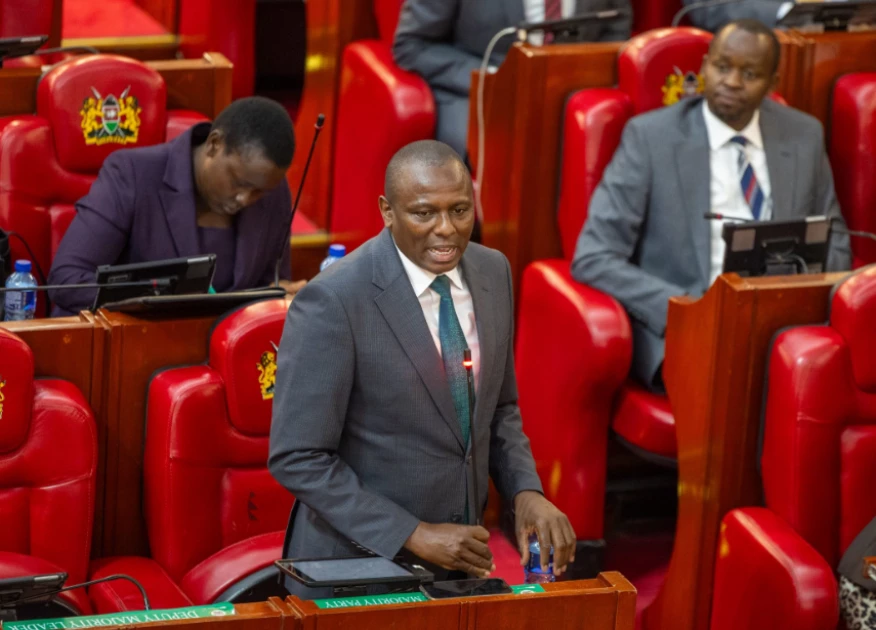
National Assembly Majority Leader Kimani Ichung’wah speaks in Parliament. PHOTO | COURTESY

Audio By Vocalize
National Assembly Majority Leader Kimani Ichung’wah on Tuesday mounted a spirited defence of the proposed National Infrastructure Fund, telling the National Assembly that the Bill is a long-planned strategy to transform Kenya’s development financing model and reduce reliance on debt.
Moving the National Infrastructure Fund
Bill at Second Reading, the Majority Leader dismissed claims that the proposal
was an afterthought, arguing that it is firmly anchored in the Kenya Kwanza
manifesto and subsequent legislative reforms.
“This Bill did not just find itself on
the floor of this House,” Ichung’wah said. “It has a clear genesis and
strategic thinking behind it.”
The Kikuyu Constituency MP traced the
idea to commitments in the Kenya Kwanza manifesto to establish a fund financed
through privatization proceeds of state corporations. He also cited the
enactment of the Government-Owned Enterprises Act as providing the legal
framework underpinning the proposed fund.
He referenced the President’s State of
the Nation Address last year, in which four national priorities were
identified: investment in energy, water for irrigation through the construction
of 50 mega dams and 200 medium-sized dams, expansion of the road network, and
extension of the Standard Gauge Railway.
According to Ichung’wah, the President
made it clear that such capital-intensive projects cannot sustainably be
financed through borrowing or by overburdening taxpayers.
A central feature of the Bill is the
ring-fencing of proceeds from privatization and partial divestiture of
government-owned assets.
Ichung’wah said that unlike in the
past, when proceeds from the sale of public assets were absorbed into the
national budget, the new fund will preserve and reinvest those resources
strictly into infrastructure and wealth-creating projects.
He cited past privatizations of
entities such as Safaricom and Kenya Power, arguing that private sector
participation improved efficiency, expanded employment, and increased tax
contributions.
“Many of these privatization proceeds
have always gone into financing our budget, paying salaries or servicing debt,”
he said. “This Fund will break that cycle.”
Under the proposal, proceeds from
future IPOs and partial sales of government stakes, such as those contemplated
in key state corporations, will be channeled into the Fund rather than into
recurrent expenditure.
The Bill bars individuals who have held
political office or been affiliated with political parties within the last five
years from serving on the board, a provision he said is meant to shield the
Fund from political patronage.
“This Fund must serve the national
interest, not political interests,” he said.
The board will be required to develop
an investment policy approved by the National Treasury Cabinet Secretary, specifying
priority sectors, asset allocation, portfolio limits, and expected rates of
return. It must also ensure that incomplete projects are prioritized before new
ones are undertaken.
“These are proven models,” he said,
adding that Kenya must adopt similar instruments if it hopes to transition from
a developing to a developed economy.
He linked the Fund’s objectives to
transformative projects in energy generation, irrigation, transport
infrastructure, ports, and airports.
He cited a missed opportunity involving
a proposed multi-billion-shilling data centre investment in Naivasha, which he
said stalled due to insufficient energy capacity.
“That data centre had the potential to
employ hundreds of thousands of Kenyans directly and indirectly,” he said. “We
lost that opportunity because we did not have adequate energy.”
He cautioned against simplistic
comparisons with previous administrations, arguing that today’s fiscal
environment demands innovative financing mechanisms.
“These national imperatives are not for
one leader or one Parliament,” he said. “They are for this generation and
generations to come.”
Ichung’wah stressed that proceeds from
privatization would not be used to pay salaries, service debt, or finance
recurrent expenditure.
Framing the Bill as historic, the
Majority Leader challenged the 13th Parliament to seize the moment.
“It is this generation that will be
remembered in the transformation of our Republic,” he said, urging members to
rise above political expediency and legislate with a long-term national vision.
Join the Discussion
Share your perspective with the Citizen Digital community.
No comments yet
This discussion is waiting for your voice. Be the first to share your thoughts!