

Indigenous livestock breeds touted as key to Africa’s climate adaptation
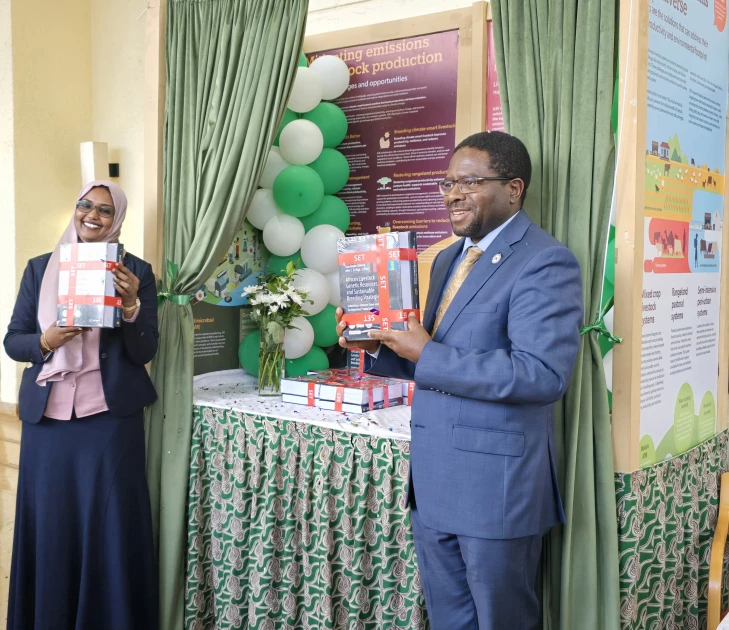
Dr. Huyam Salih, Director of AU-IBAR and Professor Appolinaire Djikeng, Director General, International Livestock Research Institute (ILRI), during the launch of the African Livestock Genetic Resources and Sustainable Breeding Strategies: Unlocking a Treasure Trove and Guide for Improved Productivity book at the International Livestock Research Institute (ILRI) in Nairobi Kenya.

Audio By Vocalize
A newly launched open-access reference by the African Animal Breeding Network (AABNet) and partners including the International Livestock Research Institute (ILRI), the Centre for Tropical Livestock Genetics and Health (CTLGH), and the African Union – Inter-African Bureau for Animal Resources (AU-IBAR) argues that these genetic resources are central to climate adaptation strategies across the continent.
The publication consolidates decades of research showing that locally adapted breeds — including up to 180 indigenous cattle types and hundreds of sheep and goat breeds — are better suited to withstand heat stress, endemic diseases, and poor-quality feed than many imported breeds. In smallholder and pastoral systems, where veterinary services and commercial feeds are limited, these traits are critical.
However, the report warns that many indigenous breeds are under threat from indiscriminate crossbreeding aimed at boosting short-term productivity. While crossbreeding can increase yields in controlled environments, it can also erode adaptive traits that are essential under climate stress.
The authors argue that climate-smart breeding strategies must balance productivity gains with the preservation of adaptive genetics. Improving animal health, management, and targeted selection within indigenous populations can raise output while lowering emissions intensity per unit of meat, milk, or eggs — without undermining resilience.
As climate variability intensifies across Africa’s drylands and mixed farming zones, the debate is shifting from simply increasing production to strengthening systems that can endure shocks. The book positions livestock genetics not as a niche scientific issue, but as a core pillar of long-term climate adaptation and rural livelihood security.
Leave a Comment