

Is Africa’s digital landscape rich enough for online business growth

A general view shows the central business district in downtown Nairobi, Kenya February 18, 2022. REUTERS/Thomas Mukoya

Audio By Vocalize
Africa’s digital story is no longer about first steps—it’s about uneven acceleration. Across the continent, mobile-first habits, new data center builds, and everyday digital payments are reshaping what’s possible for consumer internet businesses.
Still, real depth varies
widely by market and by layer of the stack: connectivity is expanding but not
evenly; smartphones are common but not universal; and payments are simple in
some places and fragmented in others. For founders and operators, the practical
question isn’t whether growth exists—it’s whether the foundations are strong
enough, today, to support products that demand reliability, speed, and trust at
scale.
That’s why it helps to stress-test the ecosystem with use cases that are unforgiving about latency, concurrency, and secure payments. Competitive real-time entertainment, live sports streaming, marketplaces that settle instantly—these are the kinds of experiences that reveal whether the underlying pipes are truly ready.
The answer, as of late
2025, is encouraging but nuanced: Africa, where countries like Kenya host developed innovation hubs, has rich
pockets of maturity alongside visible gaps, and the entrepreneurs who win are
the ones who design for both. In the sections that follow, we use a demanding
real-time vertical to examine the stack, quantify the biggest enablers and
bottlenecks, and outline how teams can build for resilience while the
infrastructure continues to deepen.
Oftentimes, it’s not about whether a market is
ready to host certain types of businesses, because what we see is that customer
demand can be more powerful. Let’s explain this in a bit more detail.
Industries like online gaming don’t enter different economies because they see
big opportunities there. Well, that matters, of course, but it’s the people who
shape the demand. If the majority of gamers shift their preferences from
physical casinos to online gambling sites, the relocation of businesses happens
naturally.
Consider poker
online as a lens for evaluating digital depth. This is a category
that puts simultaneous pressure on network performance, game integrity,
payments, and device optimization. It must handle thousands of concurrent
players, keep gameplay fair, settle balances instantly, and run smoothly on
mid-range Android devices on variable mobile networks. If an ecosystem can
support this well, it likely has the ingredients for many other high-engagement
consumer businesses.
Game integrity is another proxy for digital
maturity. Production-grade systems rely on cryptographically secure random
number generation, anti-collusion models that analyze betting patterns and
shared-device signals, and anomaly detection that can pause and audit suspect
hands in near-real time. These mechanisms depend on consistent telemetry from
clients, well-instrumented servers, and durable streams—capabilities shared by
many other apps that need trust at scale.
Payment rails complete the picture. In many African markets, mobile money is the default for topping up balances and cashing out. To deliver a smooth experience, teams map local payment flows end-to-end, including instant wallet confirmations, low-value transaction handling, and transparent fees.
Account verification flows should be light,
device-friendly, and tolerant of intermittent connectivity. Finally,
responsible product design—opt-in limits, clear session histories, and
frictionless customer support—drives retention by building confidence. In
short, poker online is a stress test: if you can deliver a fair, fast,
low-friction experience here, you’ve likely tuned your tech, payments, and UX
for success in adjacent online categories as well.
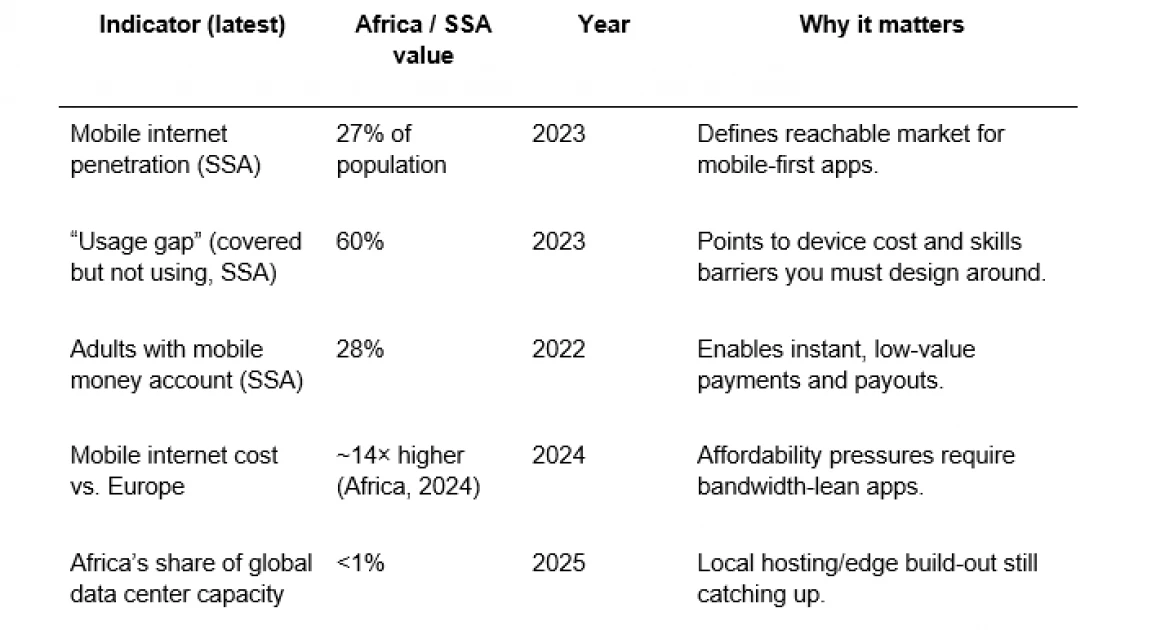
The region’s fundamentals are improving, but they are not uniform. Mobile internet use in Sub-Saharan Africa reached 27% of the population by end-2023, with a sizable “usage gap” of 60% among people who are covered by mobile broadband but not yet using it. Affordability of devices and digital skills remain key barriers.
Today, more than two-thirds of Kenyan adults rely on mobile money for payments, savings, and even business operations, making the country one of the world’s strongest examples of rapid digital financial adoption.
Mobile money continues to be a standout
enabler for consumer internet business models. As of 2022, 28% of adults across Sub-Saharan Africa had a
mobile money account, and in more than half of surveyed economies, at least 30%
of adults used one. That’s well above the developing-economy average.
At the infrastructure edge, Africa still hosts less than 1% of global data center capacity, though investment is rising—helped by large commitments from development financiers and growing interest from major cloud providers. Local hosting reduces latency and improves reliability for transactional apps.
It’s worth noting that the “infrastructure
picture” is not static: GSMA forecasts data traffic per connection in the
region to roughly quadruple by 2030 as 4G becomes dominant, which will raise
user expectations for always-on, low-latency experiences. Builders should plan
for a near-future where bandwidth and device capabilities are materially better
than today—without assuming uniform access across all markets.
Two priorities stand out for operators entering or scaling in Africa: local performance and local payments. Latency-sensitive products benefit from regional peering and hosting wherever possible; it also helps to architect for graceful degradation on weaker networks.
As GSMA notes, 4G will be the dominant connection type by 2030 in
Sub-Saharan Africa, and per-connection data usage is set to rise
sharply—tailwinds for richer, real-time experiences if apps are built with
efficiency in mind.
Quote to keep in view: “In 2023, mobile
Internet costs in Africa were 12 times higher than in Europe—a gap that
increased to 14 times in 2024.” — ITU, Facts and Figures 2024. This cost
reality explains why successful products compress assets aggressively, minimize
background traffic, and pre-cache critical views.
On the payments side, mobile wallets anchor
simple, trusted flows for deposits, subscriptions, tips, and refunds. The World
Bank’s latest Findex update highlights how widespread
these accounts have become across the region—an advantage for digital
businesses that can integrate localized rails, surface transparent fees, and
handle low-value transactions profitably.
Finally, the edge is getting closer.
Development-finance capital has begun to accelerate neutral colocation across
multiple countries, and while Africa still hosts less than 1% of global data
center capacity, each new facility reduces latency and improves uptime for
transactional services. Teams that can place workloads regionally—caching
content, terminating sessions locally, and keeping critical game or marketplace
logic near users—will feel the difference in conversion and retention.
Leave a Comment