

Kenya confronts critical cornea shortage amid cultural resistance
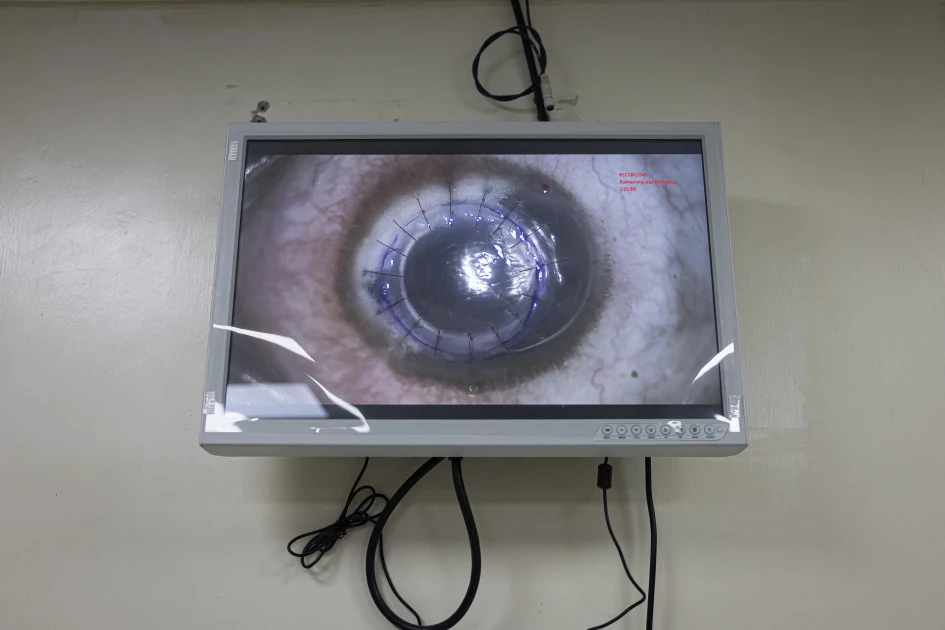
A monitor displays a cornea transplant surgery inside the operating theater at Lions SightFirst Eye Hospital in Nairobi on August 12, 2023. Cultural and religious beliefs prevent many people from donating their organs in Kenya, including their corneas. The lack of donations is creating a backlog for cornea surgeries in many hospitals, with waiting lists reaching over 1000 people. Lions EyeSight First Hospital has a special unit on call 24/7 to harvest corneas from the few people willing to donate them after they die. (Photo by Patrick Meinhardt / AFP)

Audio By Vocalize
Despite advances in medical procedures and a growing number of patients in need, cultural beliefs and longstanding fears around organ donation continue to impede progress.
The country’s only eye bank, located at Lions SightFirst Eye Hospital in Nairobi, is now calling on the public to embrace cornea donation. Specialists emphasise that transplants rely solely on tissue from deceased donors, and that the cornea must be harvested within hours after death to be viable.
For many Kenyans, the concept of eye donation remains clouded by stigma. Yet for those who have undergone the procedure, the results have been life-changing.
Elizabeth Bosibori, a teacher, once watched her world slowly blur after an acid injury severely damaged her eyes.
“My eyesight was deteriorating,” she recalls. “Now I can use my computer comfortably, I can read documents, I can even mark students’ work again.”
Teresa Mwende, a medic, has also regained her independence after receiving a corneal transplant.
“It has changed how I see things,” she says. “I can walk at night, I can drive, and I’m more confident. Before, I had to be careful with everything.”
Law student John Chege describes how deteriorating sight pushed him into institutions for the visually impaired.
“I struggled in academics until I eventually joined the Thika School for the Blind,” he says.
For all three, a corneal transplant — a procedure that replaces the damaged outer layer of the eye with healthy donor tissue — restored clarity and dignity.
Doctors reiterate that only the cornea is harvested during donation, ensuring no visible disfigurement to the deceased. Corneal surgeon Dr. [Name], speaking at the Nairobi eye bank, noted:
“We need at least 30,000 corneas nationwide to help people living with preventable blindness.”
However, securing donations remains an uphill task.
In many Kenyan communities, the human body is considered sacred after death, an integral part of burial rituals and ancestral identity. For some families, the idea of cornea removal feels intrusive or taboo. Yet transplant recipients say there is nothing to fear, urging the public to reconsider long-held beliefs.
“It doesn’t affect me knowing the cornea came from someone who died,” one recipient explained.
“Donating restores dignity — just as mine was restored.”
“If not for a donor, I wouldn’t be functioning today. More people should give this gift.”
Countries such as Sri Lanka, the United States, Nepal and India — many with strong cremation cultures — have built thriving donation systems that keep cornea banks well-supplied. Kenya’s eye bank hopes to follow that path, but success hinges on public acceptance.
For now, shelves remain too sparse to meet the growing demand. Yet for thousands living in darkness, even one donation can mean a return to the vibrant colours of life — markets, matatus, family faces — all once again in focus.
As Kenya faces this crisis, the call is simple but urgent: to see again, someone else must give.
Leave a Comment