
Kenya leading in green skills and curriculum reform, report shows
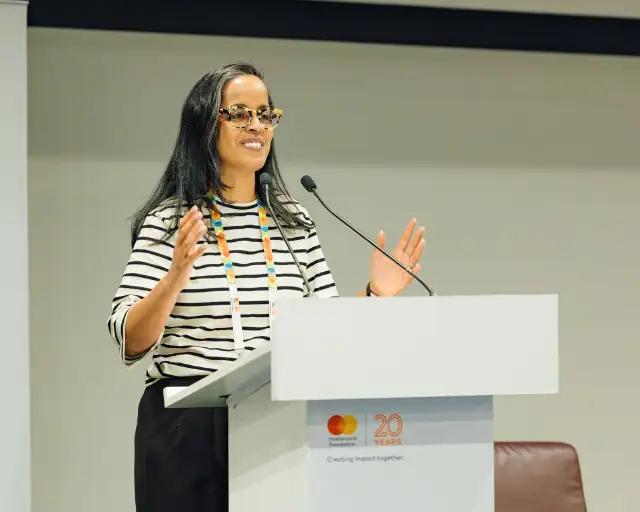
Sewit Ahderom, Chief Executive Officer and President of the Mastercard Foundation.

Audio By Vocalize
Kenya is recognised for one of the most advanced approaches to teaching green skills in Africa and is among the countries going furthest with curriculum reform, a new report on secondary education in Africa has found.
The report by the Mastercard Foundation, Secondary Education in Africa: Expanding Pathways to Work, Livelihoods, and Lifelong Learning, was launched in Accra, Ghana, on Tuesday. It comes weeks after Kenya’s second cohort of Grade 9 learners sat the Kenya Junior School Education Assessment (KJSEA).
“Education for today’s young people, especially at the secondary level, must lead somewhere. For most young Africans, secondary school is the last time a system reaches them at scale,” said Sewit Ahderom, President and CEO of the Mastercard Foundation.
“It’s where we can make the biggest difference to whether they find dignified and fulfilling work,” he added.
Where Kenya leads
“Kenya has one of the most advanced approaches to teaching cross-cutting green skills,” the report states.
It points to short courses in renewable energy, environmental management and sustainable construction for primary and secondary school leavers, and to the KenGen Geothermal Training Centre, which serves as a regional centre of excellence for renewable energy training in East Africa.
Kenya also offers computer programming in secondary school and is developing a national Green Jobs Strategy.
The report cites a UK partnership supporting temporary agricultural jobs for Kenyan youth.
Kenya is putting money behind secondary school, too. It is one of five African countries that allocate a larger share of education spending to secondary than to primary education.
Kenyans also spend longer in school than most Africans: 8.3 years on average, against an African average of 7.1. Adjusted for literacy skills, that is worth about 4.5 years of learning, above the African average of 3.8 and close to Tanzania’s 4.6.
Bold reform, with teachers at the centre
The report singles out Kenya’s shift to competency-based education. It notes that Kenya “removed its primary leaving exam in 2023 and in 2025 introduced a new exam at Grade 9 as part of the competency-based curricula reform.” The last KCPE was held in November 2023, and more than 1.1 million learners sat the first KJSEA in 2025.
Kenya is also among the countries that, according to a UNESCO background study cited in the report, “have undertaken significant curriculum reviews to address earlier gaps and challenges, while maintaining their commitments to competency-based reform.”
Kenya is not reforming alone. Rwanda, one of seven countries the report studied in depth, also teaches computer programming in secondary school and doubled the share of secondary learners graduating from technical and vocational training, from 20 per cent to 40 per cent, between 2021 and 2024.
“Formal schooling cannot be the only route to opportunity. Governments must recognize, accredit, and scale flexible learning pathways as an alternative and integral part of education systems,” said Rwanda’s Minister of Education, Hon. Joseph Nsengimana.
Making reform work in every classroom is the next test. Key informants from Kenya, South Sudan and Egypt “highlighted persistent challenges related to teacher capacity, ongoing professional development, and resistance to change during implementation,” the report says.
Money for teachers is under pressure. “In Kenya, where debt servicing was one of the largest government expenditures, the government deferred plans to upgrade 24,000 intern teachers to permanent positions,” the report states. Teacher salaries typically take up 70 to 90 per cent of recurrent public spending on education, which leaves little room in education budgets when debt costs rise.
“Teachers turn ideas on paper into something a young person experiences in real life, and we need to back them,” Ahderom said.
The bigger African picture
More than 330 million young people in Sub-Saharan Africa will reach working age by 2035, more than in the rest of the world combined. Only 9 per cent enrol in tertiary education, meaning secondary school is the last stop for most.
Secondary enrolment rose from 95 million in 2020 to more than 110 million in 2024. But 85 per cent of that growth reflects larger cohorts, not more learners progressing, a pattern the report calls a “demographic treadmill”. About 77 million secondary school-age young people remain out of school.
Each year, more than 10 million young Africans enter the job market, while only about three million formal jobs are created. Young women made up 61 per cent of the 102 million young people not in employment, education or training in 2025.
Funding is also under strain. Only 22 of 42 African countries with data meet the recommended share of GDP for education, and since 2020, debt repayments have exceeded education spending in 18 countries.
“Secondary education is a human-capital infrastructure, and we need to crowd in new financing and use existing resources more efficiently. The multiplier effect from those investments is what will shape Africa’s economies for generations,” said Shem Bodo, Senior Programs Officer at the Association for the Development of Education in Africa (ADEA).
What the report wants
The report calls on governments to reform curricula, transition support, teachers, inclusion, flexible pathways and technology together, and to prepare young people for many routes to a living, from formal jobs to self-employment and digital, green, care and creative work.
“The Mastercard Foundation is committed to working alongside governments and partners to turn this evidence into action, so that young people leave school able to earn a living and build a future on their own terms,” Ahderom said.
The launch in Ghana was attended by ministers of education from Ghana, Liberia, Sierra Leone and Rwanda.
Join the Discussion
Share your perspective with the Citizen Digital community.
No comments yet
This discussion is waiting for your voice. Be the first to share your thoughts!