
Kenya’s Debt Reckoning: Citizens rise to ‘Okoa Uchumi’ #AD
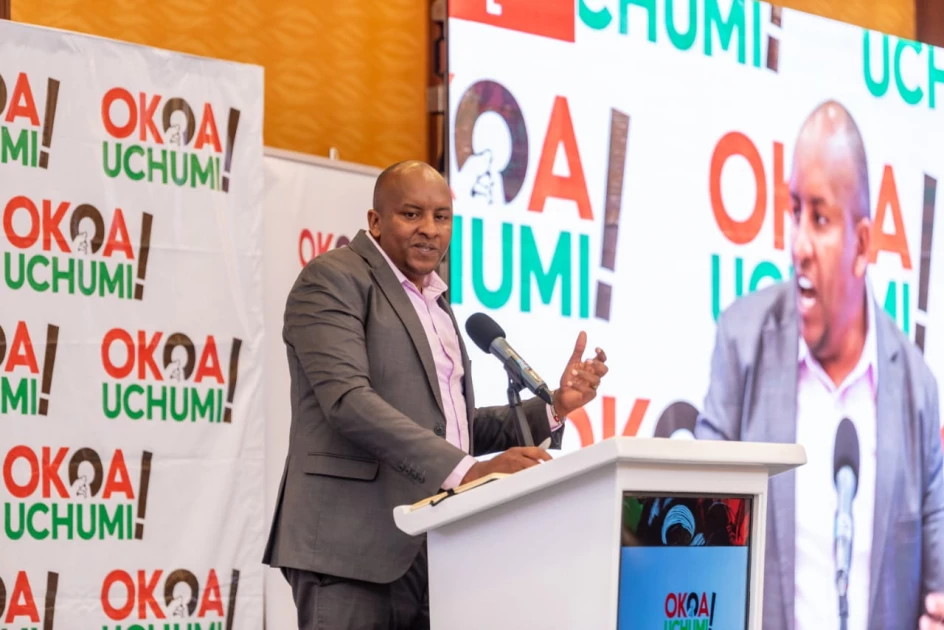
Alexander Riithi presents the preliminary findings of the Governance & Corruption Diagnostic at the Okoa Uchumi Public Debt Conference 2025

Audio By Vocalize
For years, citizens have watched as debt repayments swallow up funds meant for hospitals, schools, and social programs.
On October 7th, 2025, a coalition of civil society groups, religious leaders, academics, professional associations, journalists, and youth movements gathered at the Nairobi Serena Hotel for the Okoa Uchumi Debt Recovery and Economic Justice Conference to confront this crisis head-on.
Under the theme “Co-Creating Solutions for Kenya’s Debt Recovery and Economic Justice,” the conference ended with the adoption of the Nairobi Serena Declaration, a bold call for transparency, accountability, and reform in how Kenya manages its public finances.
Delegates at the conference did not mince their words. They warned that Kenya’s debt has evolved into a full-blown national crisis, threatening both economic stability and the social well-being of its people.
They described a country captured by corruption, political patronage, and mismanagement, a place where public resources have been turned into private wealth for a privileged few.
"Corruption is no longer about isolated scandals,” the communiqué declared. “It has become a systemic political economy that enriches the elite and impoverishes the majority.”
The delegates accused successive parliaments of failing in their oversight role, pointing to the misuse of Article 223 of the Constitution to authorise unbudgeted spending and an increasingly defiant Executive that routinely sidesteps accountability institutions.
This, they argued, has not only eroded public trust but also undermined the doctrine of separation of powers that anchors Kenya’s constitutional democracy.
Emphasising that parliamentary oversight has weakened, and parliament has repeatedly abdicated its fiscal oversight role and too often rubber-stamps executive decisions rather than interrogating them, this has emboldened the Executive to operate with impunity, thus undermining the principle of separation of powers and eroding public trust in democratic institutions.
Noting that the executive impunity and overreach, including attempts to centralise powers through privatisation and Presidential Taskforces, threaten constitutional checks and the independence of anti-corruption, prosecutorial, and oversight bodies.
The gathering also lamented the inequality deepened by excessive domestic borrowing, which has locked out small businesses from credit and concentrated wealth in the hands of a few.
Tax policies, they noted, have worsened this injustice; ordinary citizens continue to shoulder a heavy tax burden while politically connected individuals and companies enjoy tax waivers, inflated contracts, and special access to state resources.
The delegates observed that austerity measures backed by the International Monetary Fund have only worsened the situation, cutting social spending and pushing more Kenyans into poverty.
Yet amid the grim analysis came a roadmap for change. The Okoa Uchmi Declaration outlined a series of reforms designed to embed fiscal responsibility and citizen-centred governance at the heart of Kenya’s recovery.
The proposals included introducing Zero-Based Budgeting to eliminate waste and ensure every expenditure aligns with national priorities, and establishing a public, searchable Beneficial Ownership Register to expose secret wealth and financial flows hidden behind opaque company structures.
Delegates called for a full forensic audit of Kenya’s public debt, stricter limits on domestic borrowing, and stronger protection for independent institutions like the Auditor-General, Controller of Budget, and the Judiciary — all of which have faced sustained political interference.
They also urged an overhaul of the tax system in line with Article 201 of the Constitution to shift the burden from consumption to wealth, capital gains, and illicit financial flows.
Parliament, they emphasised, must reassert its constitutional role by tightening controls on supplementary budgets and borrowing.
Delegates further recommended the establishment of special anti-corruption courts to fast-track economic crime cases, ensuring justice is both swift and transparent.
Throughout the discussions, participants grounded their demands in the principles of Kenya’s 2010 Constitution.
They invoked Article 1, which vests sovereign power in the people; Article 3, which obliges every citizen to protect the Constitution; and Article 10, which enshrines the national values of accountability, good governance, and public participation.
“The spirit of the Constitution gives us the roadmap to equity, accountability, and responsible use of resources,” one participant remarked. “All we need is political will.”
The Okoa Uchumi campaign pledged to transform these resolutions into action — scaling up civic education on debt and budget literacy, monitoring government spending, and advocating for transparency in public-private partnerships and loan contracts.
They also committed to organising county-level accountability forums where citizens can directly question how public funds are being used.
Their shared vision is clear: to ensure that every shilling collected serves the welfare and dignity of the people, not the comfort of the powerful.
As the conference drew to a close, the mood in the room was a mix of urgency and determination. Delegates vowed to hold the government to its constitutional duties, to resist executive impunity, and to fight for fiscal justice that puts people before politics.
Their message was sharp and unapologetic — Kenya does not have a revenue problem; it has an expenditure problem.
The Nairobi Serena Declaration ended with a vision that captured the spirit of the movement: a Kenya where every resource is used with integrity, and where economic policy serves justice, inclusion, and the promise of dignity for all.
Join the Discussion
Share your perspective with the Citizen Digital community.
No comments yet
This discussion is waiting for your voice. Be the first to share your thoughts!