
Locals move to protect endangered water springs in Southwestern Mau Block
null

Audio By Vocalize
But these vital sources are under growing threat, as settlement, farming and deforestation intensify pressure on the forest ecosystem.
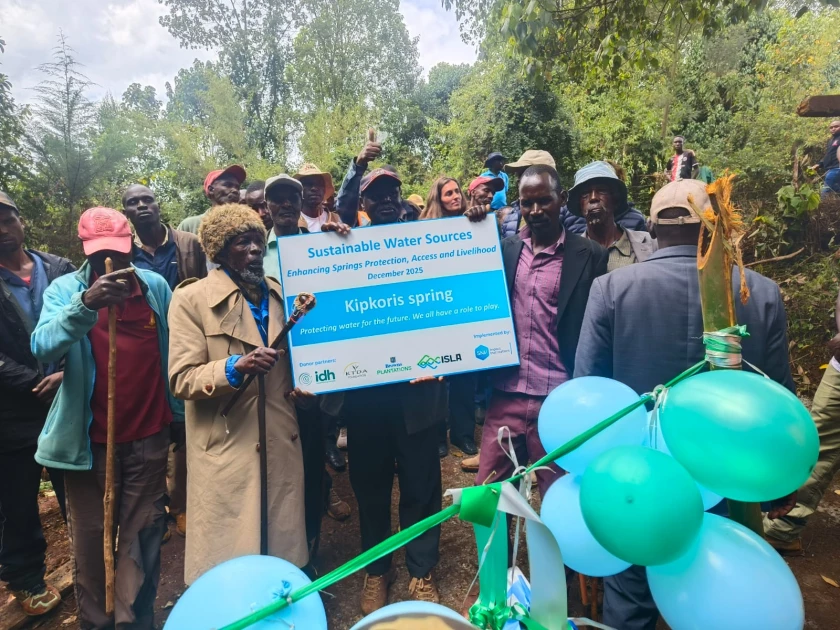
In South Western Mau, however, community-led restoration is helping to revive endangered springs and secure water access for thousands of households.
The Mau Complex is Kenya’s largest montane forest ecosystem, a critical water tower and the source of 12 rivers that serve millions of people across Kenya, Uganda and Tanzania. Yet as human activity expands, so does the risk to the fragile “spring eyes” that keep the forest’s lifeblood flowing.
For 86-year-old Mary Ng’eno, a resident of Siomo East Village in Bomet County, the forest spring has shaped daily life for decades.
For more than 60 years, she trekked up and down the slopes to Tiriakan Spring to fetch water. When Citizen Digital visited her, she could only manage to say her name.
“My name is Mary Ng’eno,” she said, her voice shaky.
Her fourth-born child, Robert Rono, 46, remembers how the spring once dictated the family’s routine.
“We used to fetch water from the spring down the slope. As children, we helped mum with water only during weekends because weekdays we were in school. Right now we have water at our compound—we are enjoying life,” Rono said.
For the family, the potential loss of Tiriakan Spring would have been devastating—especially now that Mary is elderly and immobile.
Recognising the risk, residents rallied around a collaborative restoration effort involving the community, private partners and public stakeholders.
While some contributed labour and building materials, Mary offered a portion of her land for a community water tank that harvests and stores seepage from the spring.
A 2021 report by the Initiative for Sustainable Landscapes (ISLA) warned that among the 22 Mau landscape blocs, the South Western Mau bloc was highly degraded and required urgent intervention.
The report noted, in part: “Catchment degradation is on the rise with no clear mitigation measures in place. Water availability is declining due to pollution and catchment degradation. Awareness levels among the users is low.”
Project partners say misunderstanding of how springs work has also contributed to their disappearance.
“People assumed if they dig a water source, they will get more water—not knowing they are interfering with the flow, and in most cases that spring would definitely disappear,” said Judy Muriu, a Stakeholder Engagement Specialist with the Enhancing Springs Protection, Access and Livelihood (ESPAL) project at SNV.
Similar concerns were echoed by Beata Nzove, a Senior Programme Manager at IDH, who cited livestock overgrazing as a major driver of forest degradation, alongside charcoal production, timber extraction and the pressure of keeping more livestock than the land can sustain.
In places where restoration has taken hold, protecting the spring eye has transformed water access. Solar-powered systems now pump water directly to homes and social amenities. Protective structures over spring eyes have reduced human and livestock traffic at the source—improving hygiene and preventing the delicate outlets from being trampled and covered.
Yet not all communities have benefited.
Several kilometres from Siomo, residents of Kipreres remain dependent on Bethel Spring. Like many villagers, Faith Cherotich and her children have for years trekked long distances for water.

Using an improvised scoop fashioned from a curved banana stem, they draw water at a makeshift point that taps directly from the fragile source.
“I came to this village in 2018. Ever since, I have been fetching water here. I have three children who help me when they are not in school. We make two rounds for water to be enough for a day. Alone I have to make four rounds at the spring. Please help us too to have water near home,” Faith pleaded.
Muriu says demand far outstrips the programme’s capacity.
“We mapped 61 springs and we have only managed to do 10 in two years. There is high demand for water access, and the funding is really not there,” she said.
A water spring is a natural discharge point where groundwater flows from an underground aquifer to the surface. Under ESPAL, restoration combines green and grey approaches.
The green interventions include fencing off spring areas to keep out livestock and minimise human intrusion, and planting indigenous trees to return catchments closer to their natural state. Grey interventions involve building structures for people and livestock that protect water quality and prevent damage to the spring eye.
Reinilde Eppinga, a Project Manager at SNV, said the costs vary depending on the size and yield of the spring.
“We have two types of springs. Low-yielding springs, where we have hand-washing facilities as well as facilities for livestock—the infrastructure is normally between Sh1 million and Sh2 million. Then the larger structures that have solar systems that pump the water up to bigger tanks and water kiosks will cost up to Sh6 million to Sh8 million,” Eppinga said.
To safeguard water quality, a multistage filtration system—using large stones, gravel, sand and polythene sheeting—filters water from the spring eye into a collection chamber.
From there, it is piped to a sump, pumped uphill using solar power, and treated with measured chlorine before distribution to households, water kiosks, schools, hospitals and other facilities.

Engineer Stanley Kiilu of Sparlex Limited said collection chambers are essential to stabilise abstraction.
“The main reason for having a collection chamber is to collect water so that it is drawn into the pipeline. The water is drawn using those pipes direct to the sump. From the sump, we install a solar pump which then pumps to the highest point—to those tanks,” Kiilu explained.
Some communities worry that abstraction could cause springs to dry up. But Calvin Ogora, a site agent at Cilneod Africa, said properly managed systems should not harm a spring.
“Where the spring eye is, it should have a constant flow. So when there is continuous flow, you will definitely have continuous flow on the spring. One thing I can assure you—the spring water will not disappear,” Ogora said.
Communities are also being organised into Springs Improvement Committees and trained on conservation and governance. Members contribute to tree planting, encourage neighbours to follow environmental best practices, and plan for maintenance costs—an approach that has strengthened local leadership and confidence in managing shared resources.
Winnie Chepng’eno, a resident of Kapkembu and secretary of the Kapkembu Spring committee, said one measure the group adopted is a small user fee to cover maintenance.
“We will charge Sh2.50 for a 20-litre jerrican. This is not for profit, but for maintenance in case of any breakage,” she said.
The Water Resources Authority (WRA) says abstraction must be documented and regulated to protect river systems that depend on the Mau headwaters.
“One of our key activities was to ensure that the Water Resources Regulations 2025 and the Water Act 2016 are observed when it came to abstraction,” said John Kinyanjui, Manager for Water Resources Assessment at WRA. “These springs form the headwaters of major rivers, including the transboundary Mara River system. Abstraction from here has to be documented and properly controlled to ensure the rivers don’t dry during the dry seasons.”
Project partners say more than 2,000 households in the South Western Mau bloc are already benefiting from improved spring protection and recovery—evidence, they argue, that community-led restoration can work.
But they warn that sustaining these gains—and scaling them across the wider Mau Complex—will require stronger enforcement, consistent funding and long-term commitment as climate pressures grow.
Join the Discussion
Share your perspective with the Citizen Digital community.
No comments yet
This discussion is waiting for your voice. Be the first to share your thoughts!