

Museveni: Internet should be owned by Gov't, not private companies
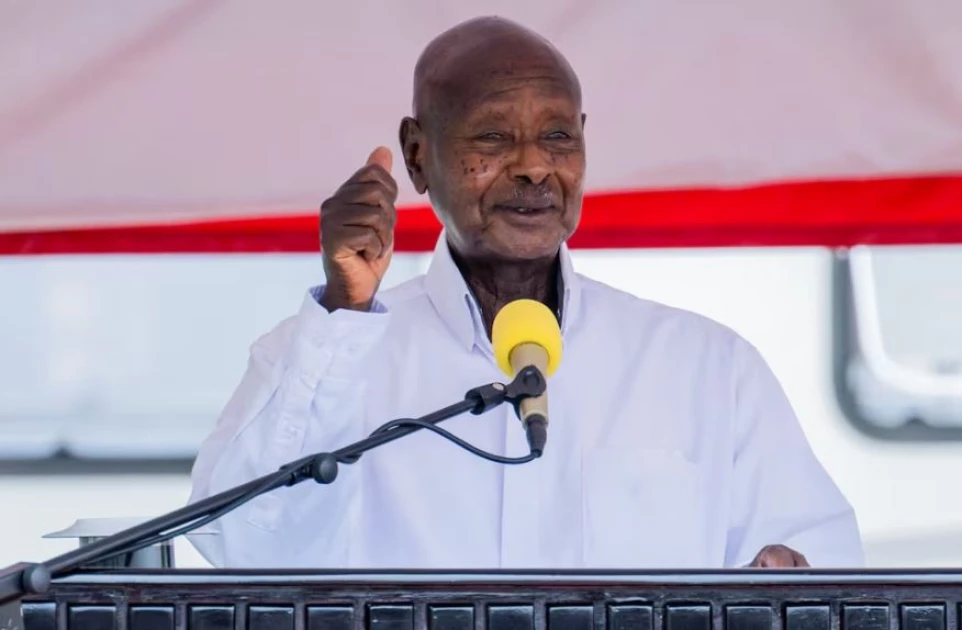
Uganda's President Yoweri Museveni delivers the 2025 State of the Nation Address at Kololo Ceremonial Grounds, in Kampala, Uganda June 5, 2025. REUTERS

Audio By Vocalize
President Yoweri Museveni now says that internet
infrastructure should not be owned or dominated by private companies, saying
government control is necessary to keep the costs low for citizens.
Speaking during a press briefing, Museveni stated that private
ownership often encourages monopolies as the companies are driven by profit
rather than national interest.
This, according to the Ugandan President, makes connectivity
unnecessarily expensive for citizens.
"The internet should not be owned by private people…because
when the internet is owned by business people, especially if they monopolise
it, they are after money, that's why the backbone (should be) owned by the
government," he stated.
To remedy this, Museveni opined that the State must maintain
authority over core internet systems to guarantee affordable access.
He noted that while private providers play a role in offering
services, they should not control essential transmission lines.
Museveni linked his argument to the broader evolution of
technology, recalling his own experience during Uganda’s liberation struggle to
illustrate how digital tools have transformed operations.
“It is true that internet and electronics have helped us to do
things much faster because when we were fighting in the early days, I had to
use my eyes to estimate how far the enemy was so that I could adjust my gun sight
to shoot properly,” he said. “These days, with laser, it tells me exactly where
the target is. I don’t have to calculate.”
The President said such technological advancement underscores
why the government must secure key digital infrastructure.
“For the internet, we need low-cost transmission so that it
doesn’t become expensive,” he said, reaffirming his administration’s commitment
to lowering data costs across the country.
Museveni, who has been in power since 1986, is seeking to run
for a record seventh term. Among his key projects is the laying of fibre cables
across Uganda to enable high-speed internet.
In 2024, he launched Phase V of the National Backbone
Infrastructure (NBI) that involves adding 5,845 kilometers of fibre cables to
the current 4,387 kilometers already laid.
During the launch, Museveni noted that the project would
reduce the cost of doing business and support government programs.
“The NBI will connect all administrative units and facilitate
access to critical e-services, education, healthcare, and business
opportunities, driving national development,” he stated at the time.
Leave a Comment