
Music festival students to battle for Ksh.2.5 million at nationals
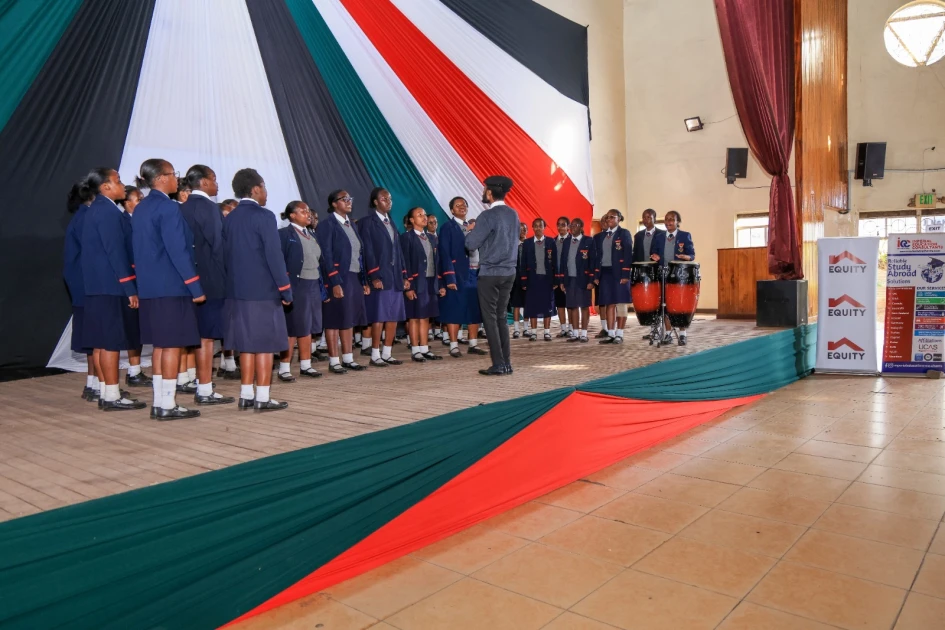
St George Girl's School students showcase a song at the 2026 Kenya Music Festivals regional levels at Buru Buru Girls High School.

Audio By Vocalize
Learners from across the country will compete for a Ksh.2.5 million prize pot at this year's Kenya Music Festival (KMF) nationals, after Equity Bank rolled out the funds to motivate students in categories sponsored by the financial institution.
Equity Bank Head of Education Peter Ndoro
said the nationals, set to be held at Kibabi University in Bungoma County, mark
the pinnacle of Equity's sponsorship this year, with the bank having supported
the festival from sub-county with over Ksh25 million running for three
consecutive years.
"Our partnership goes beyond
sponsorship. We want to create meaningful opportunities and nurturing
responsible citizens who will drive positive change in our society," Ndoro
said while addressing students and teachers at the concluded Nairobi regional
edition at Buru Buru Girls.
As the major partner, students will continue
showcasing performances under Equity's own sub-theme, Sustainable
Transformation for a Resilient Future: Protecting Our Environment, Empowering
Our Communities for Wealth Creation.
The theme complements this year’s music
festival’s main theme, Enhancing the Creative Economy through Knowledge,
Skills and Artistic Production for Sustainable Development.
"The themes speak directly to the
aspirations of our nation and values that guide Equity Bank. Students should
use their talents creatively to inspire change, promote environmental
responsibility, and demonstrate how empowered citizens can create wealth and
resilience,” Ndoro said.
At the regional level, Equity sponsored 11
classes spanning primary, junior, and senior schools, with Ksh4.4 million going
to winners and 88 trophies handed out across the categories, out of 130 donated
in total.
The competition widens at the national
level, where Teacher Training Colleges, TVETs, and universities join the field,
pushing the number of classes under the Equity theme to 14. National winners
will share a Ksh2,520,000 prize pot, with first place in each class earning
Ksh100,000, second place Ksh50,000, and third place Ksh30,000.
Trainers behind winning performers also
stand to benefit, with Ksh30,000, Ksh20,000, and Ksh10,000 for first, second,
and third place respectively.
Equity Group Managing Director and CEO Dr.
James Mwangi, in a message released to mark the festival, tied the sponsorship
to the bank's wider sustainability agenda. "The question before us is no
longer simply how to transform lives," Mwangi wrote. "It is how to
sustain that transformation for generations to come."
He added that sustainability at Equity is
not an abstract concept, but a deliberate strategy embedded in how they
finance, invest, and empower communities. "We recognize that prosperity
cannot exist without stewardship of our environment," he said.
Equity Bank's environmental programmes back
that commitment. The bank has supported the planting of over 39.6 million
trees, part of the national drive to plant 15 billion trees by 2032. Its clean
energy work for schools and communities includes energy transition support for
learning institutions, solar power installations, clean cooking energy
solutions, and water harvesting and purification systems, alongside green
financing for renewable energy adoption, climate-smart agriculture, and
sustainable enterprises.
These efforts, Dr Mwangi said, help institutions
and households reduce energy and lighting costs, lower emissions, and build
resilience.
He also framed sustainability in financial
terms, describing Equity's mission of economic empowerment as now carrying a
strong focus on responsible growth. "True wealth creation is responsible
and long-term," he said. "Wealth can grow without degrading the
environment or excluding communities."
On the financial sustainability side, the
bank points to its work promoting a savings culture among learners and
communities, supporting youth and women entrepreneurship, financing sustainable
enterprises, encouraging climate-smart and green investments, and providing
insurance to protect wealth already created.
For Dr Mwangi, the festival carries weight
beyond the stage, framing it as a platform for shaping national consciousness
and driving all-round excellence rather than simply celebrating artistic
talent. He noted that through music, poetry, and performance, learners have the
chance to internalize and project the idea that sustainable wealth protects the
environment, empowers communities, and secures the future, and that those who
grasp sustainability holistically become ambassadors of transformation within
their schools and communities.
Peter Ndoro concurred, adding that the
bank's interest in the festival stretches beyond this year's trophies and prize
money. He recalled how, in years past, students would compete, win, and go back
home once the festival ended, a pattern he said Equity wants to break.
He raised the question of what more could
be done to help learners earn a livelihood from their talents, revealing that
talks are already underway with the Ministry of Education on how to help young
performers monetize their skills.
"Now it is our responsibility as
responsible organizations to look at how do we support these children, these
young learners to be able to earn a livelihood out of their talent," Ndoro,
Equity Bank’s Head of Education said. "That is our responsibility, and as
Equity Bank, we are determined to make it happen."
Join the Discussion
Share your perspective with the Citizen Digital community.
No comments yet
This discussion is waiting for your voice. Be the first to share your thoughts!