

NASA’s historic Artemis I mission is coming to a close
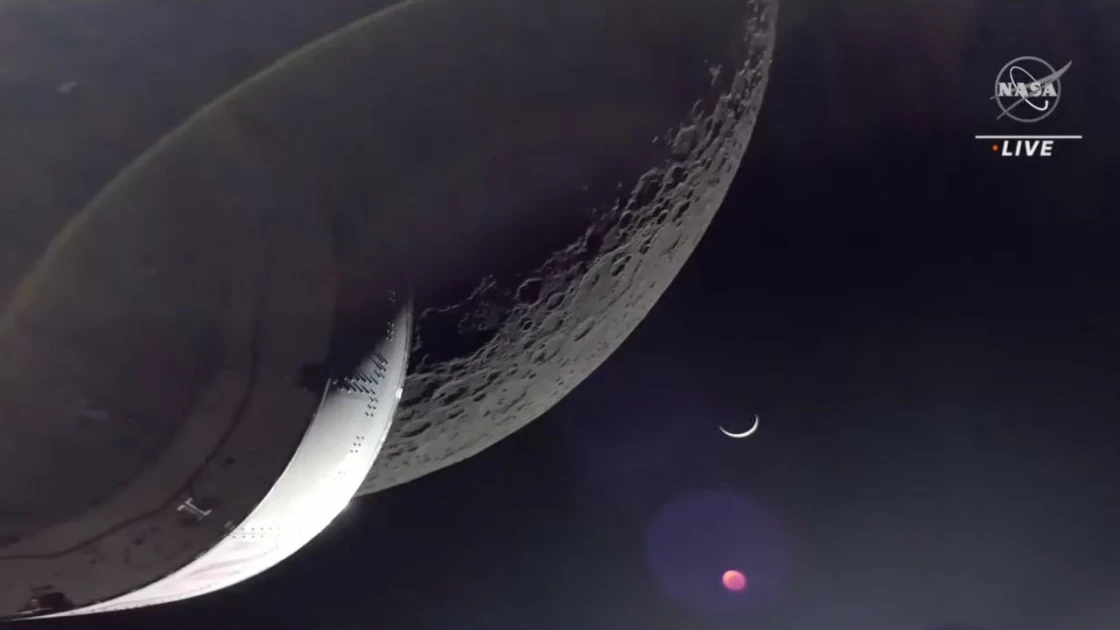
The NASA Orion capsule captures a view of the "Earth rise" as it emerges from the far side of the moon. | NASA

Audio By Vocalize
The historic Artemis I
mission, which is sending an uncrewed spacecraft on an unprecedented trip
around the moon, is now in the final stretch of its historic journey.
Orion, as NASA’s new space capsule is called, made another
pass by the surface of the moon Monday morning, capturing views of notable
lunar sites, including a couple of Apollo landing sites. The spacecraft then
passed just 80 miles (128.7 kilometers) above the lunar surface, its second
close flyby of the moon.
After that, Orion fired
up its main engine for about three and a half minutes — the longest burn
conducted on its trip thus far. The engine burn set the capsule on its final
path home, kicking off the last leg of its 25-and-a-half-day trip.
The Artemis I mission lifted off on November 16, when
NASA’s beleaguered and long-delayed Space Launch System
(SLS) rocket vaulted the Orion capsule to space, cementing its status as the
most powerful operational launch vehicle ever built. The SLS rocket’s thrust
exceeded that of the Saturn V rocket, which powered the 20th-century moon
landings, by 15%.
Orion separated from the rocket after reaching space and
has since been on a journey circumnavigating the moon. About a week ago, the
capsule entered what’s called a “distant retrograde orbit” around the moon,
allowing it to swing more than 40,000 miles (64,374 kilometers) beyond the
moon’s far side. That’s farther than any spacecraft designed to carry
humans has ever flown.
The spacecraft is now set to traverse the 238,900-mile
(384,400-kilometer) void between the moon and Earth. It’s expected to plunge
back into Earth’s atmosphere on December 11, a process that will create enough
pressure to heat its exterior to more than 5,000 degrees Fahrenheit (2,760
degrees Celsius).
If
astronauts were on board, they’d be protected by a heat shield. Upon reentry, Orion will be traveling at 20,000 miles per
hour (32,187 kilometers per hour), or more than 26 times the speed of sound.
All of that energy will be dispersed as the capsule crashes back into Earth’s
dense inner atmosphere and then releases its parachutes to further slow its
descent before its splashdown in the Pacific Ocean.
All told, the Orion capsule will have traveled more than 1.3
million miles in space.
NASA has been preparing for this mission for more than a
decade. Following its successful completion, the space agency will then look to
choose a crew to fly the Artemis II mission, which could take off as soon as
2024. Artemis II will aim to send astronauts on a similar trajectory as Artemis
I, flying around the moon but not landing on its surface.
That could pave the way
in turn for the Artemis III mission, which is currently slated for a 2025
launch — and is expected to put a woman and a person of color on the moon
for the first time. It would also mark humans’ first visit to the lunar surface
in half a century.
The Orion spacecraft’s performance has been “outstanding,”
Howard Hu, the Orion program manager, told reporters last week.
The space agency did have to troubleshoot some minor issues, including an unexpected communications blackout that lasted nearly an hour. But NASA officials said there have been no major problems, and so far have chalked up the mission as a resounding success.
Leave a Comment