

OPINION: Han Zheng’s visit marks a strategic turning point in China–Kenya ties
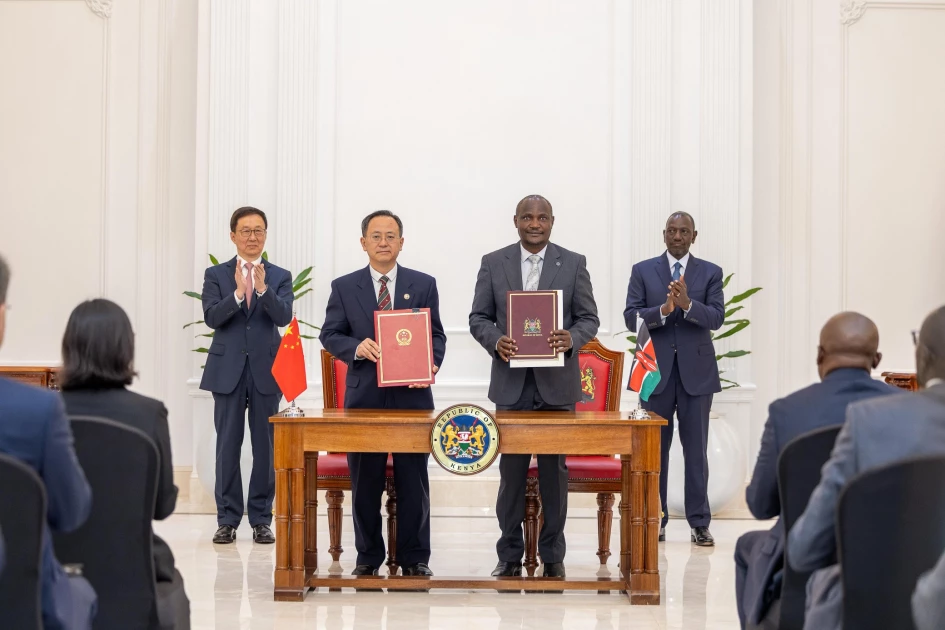
China and Kenya signed four MoUs during Vice-President Han Zheng's visit to Nairobi. Photo: PCS

Audio By Vocalize
By
Onyango K’onyango,
For Kenya, and indeed much of East Africa, this engagement with China represents both an opportunity and a strategic choice about the future of development in a multipolar world.
Over the past six decades, relations between China and Kenya have evolved from symbolic solidarity to substantive cooperation.
What distinguishes this partnership today is its forward-looking nature. When William Ruto and Xi Jinping agreed to build a “China-Kenya community with a shared future,” they were not merely issuing diplomatic rhetoric.
They were outlining a framework that aligns Kenya’s development ambitions with China’s expanding global economic vision. This alignment is particularly timely as China embarks on its 15th Five-Year Plan, emphasizing high-quality growth and broader global integration.
For Kenya, the appeal of this partnership lies in its tangible outcomes. Infrastructure projects like the Mombasa-Nairobi Standard Gauge Railway have already demonstrated how cooperation can translate into real economic transformation.
The railway has not only improved connectivity between the port city of Mombasa and the capital Nairobi but has also lowered transportation costs, enhanced trade efficiency, and stimulated regional commerce. Such projects are often criticized in abstract geopolitical debates, yet on the ground, their impact is visible and measurable.
Perhaps the most consequential development arising from Han’s visit is China’s decision to extend zero-tariff treatment to 53 African countries, including Kenya.
This policy, taking effect on May 1, offers Kenyan exporters unprecedented access to one of the world’s largest consumer markets. For a country striving to diversify its exports beyond traditional commodities, this is a game-changer.
It opens the door for value-added agricultural products, manufactured goods, and even services to find a foothold in China’s vast economy.
Critically, this opportunity comes at a time when global trade faces increasing protectionism and uncertainty. As Han rightly noted, the international political and economic environment is becoming more complex, with mounting challenges to free trade.
In this context, China’s willingness to expand market access contrasts sharply with the inward-looking tendencies seen elsewhere. For Kenya, embracing this opening is not merely beneficial—it is necessary.
The role of Kenya as a regional hub also adds another layer of significance to this partnership. Deputy President Kithure Kindiki emphasized the country’s ambition to position itself as a gateway for Chinese engagement with the broader African market.
This is not an unrealistic aspiration. With its relatively advanced financial sector, strategic geographic location, and improving infrastructure, Kenya is well placed to serve as a conduit for trade and investment flows across East and Central Africa.
However, enthusiasm for this partnership should not come at the expense of critical reflection. Kenya must approach its engagement with China with a clear strategy that prioritizes long-term national interests.
This means ensuring that trade agreements benefit local industries, that infrastructure projects are economically viable, and that debt sustainability remains a guiding principle. Partnership, after all, is most effective when it is balanced and mutually accountable.
At the same time, China’s approach to Africa, as demonstrated during this visit, appears to be evolving. There is a growing emphasis on trade facilitation, industrial cooperation, and integration into global value chains, rather than solely focusing on large-scale infrastructure financing.
This shift aligns well with Africa’s own development priorities, particularly the push for industrialization and economic diversification under frameworks such as the African Continental Free Trade Area.
Another noteworthy aspect of Han’s visit was his engagement with United Nations agencies in Nairobi, including the United Nations Office at Nairobi. This underscores China’s broader ambition to play a more active role in global governance while reinforcing multilateral institutions.
For Kenya, hosting such interactions enhances its diplomatic stature and reinforces its role as a key player in international affairs.
Ultimately, the strengthening of China-Kenya ties reflects a broader trend: the gradual reconfiguration of global partnerships toward a more multipolar and interconnected order.
For Kenya, the challenge is not whether to engage with China, but how to do so effectively. The opportunities are undeniable—expanded trade, accelerated infrastructure development, and deeper integration into the global economy. Yet these must be matched with sound policies, transparent governance, and a commitment to inclusive growth.
As Han Zheng’s visit concludes, it leaves behind more than signed agreements and diplomatic statements. It offers a glimpse into a future where Kenya is not merely a participant in global economic processes but an active architect of its own development trajectory.
If managed wisely, this partnership could serve as a model for how African nations can leverage international cooperation to achieve sustainable and shared prosperity.
The writer is a Journalist and Communication consultant
Leave a Comment