
OPINION: The Mrima Hill discourse: The other side of the story
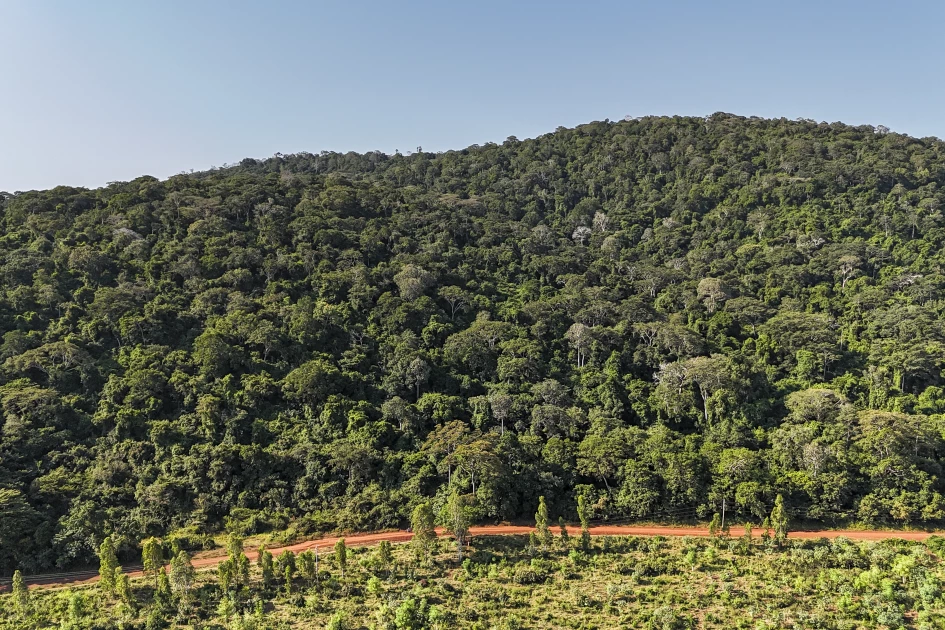
An aerial view of a section of the Mrima Hill Forest in Lunga-Lunga, Kwale county on September 26, 2025. Photo by TONY KARUMBA / AFP

Audio By Vocalize
The Mrima Hill discourse: The other side of the story
The name Mrima Hill is not new or strange to many; it is currently the in-thing not only in Kenya's mining industry but globally.
There is consternation among leaders and the community on the future of this hill. The figures being floated on the value of the minerals in Mrima are mind-boggling. Any government would be interested in exploiting such wealth.
In the midst of all the confusion, we have forgotten the true significance of Mrima Hill. It is not just another hill; it is something far greater.
The hill is located in the South Coast of Kenya, in Kwale County, and it's approximately 100km from Mombasa City.
This piece deliberately turns our attention to the other side of Mrima Hill, the side often left untold. That many people are not talking about or even aware of.
This will perhaps open and expand the disputation and promote inclusivity in the discussion.
Mrima is a biodiversity hotspot of unimaginable magnitude! Its importance extends from the local communities who live in its shadow to national heritage and even to global significance, an importance that cannot simply be wished away.
Very few other sites in Kenya have the conservation status of Mrima Hill.
Mrima Hill is a forest, a part of the larger eastern African coastal forest ecoregion, which is recognised as one of Africa’s centres of species endemism due to a high concentration of plant, birds and animal species so rare that they are not found anywhere else in the world.
Conservation International ranks the ecoregion 11th in species endemism globally, and Bird Life International ranks it as one of the most globally important Endemic Bird Areas.
It is ranked by WWF as among the top 200 out of the world's 850 ecoregions that are most important for global biodiversity conservation.
In Mrima alone, a 1989 expedition identified over 270 plant taxa, with 25 being rare globally or nationally, including rare trees like Uvariodendron gorgoni, critically endangered Gigasiphon macrosiphon and unique giant orchids among many others.
Compare this to Kakamega forest, 10 times bigger than Mrima, with approximately about 380 plant species, you can start understanding the value of the hill.
Mrima forest stands on a hill elevating to about 300 meters above sea level; the hill is covered by 380 ha (939 acres) of dense coastal forest.
The forest has various protection regimes and an international conservation status. Firstly, Mrima is a gazetted Forest Reserve under the Forest Management and Conservation Act 2016. It was not gazetted yesterday; it was done in 1961 during the colonial era, vide Legal Notice Number 304.
As if that were not adequate protection, the forest was later put under even more strict conservation status. In 1989, the government elevated it to a Nature Reserve vide Legal Notice Number 212.
As a Nature Reserve, Mrima is purely for preserving ecosystems, biodiversity (plants, animals, landscapes), with educational/recreational activities, the main aim is to protect biodiversity.
Yet, in 1992, it was also gazetted as a National Monument (Kaya Sacred Forest) under the National Museums and Heritage Act. As a Kaya sacred forest, Mrima holds invisible features of great spiritual significance to the Digo community.
It is here that the community communes with ancestral spirits to appease for interventions during calamities or thanksgiving during good times.
In Mrima, there are three sites where prayers and sacrifices are offered, including Bege, Mzemani and Chigongoni sacred sites.
May the spirits of the departed community spiritual leaders, including Mzee Mnyenze of Kinondo, Omar Bege of Mrima, and Shaban Ndegwe of Duruma, continue guiding the current elders and community at large as they navigate through this delicate discourse.
Globally, Mrima has two other key recognitions for its abundance in biodiversity. Its recognized as one of the world’s Important Bird Areas (IBAs), making it a refuge for critically endangered bird species as classified by the International Union for Conservation of Nature (IUCN).
Mrima is also a legacy Key Biodiversity Areas (KBAs). KBAs are areas globally recognised as sites that make a substantial contribution to the continued existence of global biodiversity.
These areas are appropriately identified using a Global Standard adopted in 2016 during the IUCN Congress. Kenya has 68 KBAs.
It is for these reasons that when debate on mining in Mrima ranges on, at the end of the day, we must all sit back, relax and reflect.
How do we navigate through this delicate and sensitive ecosystem with multiple national protection status, which falls under several Multilateral Environmental Agreements (MEAs), to which Kenya is a signatory, as well as being a living museum of people’s culture and traditional beliefs.
How will Kaya elders, historians, and cultural custodians respond to mining within a sacred site, while safeguarding its sacredness and ensuring it is not discredited?
A site where forefathers are trusted with cultural sacred objects that protect the whole community, where the said forefathers are buried, and their spirits peacefully roam about for centuries protecting the greater good.
How can mining be proposed in a Nature Reserve, where the law clearly prohibits any form of extraction? It would be enlightening to hear the perspectives of the Kenya Forest Service (KFS), National Museums of Kenya and the National Environment Management Authority (NEMA)—the national agencies mandated to protect such sites.
Base Titanium Limited (BTL) mining operations in Kenya demonstrated to us that mining can actually be done following internationally set standards and best practices.
That environmental considerations, good governance and social well-being can be elevated beyond levels known in Kenya before.
We learnt many lessons which should inform any future large-scale mining venture. Yet, the sensitivity of Mrima forest is far beyond what BTL faced.
Unlike Mrima, BTL Kwale operations were done on previously farmed lands with little biodiversity significance and conservation status.
In conclusion, Mrima is a forest of outstanding global value, it contains cultural and natural significance so exceptional that it transcends national borders, belonging to all humanity for present and future generations.
It demonstrates authenticity and integrity that should be an inherent part of any mining proposition.
Elias Kimaru is an Environmental, Social and Governance Expert. He is also an Honorary member of ICCA Consortium.
kimarueg@gmail.com
Join the Discussion
Share your perspective with the Citizen Digital community.
No comments yet
This discussion is waiting for your voice. Be the first to share your thoughts!