

Over 100,000 learners to benefit as SHOFCO scales up education support programme

Audio By Vocalize
The initiative by Shining Hope for Communities (SHOFCO) is expected to benefit more than 100,000 learners by improving learning conditions in underserved urban schools.
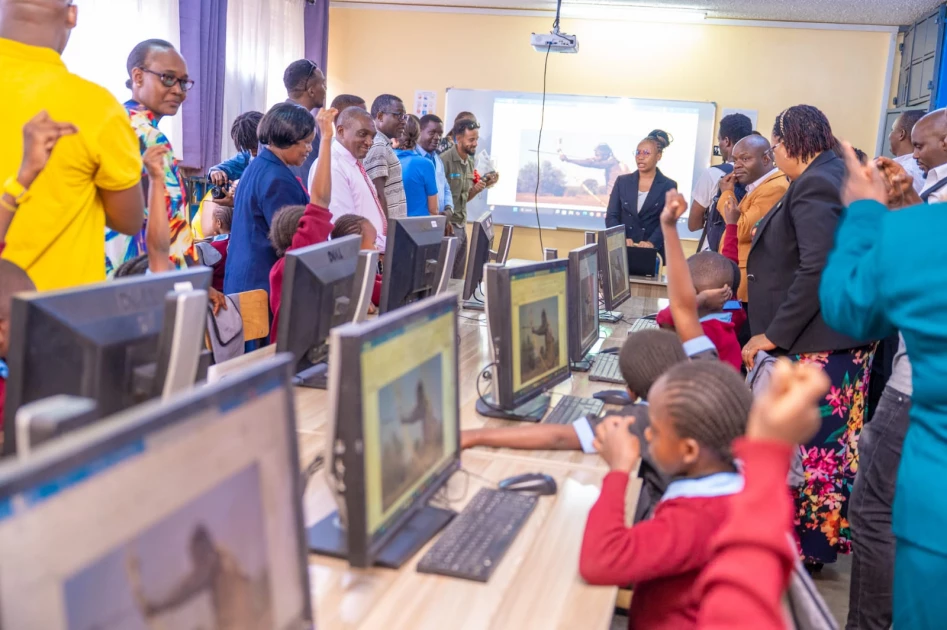
The facilities were officially launched in partnership with the Ministry of Education, including a new ICT laboratory at Salama Primary School and a sanitation block at Huruma Primary School, where about 2,700 learners had been relying on limited toilet facilities.
SHOFCO Chief Executive Officer Dr Kennedy Odede said the organisation was expanding lessons from its own schools in Kibera and Mathare to support learners in public institutions.
“Our own schools in Kibera and Mathare showed us what is possible — that children from the neediest backgrounds are just as able to excel academically with the right support,” said Odede.
“We want every child to be learning, safe and healthy, with well-supported teachers and parents engaged in education.”
The intervention comes amid concerns over persistent infrastructure and staffing shortages in public schools, particularly in science and technology learning.
A recent report by Usawa Agenda and Zizi Afrique Foundation found that only 21 per cent of teachers in public junior schools are trained in STEM subjects, while 35 per cent of schools lack a STEM teacher entirely. The report also showed that nearly half of learners do not have access to STEM laboratory facilities.
Sanitation remains another major challenge in public schools. According to the findings, an average of 66 boys and 62 girls share a single washroom, more than double the Ministry of Education’s recommended standard.
At Huruma Primary School, the new sanitation facilities have reduced the pupil-to-toilet ratio for girls from 1:99 to 1:68, and for boys from 1:83 to 1:58.
At Salama Primary School, the ratio for girls has improved from 1:86 to 1:65, while that for boys has dropped from 1:112 to 1:84.
Beyond infrastructure, the programme also includes teacher training and leadership coaching for school administrators.
Dr Emmanuel Munyasa, Executive Director of Usawa Agenda, said the ICT investments were timely given the growing role of digital learning under the Competency-Based Education (CBE) framework.
“Many institutions lack computer laboratories, yet ICT is now a critical component under CBE. SHOFCO’s intervention is both timely and impactful,” he said.
A representative from the State Department for Basic Education, identified only as Florence, welcomed the partnership and called for proper upkeep of the new facilities.
“A healthy learner is able to attend school regularly. I urge school heads to ensure that these facilities are well-maintained,” she said.
Huruma Primary School Headteacher Beatrice Njoroge said the improvements would help narrow disparities between learners in informal settlements and those in better-equipped schools.
“Teachers will also benefit from powerful tools to enhance teaching and learning,” she said.
Odede said the organisation’s role is to complement, rather than replace, government efforts in education.
“Our kids cannot go to school if they don’t have clean and safe toilets. Since last year, we have been working with public schools because these things are essential for our children,” he said.
“SHOFCO doesn’t come to do the work of governments or public schools. We work with government priorities.”
SHOFCO currently operates two schools in Kibera and Mathare, serving more than 600 learners, and says those experiences are now informing its broader partnership with government to improve conditions in public schools.
Leave a Comment