

Pentagon warns China is rapidly expanding its nuclear arsenal

Audio By Vocalize
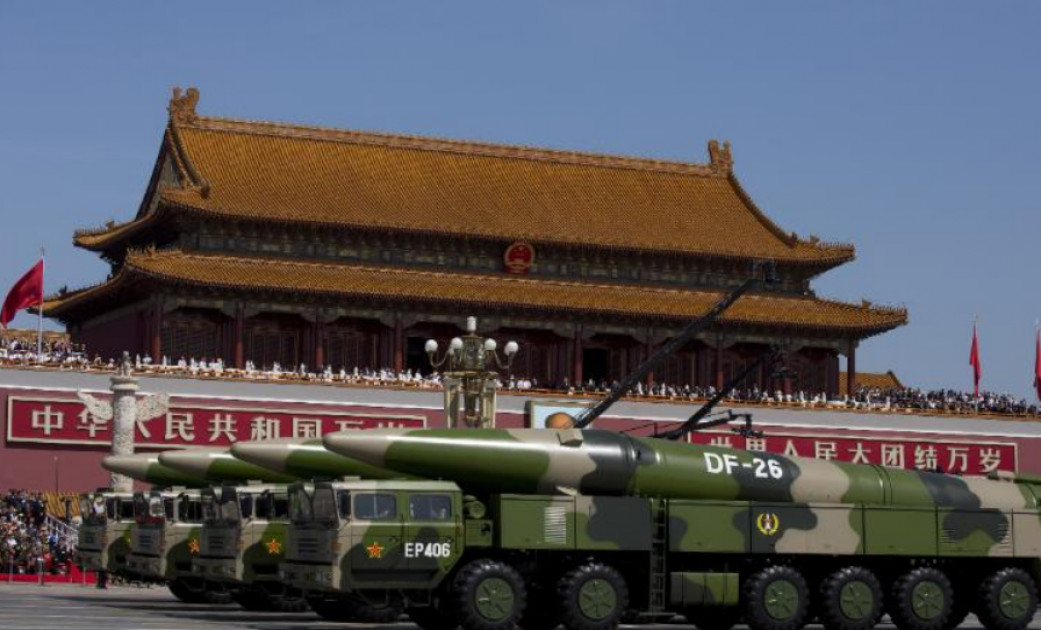
China is rapidly expanding its nuclear arsenal and may have
1,000 nuclear warheads by the end of the decade as it aims to surpass US global
influence by the middle of the 21st century, according to a major Pentagon report released on Wednesday.
The estimate, based on the rapid modernization of China's
nuclear strike options and its construction of missile silos, marks a dramatic
increase from the projection in last year's China Military Power report, which
estimated that China would double their stockpile of 200 warheads within a
decade.
The report comes amid heightened tensions over the issue of Taiwan and was published hours
after the most senior US general, Chairman of the Joint Chiefs of Staff Mark
Milley issued a stark warning about China's military progress stating it
amounts to "one of the largest shifts in global geostrategic power that
the world has witnessed."
A senior defense official briefing reporters on the report
adopted a similar stance.
"The nuclear expansion that the [People's Republic of
China] is undertaking is certainly very concerning to us," the official
said. "It's one thing to observe what they're doing, but they haven't
really explained why they're doing it."
The official said the buildup raises serious doubts about the
intent behind their nuclear stockpile.
"They're moving in a direction that substantially exceeds
where they've been before in terms of numbers and capabilities," the
official said. Though China still maintains a no first-use policy when it comes
to nuclear weapons, the official said China has suggested "there are
circumstances under which that wouldn't apply."
China has also focused on a "lean and effective nuclear
force," but their current buildup is greater than the US anticipated
"and well beyond where they've been historically." The investment in
its nuclear force has allowed China to establish a "nascent" nuclear
triad of air-launched ballistic missiles, as well as surface and sea-launched
missiles, similar to the United States' own triad.
The US currently has 3,750 nuclear warheads in its stockpile,
according to the latest data from the State Department, dwarfing the size of
China's nuclear stockpile.
The Federation of American Scientists (FAS) published a report
this week about the rapid building of three suspected silo fields in western China.
The silo fields are still years away from becoming operational, wrote the
authors of the FAS report, Matt Korda and Hans M. Kristensen, but they could
eventually be capable of launching long-range nuclear missiles.
Modernization provides 'a range of different options' on
Taiwan
The Pentagon report, officially called Military and Security
Developments Involving the People's Republic of China 2021, also focuses on
Beijing's goals for future development and modernization of its armed forces.
Crucially, if China meets its interim modernization goal for 2027, it could
provide Beijing with "a range of different options" regarding Taiwan,
from a blockade of the island to a potential amphibious invasion of either
Taiwan itself or one of the smaller outlying islands.
At the same time, China also aims to deter foreign
intervention in what Beijing sees as a domestic political issue.
"Obviously, they're looking at the United States or other
parties they think might intervene on Taiwan's behalf," the official said.
Beyond 2027, China is looking to complete modernization of its military by 2035
and become a world class military by 2049, the 100th anniversary of the
establishment of the People's Republic of China (PRC). That would allow it to
"displace US alliances and security partnerships in the Indo-Pacific
region," the report said.
The report, which summarizes Chinese military developments
during 2020, does not describe China's recent hypersonic missile test over the
summer. On Wednesday at the Aspen Security Forum, where he was interviewed by
NBC's Lester Holt, Milley said hypersonic technology is just one area where
China is making significant advances.
Asked about the recent test of a hypersonic weapon, Milley said it was just one part of the
broader picture with regard to China's rapidly advancing military capability,
which he characterized as a "fundamental change" in warfare that is
already reshaping elements of international order.
The report does note that China fielded the DF-17 last year, a
medium-range ballistic missile capable of launching a hypersonic glide vehicle.
Last week, the second most senior US general said that the
pace at which China's military is developing capabilities is "stunning" while US development suffers
from "brutal" bureaucracy. The outgoing Vice Chairman of the Joint
Chiefs of Staff, General John Hyten, told reporters at a Defense Writers Group
roundtable that "the pace they're moving and the trajectory they're on
will surpass Russia and the United States if we don't do something to change
it. It will happen. So I think we have to do something."
The Pentagon has repeatedly referred to China as the
"pacing challenge" for the US, but President Joe Biden stressed
Tuesday that competition does not make conflict inevitable.
At the closing press conference of the COP26 climate summit,
Biden said, "There's no reason there need to be conflict." Of his
upcoming virtual summit with Chinese President Xi Jinping, Biden said,
"I've also indicated to him, so I'm not reluctant to say it publicly, that
we expect him to play by the rules of the road."
This year's report adds a new section on China's chemical and
biological research, raising concerns about the possible dual-use applications
of the country's biological activities. But it does not dive into the origins
or spread of coronavirus. Instead, it notes that the Covid-19 pandemic was a
driving force behind the China's foreign policy, as it sought to deflect any
blame for the outbreak while using foreign assistance to build regional
influence.
Leave a Comment