
Race against time as universities brace for 2029 CBE intake amid funding crisis
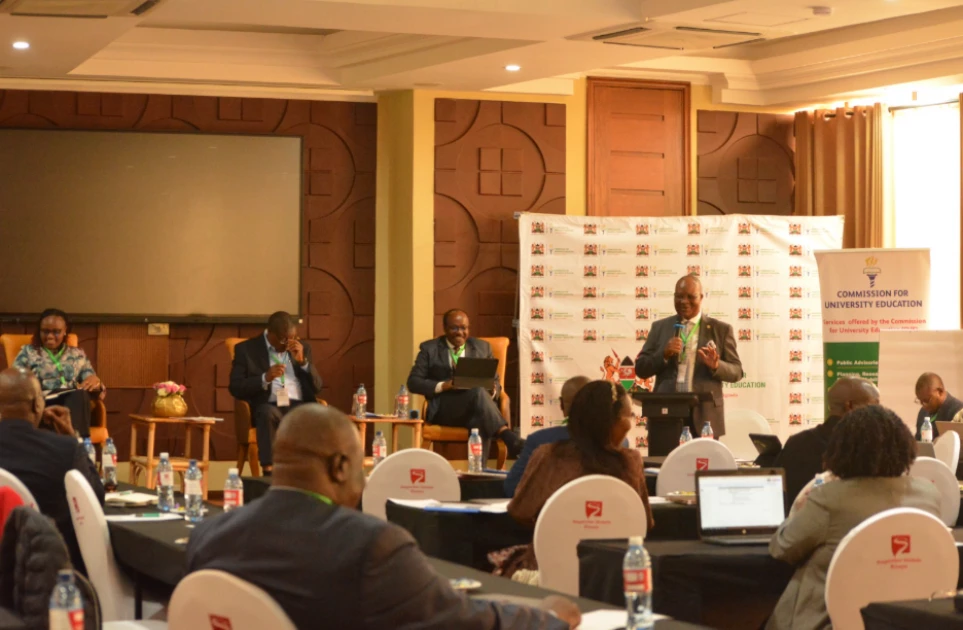
A stakeholders’ forum by the Commission for University Education (CUE) held in Naivasha on February 25, 2026.

Audio By Vocalize
Kenya’s
universities are racing against time to prepare for the 2029 admission of the
first cohort of the Competency-Based Education (CBE) graduates from senior
schools.
The
transition is however facing strong headwinds of financial challenges and
pressures that have nearly brought the institutions of higher learning to their
knees.
With
just four years remaining until the pioneer cohort of students shaped by
hands-on, skills-focused training joins institutions of higher learning,
universities now face a litmus test and a need to overhaul their curricula,
retool faculty, redesign their assessment criteria and invest in the requisite
infrastructure.
This
comes at a time when universities are already struggling to stay afloat. The
sector, still recovering from a crippling industrial strike, is facing a Ksh.223
billion funding crisis, with pending bills standing at Ksh.85.28 billion.
Many of
these institutions are struggling to pay salaries, remit statutory deductions
and clear supplier debts. For the 2026–27 financial year, Ksh.311.9 billion is
required for recurrent expenditure, yet only Ksh.155.2 billion is available.
The
Commission for University Education (CUE) is currently convening a stakeholders’
forum in Naivasha to bridge the gap between policy and reform, as well as chart
a way forward in preparation for the transition.
The
commission has begun rallying universities to align with reforms already
implemented in basic education.
CUE
Chief Executive Prof. Mike Kuria says the country must urgently confront
fundamental questions before the first cohort joins universities in three
years.
Prof.
Kuria has brought to question the universities’ preparedness to receive the
first cohort, emphasizing the need to address core issues urgently, among them:
What exactly defines CBE at the university level? How will it differ from the
traditional 8-4-4 system? What changes in pedagogy, content, and assessment are
required, and how will lecturers be re-tooled to teach it effectively?
"These
questions should be part and parcel of the discussions as we prepare for the
first cohort of learners in 2029," Prof. Kuria said, stressing that
universities must decide the depth of transformation and whether it touches
content, teaching methods, grading, and entry criteria.
CUE
Board Chairman Prof. James Onyango Awino described the shift as a historic
"fifth revolution" in education, requiring a fundamental move to
learner-centered approaches and practical applications.
"The
methodology must change to suit the CBE learners. Course material will change.
Assessment will change. Teaching methodology will change," he said, adding
that producing graduates capable of innovation such as "flying things into
space" demands massive resources that come at a high cost.
Stakeholders
warn that if funding gaps persist, universities could struggle to meet even
routine obligations, let alone fund the expensive upgrades needed for CBE like
new labs, innovation hubs, digital tools, and large-scale faculty training.
Darius
Ogutu, Director of Higher Education at the Ministry of Education, acknowledged
the heightened costs: "We have to bring on board the conversation of the
resources for the UCBE framework. It is going to be more costly than the
current cohort."
The
government plans to collaborate with partners like the World Bank and the
African Population and Health Research Centre for data-driven solutions.
Roberta
Malee Bassett, the World Bank's Global Lead for Tertiary Education, affirmed
international support, noting that CBE aims to equip youth with adaptable skills
for a changing workforce where some jobs may vanish in years.
"Reforms
are a means to an end, the end being youth with higher skills and ability to
adapt to the world’s changing dynamics," she said.
Admission
criteria could also evolve, moving beyond KCSE grades to incorporate
competencies, projects, and experiential learning. Kenya National Examinations
Council (KNEC) CEO Dr David Njengere called for rethinking the purpose of
university education.
As the
clock ticks toward 2029, stakeholders in the higher education sector grapple
with the question of whether universities will pass the CBE transition test
better than their counterparts in basic education did and whether all the gaps
will be bridged in time to receive the first cohort of CBE learners.
Join the Discussion
Share your perspective with the Citizen Digital community.
No comments yet
This discussion is waiting for your voice. Be the first to share your thoughts!