
Red Bull Basement winner to represent Kenya at global finals in the US
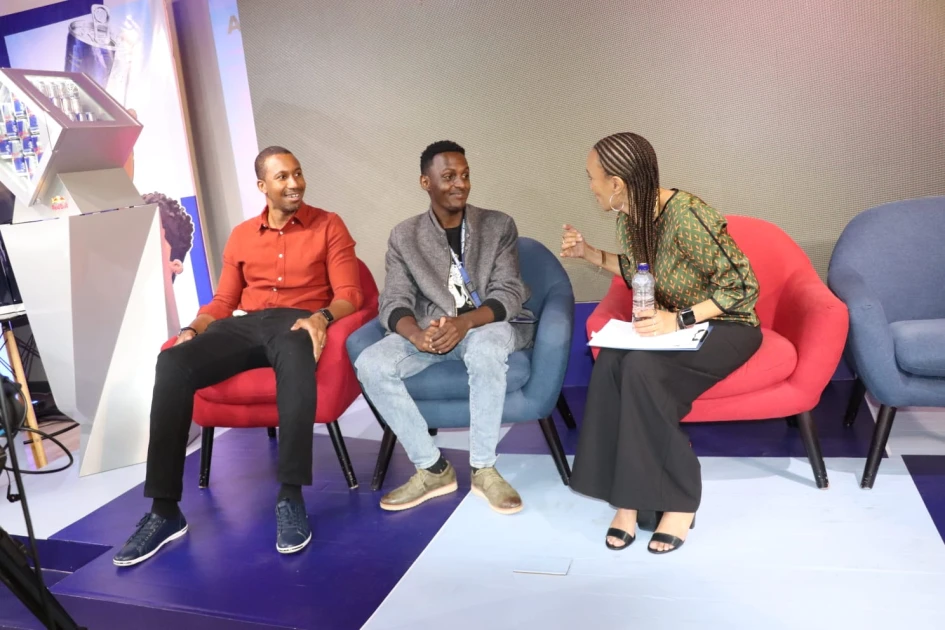
Winner of the Red Bull Basement Kenya National Finals Abdihamid Hassan (centre) gets advice from judges Bright Gameli (left) and Wandia Gichuru (right) at iHub, Nairobi on March 28, 2026. Photo/ Courtesy

Audio By Vocalize
Abdihamid Hassan, a 23-year-old graduate from Isiolo County, has been named the winner of the Red Bull Basement Kenya National Finals, securing a place at the global finals in San Francisco in June.
His rise from a pastoralist region long defined by climate vulnerability to a national innovation stage reflects a broader shift among young Kenyans who are turning to technology to confront deeply rooted economic and environmental challenges.
Hassan, the fifth-born in a family of seven, graduated in December 2024 from Jomo Kenyatta University of Agriculture and Technology with a degree in Community Development and Environment. His path mirrors that of a generation that has come of age alongside Kenya’s expanding tech infrastructure, yet remains closely tied to the lived realities of rural communities.
“I want to thank my fellow finalists because no idea was small. Let’s execute these ideas regardless of the outcome,” Hassan said. “I also want to thank the Red Bull Basement team for this amazing opportunity, and being able to showcase the solutions Kenyans want, especially in my homeland in Isiolo County.”
His winning idea, Arda Link AI, seeks to bring precision and predictability to Kenya’s pastoralist economy, which remains both vital and vulnerable.
The platform uses artificial intelligence to synthesize real-time satellite data in order to monitor livestock nutrition, track herding movements and forecast drought conditions and pasture availability. It is designed to function across local pastoralist dialects, a feature intended to extend digital access to communities often excluded from technological tools.
The stakes are high. Kenya’s pastoralist sector is valued at $1.1 billion and supplies roughly 90 percent of the meat consumed in the country, even as it faces mounting pressure from climate change and resource scarcity. By attempting to translate complex data into actionable insights for herders, Hassan’s model reflects a growing emphasis on locally grounded innovation rather than imported solutions.
The national finals, held on March 28 at iHUB Nairobi, drew more than 3,800 submissions from across the country, underscoring both the scale of interest and the competitive nature of Kenya’s startup pipeline.
Fifteen finalists were selected to present before a panel that included the AfricaHackon founder Dr. Bright Gameli, Kytabu founder Tonee Ndungu, Vivo Fashion chief executive Wandia Gichuru and Microsoft software engineer Fatma Ali.
Hassan’s proposal distinguished itself in a field that judges said was defined by both creativity and practicality.
“There were criteria we used to decide the winner. The first was idea feasibility and if it can work. The second was business impact and how it can grow. Then there was the founder profile,” said judge Ndungu. “The last one was concept uniqueness. It must be something that cannot be built anywhere else online.”
As the national winner, Hassan will enter a global pre-acceleration program in the United States, where he is expected to refine his concept into a minimum viable product. The program includes technical resources, funding support and mentorship aimed at transforming early-stage ideas into scalable ventures.
He will then represent Kenya at the Red Bull Basement World Final in Silicon Valley, competing against 44 innovators selected from a pool of 100,000 participants worldwide. The winner will receive $100,000 in funding, additional cloud credits and access to mentorship from Red Bull Ventures.
The Red Bull Basement initiative, launched in 2015 in São Paulo, Brazil, has expanded steadily, arriving in Africa in 2018 as part of a broader effort to support youth-led innovation in emerging markets.
“This year’s competition highlights the opportunities we have in Africa. Every African country in this competition has the chance to showcase to the world what Africa has to offer and how it can use its own innovation to solve its challenges,” said judge Gichuru.
For Kenya, such platforms have become an important bridge between raw ideas and investable ventures, particularly as the country positions itself as a regional technology hub. The convergence of local insight and global support is increasingly seen as essential in turning prototypes into products that can withstand both market pressures and environmental realities.
“I wouldn't want to see the 14 ideas die, I want to see them grow and, yes, I would invest in them,” said judge Gameli. “The ideas can be built and scaled.”
As the event drew to a close and conversations shifted from pitches to possibilities, Hassan’s win seemed to capture something larger than a single competition. It pointed to a generation that is not waiting for solutions to arrive from elsewhere, but is instead building them from the ground up, often in places that have long been overlooked.
For Hassan, the journey now stretches from Isiolo to Silicon Valley. For the others, it offers a different kind of momentum, one that suggests the real contest may lie not in winning, but in what comes next.
Join the Discussion
Share your perspective with the Citizen Digital community.
No comments yet
This discussion is waiting for your voice. Be the first to share your thoughts!