
Senators raise red flags over Nairobi cooperation deal, cite lack of public participation
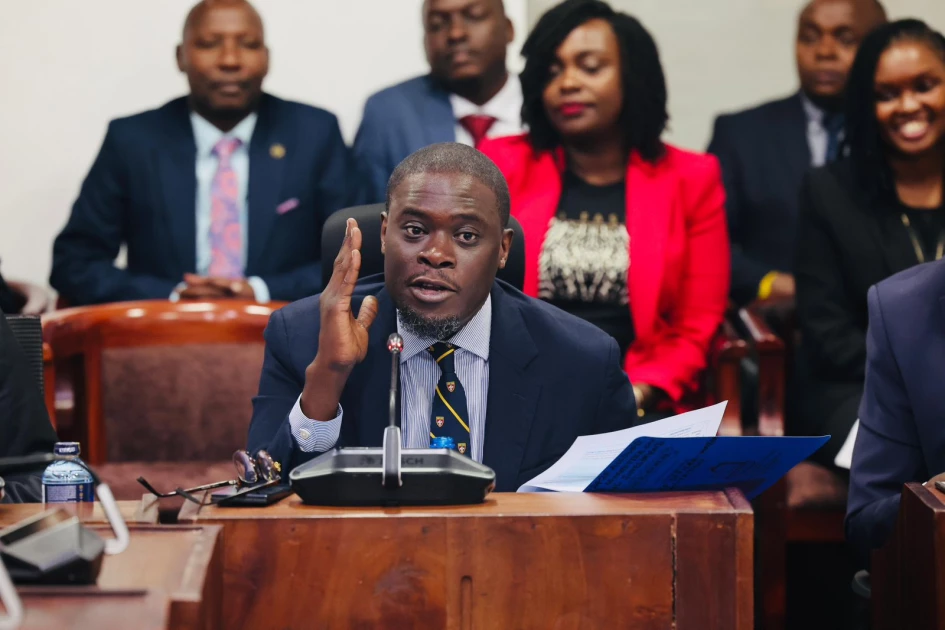
Nairobi Governor Johnson Sakaja before the Senate County Public Investments and Special Funds Committee.

Audio By Vocalize
Prime Cabinet Secretary Musalia Mudavadi, however, defended the agreement, maintaining that it is constitutionally grounded and designed to enhance service delivery in the capital by unlocking additional funding.
Mudavadi appeared before the Senate committee to clarify the legal framework and procedural steps underpinning the agreement, which was signed on February 17.
Lawmakers on the committee questioned the process leading to the deal, with some arguing that it mirrors the 2020 Nairobi Metropolitan Services (NMS) arrangement, which transferred key county functions to the national government.
Nominated Senator Catherine Mumma faulted the process, stating that public participation requirements were not adequately met.
“The public participation process was not properly followed. It was done post-facto,” she said.
Committee chairperson Mohammed Abass sought clarity on the role of county institutions under the agreement, particularly in relation to accountability and oversight.
“What is the role of the county in all these? In terms of accountability and implementation, what would be the role of the County Assembly?” he posed.
Kiambu Senator Karungo Thang’wa also raised concerns about the long-term implications of the arrangement, warning that it could create uncertainty depending on future administrations.
“We are creating a governor of all governors. We have 24 months to run this agreement. What if another president comes and says they do not want to continue with this?” he said.
Several senators argued that the agreement effectively transfers operational control of county functions to the national government without explicitly invoking Article 187 of the Constitution, which governs the transfer of functions between levels of government.
“This is a transfer of functions. What you are implementing is Article 187 without agreeing that you are implementing it. This is another NMS with a good name,” Thang’wa added.
They further warned that the arrangement risks sidelining the Nairobi Governor and Members of the County Assembly by leaving their roles unclear.
In response, Mudavadi dismissed the allegations, insisting that the Sh80 billion deal is anchored in Article 189 of the Constitution, which provides for cooperation between the two levels of government, as well as Section 6(5) of the Urban Areas and Cities Act.
“This is not a takeover. This is a cooperation agreement and not a transfer of functions. NMS was a transfer of functions. This is purely on coordination of functions,” he said.
Mudavadi added that the agreement outlines distinct roles for both levels of government, with the national government providing oversight through a joint steering committee, while implementation remains the responsibility of the county government.
“The joint steering committee that I chair is an oversight body. The governor has to do the work through the implementation committee. County assemblies must have oversight, and the County Assembly gave its approval,” he said.
Under the agreement, Nairobi County is set to receive an additional Sh80 billion in funding aimed at improving infrastructure and service delivery. Key projects include the installation of 50,000 street lighting points, expansion of last-mile connectivity in informal settlements, increased water supply by 50,000 cubic litres, construction of 54 kilometres of sewer lines, and improvements to roads and drainage systems.
The debate now places the spotlight on the balance between intergovernmental cooperation and the protection of devolved functions, as senators continue to scrutinize the agreement’s legal and operational framework.
Join the Discussion
Share your perspective with the Citizen Digital community.
No comments yet
This discussion is waiting for your voice. Be the first to share your thoughts!