

Study raises alarm over lack of early childhood interventions after extreme weather

Audio By Vocalize
A review of early childhood psychosocial interventions following extreme weather events in low- and middle-income countries, published by Sage Journals in October 2025, suggests that there are currently no adequate interventions targeting early childhood populations, despite them being among the most vulnerable to the effects of the climate crisis. The review calls for more research, policy attention, and urgent action to address the issue.
It is this gap that Dr. Moses Omondi Abiero is seeking to confront.
Dr. Abiero’s journey as an academic began on the shores of Lake Victoria in Kenya, where he dropped out of school in Class Four and became a fisherman. Today, he is an accomplished educationist holding a PhD and two master’s degrees. Through a grassroots Community-Based Organization (CBO) known as INSIDER, Abiero is working to change the life narrative in his community as an early childhood development and rural climate adaptation advocate.
His mission is simple but bold: to solve one of the most pressing yet often overlooked problems of climate change — its impact on young children.
A vast green cassava plantation spread across an acre of land welcomes visitors to Udimba Village in Maranda Division, Bondo Sub-county, Siaya County — an area often described as semi-arid and food insecure, despite its proximity to major water bodies such as Lake Victoria and the Yala River.
Dr. Abiero is racing against time with a solution-oriented vision focused on tackling the ECED hunger challenge, while also laying the foundation for a more food-secure future in Siaya County.
He believes that supporting young children cannot be a one-off intervention. Instead, it must be sustainable enough to carry them through their development and academic journey. That, he says, means addressing the challenge at the household level by directly involving caregivers, parents, and guardians.
“By improving those households, the children will be able to access better nutrition, education, health care services, and other basic needs,” Abiero emphasized.
Why Cassava?
So, how can cassava help improve household food security, child nutrition, and ultimately academic performance in the context of climate change?
Cassava thrives even in poor soils and can tolerate very high temperatures of up to 40 degrees Celsius, making it a preferred crop in drought-prone areas. While it is often celebrated for its drought resistance, cassava also shows remarkable resilience during flooding seasons. Its hardy and adaptable nature allows it to survive excessive moisture, making it a critical crop for food security in both drought and flood conditions.
Most families plant cassava mainly for its starchy roots, often unaware that its leaves are also edible and highly nutritious. Cassava leaves can be prepared as vegetables and are rich in vitamin C, iron, calcium, and plant-based protein.
The roots can be processed into porridge, ugali, and baking flour, providing additional nutritional value, including vitamin C and copper. Moreover, advances in biofortification are producing cassava varieties with higher levels of Vitamin A, iron, and zinc — nutrients that are essential in tackling malnutrition, especially among children.
Beyond nutrition, cassava products also offer income-generating opportunities, giving households additional money to spend on other needs.
In Siaya County, Dr. Abiero is determined to revive indigenous African climate-resilient food crops, starting with cassava, to improve both the wellbeing of children and their academic outcomes.
“So far in Bondo, we have reached 400 caregivers through training, and it is already beginning to bear fruit, with a number of our trainees returning to cassava farming,” he said.
“We also support them with agri-poultry enterprise knowledge to promote a complete circular economy approach.”
“In addition, we promote the use of Suma-Grow, a natural eco-friendly microbial product designed to improve agricultural productivity and soil fertility. Kitchen garden setups also complete our training cycle to ensure caregivers have enough food throughout the year, so children do not go hungry and can remain strong and focused in school.”
Slow Uptake Despite High Interest
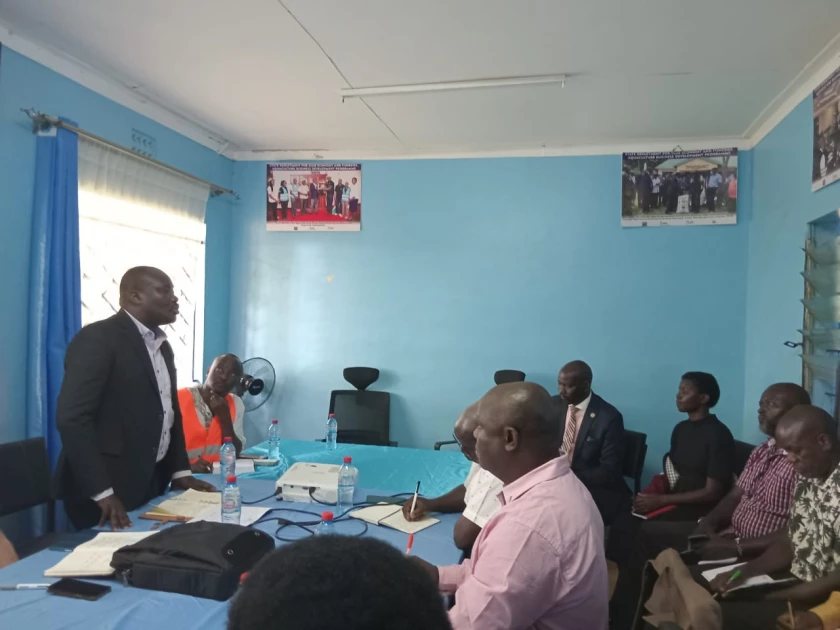
Charles Okaka Opau, the manager of the Udimba cassava farm, says local administrators and religious leaders have played a key role in mobilizing community members to attend the trainings. However, he notes that while many people show up for the learning sessions, only a few go on to apply the knowledge in practice.
“We started the free training programme on cassava growing combined with agri-poultry in April 2025. We have trained many people, both men and women. However, our monitoring and evaluation records show that only 20 people have so far put the knowledge into practice,” Okaka said.
He says feedback from trainees shows that some lack land for farming, though they have adopted poultry keeping and cassava consumption in their homes. Others, he notes, are discouraged by the long maturity period of cassava.
Cassava typically takes 9 to 12 months to mature for food, but it can remain underground for up to three years. Many small-scale farmers prefer to leave it in the soil longer, effectively using it as living storage or a famine reserve.
According to Okaka, some community members who fail to attend the training sessions cite the burden of dropping off and picking up their children from school, often over long distances to ECED centres.
A New ECED Centre to Bridge the Gap
To address this challenge, Dr. Abiero says INSIDER plans to establish an ECED centre near the demonstration farm and training facility.
The idea is to allow parents and guardians to bring their children for learning while they simultaneously attend training sessions.
One of the programme’s beneficiaries is Jacinta Okello, a resident of East Miguena in Bondo Sub-county and both an ECED and primary school teacher at Oiko Comprehensive School, located within Bondo Municipality.
Jacinta says the cassava and agri-poultry training has transformed her outlook and opened her eyes to practical solutions for food security.
“Where I live, ugali is our staple food. However, maize, which is used to make ugali flour, does not do well here,” she said.
“I am grateful to have been introduced to cassava farming. I planted cassava on a quarter-acre of land mainly for food. I also began rearing chickens. I started with three, and they grew to fifteen.”
Her voice trembles as she recounts a painful setback.
“Unfortunately, one day when no one was home, they were all stolen because my homestead is not fenced. I plan to fence it once I have the money. However, I have not given up on poultry keeping — I am working hard to start again.”
At school, Jacinta says support from well-wishers has helped provide a blended cassava flour, which is used to prepare porridge for learners.
“At school, we do not have enough space to grow cassava, but with support from well-wishers, we receive blended cassava flour that we use to prepare porridge for the children,” she explained.
“We prefer this mixture because a small amount makes a large quantity of porridge. It is also nutritious and beneficial for child development. I am a mother of three, and we are all fond of cassava.”
The Bigger Picture for Africa
According to Dr. Akinwumi Adesina, the Nigerian agricultural economist and President of the African Development Bank (AfDB), the future of global food security will increasingly depend on what Africa does with agriculture.
He argues that the continent must change its mindset and stop viewing agriculture merely as a development or social sector.
“We must not use agriculture to manage poverty; we must use agriculture to create wealth,” he said.
“By 2030, the size of the food and agribusiness market in Africa will reach USD 1 trillion, so if you are thinking about where to make money, that is the sector to be in.”
Africa is home to a wide range of indigenous climate-resilient food crops, many of which have steadily lost prominence due to the spread of westernised agribusiness models. In countries such as Kenya, this shift has pushed traditional crops like cassava to the margins.
But in Bondo, one man is betting that bringing cassava back to the centre of household farming could do more than just feed families.
It could help children stay nourished, remain in school, and perform better academically — even in the face of a worsening climate crisis.
Leave a Comment