
The first true millipede has been discovered in Australia. It has the most legs of any living animal
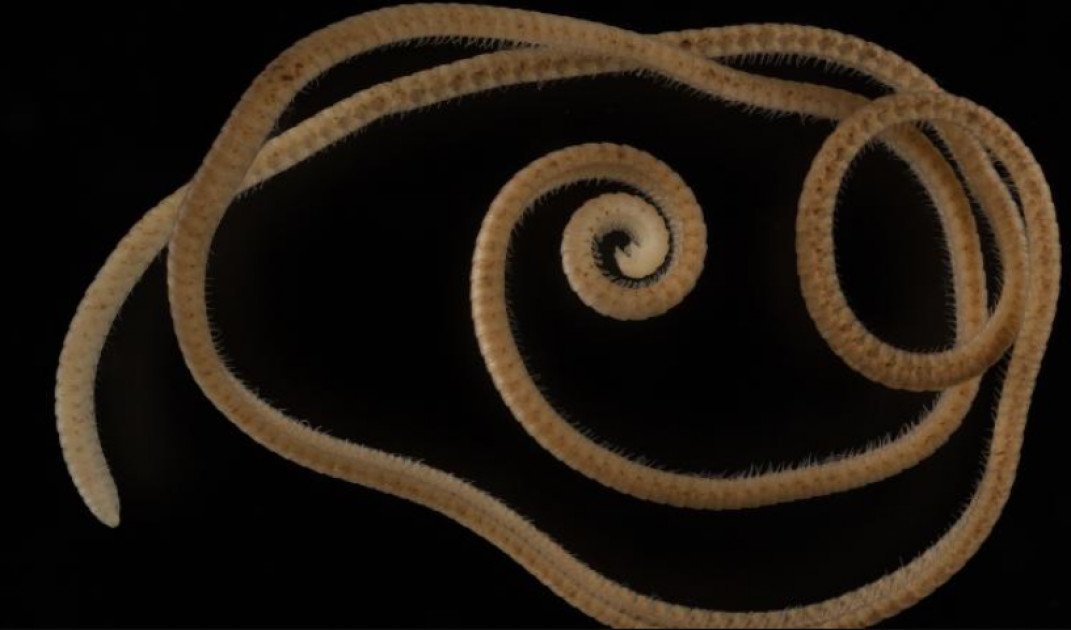
The first true millipede, with more than 1,000 legs, has been discovered in Australia.

Audio By Vocalize
Millipedes
have lots of legs. It's defining feature of this creature, which is neither
worm nor insect.
However,
despite a name derived from the Latin for thousand (mille) and feet (pes), no
millipede has been found with more than 750 legs -- until now.
Scientists
have discovered the first millipede that has more than 1,000 legs -- 1,306 to
be precise -- and the most legs of any living creature on Earth. It was found
living 60 meters (200 feet) below ground in a drill hole created for mineral
exploration in Western Australia.
The
eyeless invertebrate -- it's 3.7 inches (9.5 centimeters) long and 0.04 inch (1
millimeter) wide -- has 330 body segments, antennae, a beak for feeding and a
cone-shaped head.
"It's
as if you pulled a 3-inch white thread from a shirt (but it had 1,306
legs)," said Paul Marek, an associate professor at the department of
entomology at Virginia Tech via email.
How
do you count the legs of such a tiny creature?
To
make sure no limbs were missed or counted twice, Marek said he color-coded each
10-leg segment using a high-resolution image of the uncurled millipede in Adobe
Illustrator.
"I
counted three times, and it took about 1 hour," said Marek, the author of
the study that published in the journal Scientific Reports on Thursday.
It's
possible that Eumillipes persephone, as the millipede is officially named, is
distantly related to the previous record holder for the greatest number of
legs, according to an analysis of the taxonomic relationships between millipede
species. The Californian millipede species, Illacme plenipes, has up to 750
legs.
Navigating
an underground habitat
The
large number of segments and legs that have evolved in both species may allow
them to generate pushing forces that enable them to move through narrow
openings in the soil in which they live, the authors suggested.
While
the surface temperatures in Eastern Goldfields Province, where the millipede
was found, are sometimes higher than 114.8 degrees Fahrenheit (46 degrees
Celsius), the groundwater sites where the millipede was collected never exceed
71.6 degrees Fahrenheit (22 degrees Celsius).
The
authors, from Australia and the United States, noted that other unknown
invertebrates had been discovered beneath the Earth's surface in recent years
-- including beetles and millipedes in Brazilian iron ore caves and spiders in
the caves of the Edwards Plateau in Texas.
"These
underground habitats, and their inhabitants, are critically understudied,
despite their ecological importance in filtration of groundwater and screening
of environmental toxins," the authors said in the study.
The
researchers recommended minimizing the impact of mining in this region to
conserve the underground habitat.
Join the Discussion
Share your perspective with the Citizen Digital community.
No comments yet
This discussion is waiting for your voice. Be the first to share your thoughts!