

Where are they now: Former KCSE stars speak
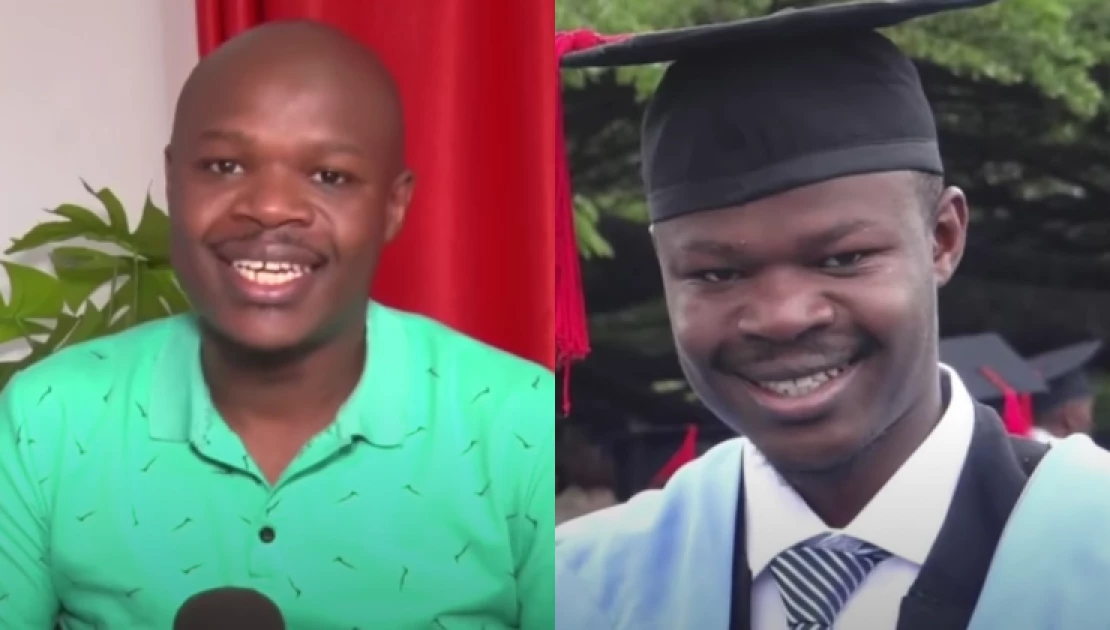
A side-by-side image Dickens Omanga(left) and Job Nalianya. PHOTO| COURTESY

Audio By Vocalize
Fourteen years ago, Dickens Omanga of Friends School Kamusinga, was the top student in the country whilst in 2011, five years later, Job Nalianya of St Peter's Seminary topped the KCSE list nationally. But where are these top students in 2021 and was the future handed to them on a silver platter because of their outstanding grades?
The year is 2006, Mwai Kibaki has ruled the country for four years so far during his first term and his education minister is the late professor George Saitoti. The top student in KCSE that year is Omanga of Friends School Kamusinga in Bungoma County. We track him down 14 years later to Eldoret, Uasin Gishu where he is now a medical doctor.
He shows us newspaper clippings from March 2006 when the whole country heard his name announced on national TV. Life changed after that for him, an experience which he recalls was both exhilarating yet challenging at the same time.
“I happened to top the country. It was a surprise. I did not expect to do the best because I knew that I would I was prepared. I remember visiting big hotels, and meeting important people. But it was also a challenge. People expected that I would go to Harvard and Yale, Ivy league. People expected me to be everything. Everyone wanted me to be a doctor, computer scientist. It comes with a bit of pressure,” he said.
The accomplishment of being the top student in the country even motivated him to tell a local journalist that he would one day be the president of the country, an ambition he no longer holds because he believes impact is possible beyond the political arena.
In 2007 dickens got a job working for a regional bank for two years and then he joined the University of Nairobi to pursue medicine successfully graduating in 2013. He has spent the last four years pursuing his master's and will soon graduate to become a consultant orthopaedic surgeon. Having recently watched a new crop of students make national headlines he has relevant advice for them.
“Don’t celebrate forever. Make good decisions. Don’t bow to a lot of pressure. Don’t be forced by your parents. Go for what you know you will do the best in. Being book-smart is not enough. You need to be aware of what is happening in this country,” he said.
In his free time, Dickens aided by his wife Mercyline indulges in creating motivational YouTube videos which he shoots and edits in his home studio. Part of the advice he gives in those videos could be applicable to a majority of KCSE students who got grades C, D and E
“The world is not only for the A students or for those at the top of the rankings. Just find out where your unique abilities lie,” he said.
The 31-year-old says he understands why the global narrative that ‘A’ students could eventually end up working for ‘C’ students is so popular.
“Getting an A itself doesn’t guarantee you success in life. A lot of A students get into school and books and read without thinking about business etc. That is where A students end up working for C students. I wish in medical school they taught some entrepreneurship,” he said.
Five years later in 2011, the top student in the country was Job Nalianya of St Peters Seminary in Kakamega County. The soft-spoken young man was hoping for a straight A but had no idea that he would be the top student in the country.
Two years later Job was accepted to the prestigious Stanford University in the US where he completed his degree in Electrical Engineering in 2017 and a masters thereafter at the same institution. He attributes his success to discipline and hard work.
“When the results came out, I was in my house, I wasn’t actually following the results as they were being announced. My friend called me and I thought he was joking. Before I knew there was a crowd of people in our compound, pretty much the entire neighbourhood went crazy,” he said.
The 27-year-old now works for Texas instruments, an American technology company.
“It’s a semiconductor company and we build chips that go into everyday use electronic devices. I work as an IC designer and design the circuits that go into the chips,” he explained.
He confesses that his education journey at Stanford was not easy despite being a top student in Kenya all his life including being index 1 in his primary school in Bungoma.
“I come to the US and pretty much every smart person from the world is also at Stanford. First, there is pressure to do really well and the game has changed. It can be very overwhelming,” he said.
He believes success depends a lot on the aspirations of an individual and not a standard set by society.
“When you think about success it is very subjective. I could be getting an A but if get a job with a boss who got a C but I enjoy what I do then there is no problem. Getting an A opens doors for you but you still have to work hard, there is no other way,” he said.
A researcher at Boston university traced 81 top students from high school graduation onwards to see what became of their lives and even though they excelled in university and generally did well in their professional careers nevertheless she observed that an A grade did not guarantee their entry into the upper echelons of society revealing that many other factors come into play where success is concerned. Prof. Bitange Ndemo of the University of Nairobi reckons that students are gifted with the ability to quickly grasp concepts ahead of their contemporaries.
“They have the unique advantage of being able to quickly understand the content and thus are miles ahead of their colleagues,” he said.
But he reckons that those who fail in local or national exams are not an indication of an intelligence deficiency but rather an indictment of an education system that assumes that all or equal when the reality is very different.
“I remember when I failed my English paper. It haunted me for life. I am grateful that we are moving to an A.I.-centred learning environment where each student can learn at their own pace,” he said.
Experts believe the future of learning will be in interactive & highly individualised learning where the curriculum aligns with the strengths of individual students and each student can learn at their own pace. it is possible that degree courses could be shorter, employees could emphasise more on skills than degrees and teachers could become more coaches.
EDITOR'S NOTE: THIS INTERVIEW WAS CONDUCTED IN 2021, SOME OF THE FACTS MIGHT HAVE CHANGED.
Leave a Comment