
USAID officially shuts down after 64 years, sparking global humanitarian crisis
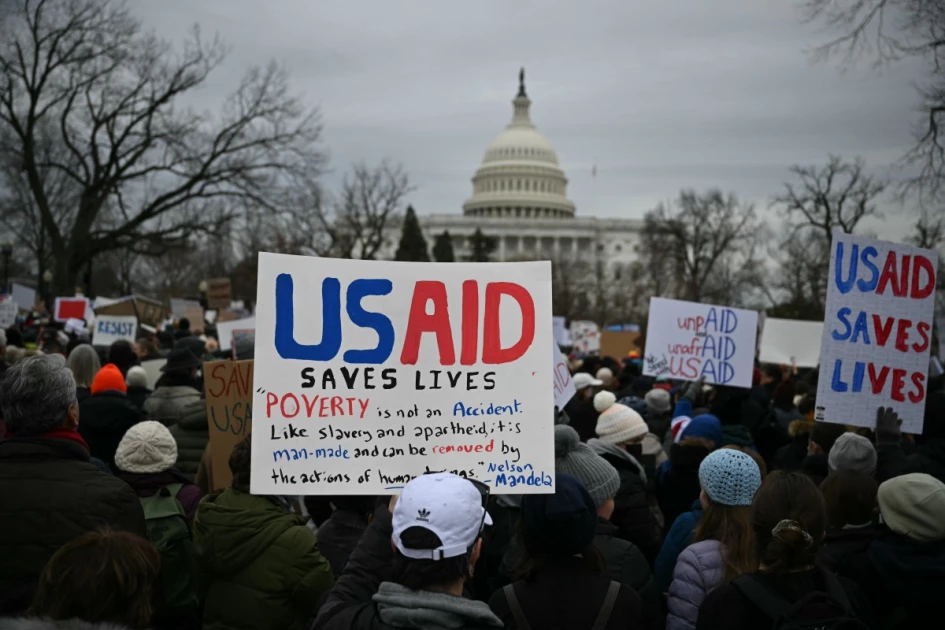
People protest against US President Donald Trump plan to shutdown USAID outside the US Capitol on February 5, 2025. (Photo by Drew ANGERER / AFP)

Audio By Vocalize
Millions of people around the world are projected to lose
their lives following the permanent withdrawal of American funding for aid.
After a 64-year run, the United States' foreign assistance
administered through the United States Agency for
International Development (USAID) has come to an end — permanently.
The Secretary of State, Marco Rubio, in pulling the plug on
USAID, stated that instead, foreign assistance that aligns with the Trump
administration and advances American interests will be administered by the
State Department.
The agency provided aid to poor and third-world countries
around the world, with missions primarily concentrated in Africa and Asia.
In most locations, USAID focused on the provision of food and
free vaccinations against diseases such as HIV, which is particularly prevalent
in countries in Sub-Saharan Africa.
Families and refugees in the region have come to rely on this
aid, and the withdrawal will hit Sub-Saharan Africa hard as a region.
Indeed, the permanent cessation of humanitarian aid through
USAID is projected to have a morbid impact across the globe.
A report published in The Lancet projects that this will
result in the deaths of 14 million people worldwide. The report shows that the
withdrawal of humanitarian aid will adversely affect the health sector,
especially HIV and AIDS management and prevention, as well as malaria.
In total, 14 million deaths are projected between now and 2030
— of these, 4.5 million will be children under the age of five.
The report further states that through USAID, 91 million
deaths have been prevented, especially those that would have been caused by
HIV/AIDS, malaria, and neglected tropical diseases.
Kenya is among the countries already reeling from the impact
of the stoppage of this humanitarian aid, with programmes like healthcare,
agriculture, and community initiatives left with funding gaps that have also
led to job losses.
Rubio has justified this move, stating that while America has
funded humanitarian assistance, the recipients have not reciprocated in kind.
He says countries in Sub-Saharan Africa, despite receiving 165 billion dollars
in aid, did not fully support US interests at the United Nations.
Meanwhile, countries in the Middle East and North Africa,
despite receiving 89 billion dollars in aid, tend to favour China over the USA.
The US has also accused NGOs of misusing the funds, at the
expense of the American taxpayer.
Join the Discussion
Share your perspective with the Citizen Digital community.
No comments yet
This discussion is waiting for your voice. Be the first to share your thoughts!