

Vanishing wetlands put $39 trillion in global benefits at risk, new report warns
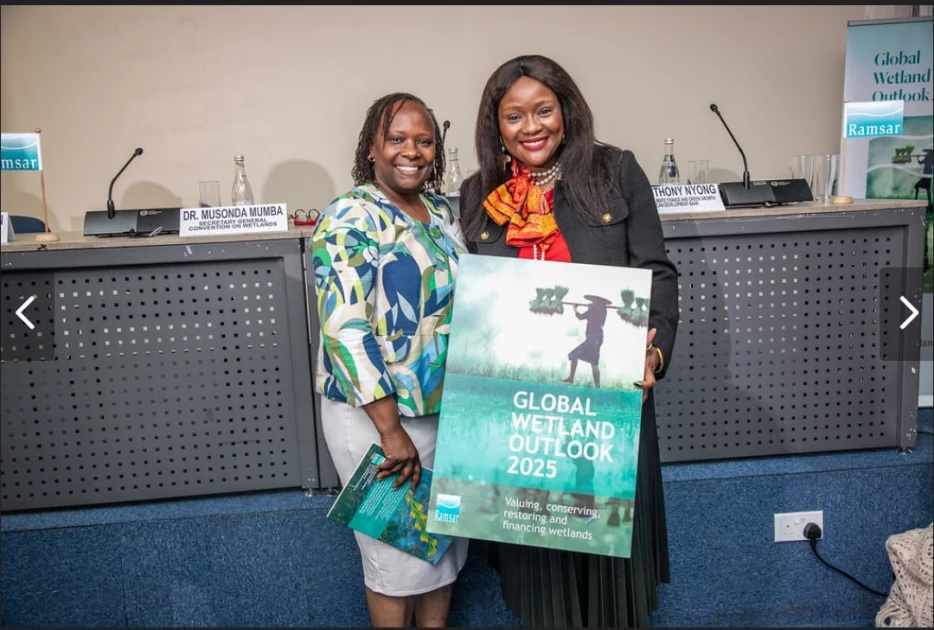
Dr. Musonda Mumba, Secretary General of the Convention on Wetlands(R) and Dr. Julie Mulonga, Director Wetlands International Eastern Africa(L).

Audio By Vocalize
Wetlands are disappearing faster than any other ecosystem on Earth, threatening biodiversity, livelihoods, and critical ecosystem services valued at over $39 trillion, according to a new report launched in Nairobi.
The Global Wetland Outlook 2025: Valuing, Conserving, Restoring and Financing Wetlands (GWO 2025), unveiled on Tuesday, paints a stark picture of global wetland loss.
The report
reveals that 22% of the world’s wetlands have vanished since 1970—equivalent to
more than half a billion football fields. If urgent action isn’t taken, another
20% could disappear by 2050, triggering massive ecological, economic, and
social losses.
Wetlands refer broadly to areas where water saturates the soil or dominates plant life. These include lakes, rivers, swamps, coastal seas, and estuaries. Wetlands are home to rich ecosystems such as mangrove forests, seagrass beds, and saltmarshes.
Despite covering just 6% of the Earth’s surface, wetlands contribute over 7.5%
of global GDP through services like clean water, food production, flood
protection, shoreline stabilization, and carbon storage. However, wetlands face
mounting threats from climate change, pollution, and human development,
prompting renewed calls for conservation and restoration.
The report,
based on the latest scientific and economic data, warns that one in four of the
world’s remaining wetlands is in poor ecological condition, with the steepest
recent declines observed in Latin America, the Caribbean, and Africa.
“Wetlands
bankroll the planet, yet we are still investing more in their destruction than
in their recovery,” said Dr. Musonda Mumba, Secretary General of the Convention
on Wetlands. “The world is sitting on a $10 trillion opportunity. Restoring
wetlands could unlock these benefits, but we’re running out of time.”
The GWO 2025
outlines the extent of global wetland loss, the cost to societies, and the
actions needed to reverse the trend. It also provides financing solutions to
support countries in meeting international environmental goals.
“Wetlands are
not a marginal issue—they’re fundamental to the water cycle, vital for climate
resilience, and essential for the well-being of billions,” said Dr. Hugh
Robertson, Chair of the Scientific and Technical Review Panel and lead author
of the report. “We have the tools and the knowledge to act. What’s missing is
sustained investment and coordinated global action.”
Without
decisive intervention, the report estimates the loss of wetlands could cost the
world up to USD 39 trillion in benefits, affecting people, economies, and
nature. These losses directly undermine efforts to combat climate change,
biodiversity loss, and sustainable development.
Reacting to the findings, Julie Mulonga, Director of Wetlands International Eastern Africa, warned that wetland degradation is already having visible impacts across Africa. “Our rivers are drying up, our lakes are polluted, and our coastal wetlands are disappearing.
Communities are feeling the effects through water
shortages, declining farm and fishery yields, and increasing vulnerability to
floods and sea-level rise,” said Mulonga. Despite the grim outlook, she
expressed hope that growing awareness and local restoration efforts could help
turn the tide.
In Eastern Africa, communities are pioneering restoration initiatives. In Ethiopia, over 3,300 hectares of wetlands have been revived using nature-based solutions. In Kenya, youth-led groups have restored 100,000 mangrove trees, supporting eco-enterprises like crab farming, beekeeping, and climate-smart agriculture.
In Uganda and Tanzania, peatland and mangrove restoration projects in Sango
Bay–Minziro and the Rufiji Delta are helping protect vital carbon sinks and
build climate resilience.
The Global Wetlands Outlook 2025
is expected to galvanize action among the 172 countries gathering later this
month at the Convention on Wetlands COP15 in Zimbabwe. Delegates are urged to
seize the moment to scale up national and international efforts to conserve and
restore wetlands, aligning their actions with global climate, biodiversity, and
sustainable development goals.
Leave a Comment