

What is Hezbollah, the Iranian-backed group that could go to all-out war against Israel?
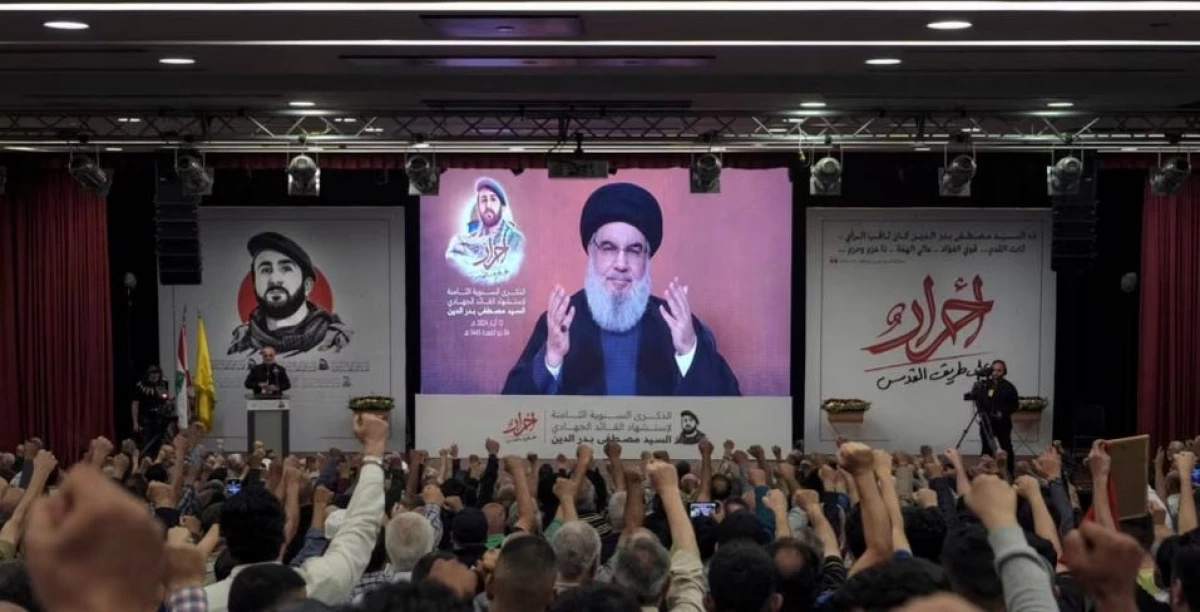
FILE - Supporters of the Iranian-backed Hezbollah group listen to a speech by Hezbollah leader Sayyed Hassan Nasrallah speaking via a video link, in the southern suburbs of Beirut, May 14, 2024.

Audio By Vocalize
After more than eight months of low-scale conflict, Israel and the Lebanese
militant group Hezbollah are threatening all-out war.
The United States and the international community are
lobbying for calm and hopeful for a diplomatic solution. They have not been
successful so far and time for a political settlement could be expiring.
Should war break out, Israel would face a much more
formidable foe in Lebanon than it faced in Hamas in the Gaza Strip.
Hezbollah leader Hassan Nasrallah warned Israel last week
that his group has new weapons and capabilities, and it has published surveillance
drone footage taken deep inside northern Israel that showed the port of Haifa
and other sites far from the Lebanon-Israel border.
A look at how Hezbollah became what many call the strongest
non-state force in the region.
Founded in 1982 during Lebanon's civil war, Hezbollah's
initial objective was ending Israel's occupation of southern Lebanon. It
achieved that in 2000.
Shiite Muslim Hezbollah is part of a collection of Iranian-backed factions and governments known as the Axis of Resistance.
It was the first group that Iran backed and used as a way
to export its brand of political Islamism.
In its early days the group attacked U.S. targets, causing
Washington to designate it a terrorist organization.
"Iran's support has helped Hezbollah consolidate its
position as Lebanon's most powerful political actor as well as the
most-equipped military actor supported by Iran in the whole of the Middle
East," said Lina Khatib, the director of the SOAS Middle East Institute in
London.
Hezbollah fighters ambushed an Israeli patrol in 2006 and
took two Israeli soldiers hostage. Hezbollah and Israel fought a month-long war
that ended in a draw but Israeli bombardment wreaked widespread destruction in
southern Lebanon.
Israel's objective was eliminating Hezbollah but the Lebanese
group came out stronger and became a key military and political power on
Israel's northern border.
Domestic opponents have criticized Hezbollah for maintaining its arsenal and for coming to dominate the government.
Hezbollah's reputation also suffered when it briefly
seized a section of Beirut in May 2008 after the Lebanese government took
measures against its private telecommunications network.
Hezbollah's military capabilities have also surged, and it
has played a key role in the Syrian civil war, keeping President Bashar
al-Assad in power. And it has helped train Iran-backed militias in Syria and
Iraq, as well as Yemen's Houthi rebels.
Throughout its latest conflict with Israel, Hezbollah has
gradually introduced new weapons to its arsenal, especially after Israel began
its ground invasion of the southern city of Rafah in Gaza in early May.
While Hezbollah initially began launching Cornet anti-tank missiles and salvos of Katyusha rockets, it later started using rockets with heavy warheads, and eventually introduced explosive drones and surface-to-air missiles for the first time.
Nasrallah said the drones are locally manufactured, with
many at their disposal.
The group notably released the two videos of footage from
drones over Haifa and other sites in northern Israel, showing critical civilian
and military infrastructure in a move intended to showcase new access and
capabilities and deter Israeli attack.
In a televised address last week, Nasrallah said that the
group will continue resorting to this tactic.
"We now have new weapons. But I won't say what they
are," he said. "When the decision is made, they will be seen on the
front lines."
How does Hezbollah compare to other Iranian-backed
groups?
Hezbollah is the Arab world's most significant paramilitary
force with a robust internal structure as well as a sizeable arsenal. Israel
sees it as its most direct threat, and estimates that it has an arsenal of 150,000
rockets and missiles, including precision-guided missiles.
In recent years, Hezbollah sent forces to Syria to help
fellow Iranian ally President Bashar Assad against armed opposition groups. It
also supported the growth of Iranian-backed militias in Iraq, Yemen and Syria.
Khatib of the SOAS Middle East Institute in London likened
Hezbollah to a "big brother" of fledgling Iranian-backed groups that
"do not enjoy the same level of infrastructure or discipline."
Hezbollah is bound to Iran by doctrine. However, its
relationship with Hamas, an offshoot of the Sunni Muslim Brotherhood movement,
is based on pragmatism.
In recent years, some Hamas officials, including its former second-in-command, Saleh al-Arouri, have since moved to Lebanon, where they have Hezbollah's protection and a presence across Lebanon's multiple Palestinian refugee camps.
Arouri was killed in an Israeli drone strike in a
southern Beirut suburb in January.
Born in 1960 into a poor Shiite family in the Beirut suburb
of Bourj Hammoud and later displaced to south Lebanon, Nasrallah studied
theology and joined the Amal movement, a Shiite political and paramilitary
organization, before becoming one of Hezbollah's founders.
He became Hezbollah's leader in 1992 after his predecessor
was killed in an Israeli strike.
Idolized by many for presiding over Israel's withdrawal from the south and leading the 2006 war, his image appears on billboards and on gadgets in souvenir shops in Lebanon, Syria and other countries across the Arab world.
But he also faces opposition among Lebanese who accuse
him of tying their country's fate to Iran.
Nasrallah is also considered to be pragmatic, able to make
political compromises.
He has lived in hiding for years, fearing Israeli assassination, and delivers his speeches from undisclosed locations.
Leave a Comment