
What’s in a name? Why Pope Leo XIV’s choice matters for the Catholic church
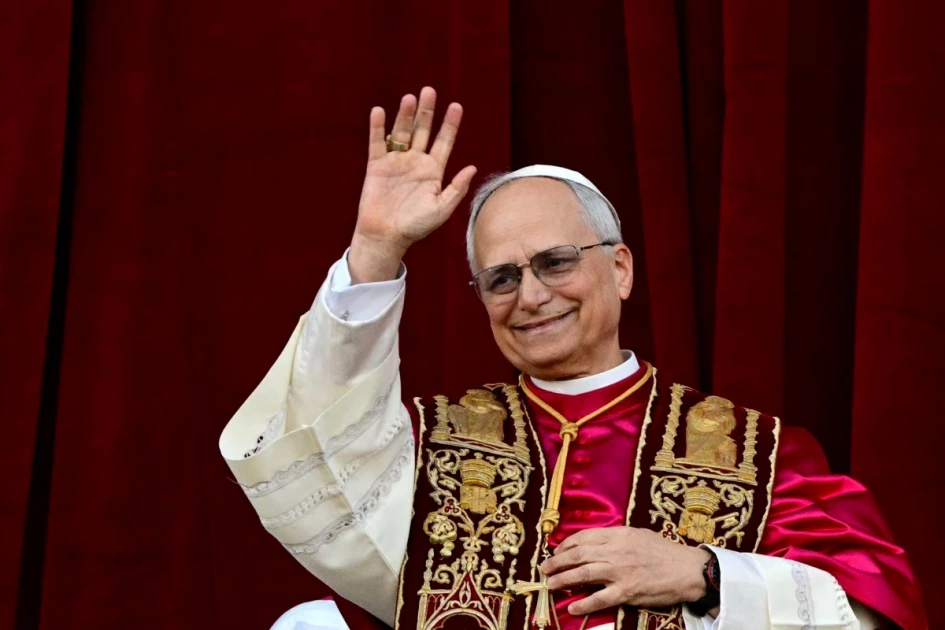
Newly elected Pope Leo XIV, Robert Prevost addresses the crowd from the main central loggia balcony of the St Peter's Basilica for the first time, after the cardinals ended the conclave, in The Vatican, on May 8, 2025. Robert Francis Prevost was on Thursday elected the first pope from the United States, the Vatican announced. A moderate who was close to Pope Francis and spent years as a missionary in Peru, he becomes the Catholic Church's 267th pontiff, taking the papal name Leo XIV. (Photo by Tiziana FABI / AFP)

Audio By Vocalize
On Thursday, 8th May, 2025, a white smoke poured from the chimney on the roof of the Sistine Chapel at 6:07 p.m. Rome time and later, French Cardinal Dominique Mamberti, protodeacon of the College of Cardinals, appeared on the central balcony of St. Peter's Basilica at 7:12 p.m. He told the crowd: "I announce to you a great joy.
We have a pope ('Habemus
papam'),". Ten minutes later, the new Pope Leo came out onto the
balcony, smiling and waving to the crowd wearing the white papal cassock, a
red mozzetta or cape and a red stole to give his first public blessing
"urbi et orbi" (to the city and the world). American Cardinal
Robert Prevost has been elected the 267th pontiff by 133 cardinal electors. He
chose the name Leo XIV.
While Roman Pontiffs aren't obliged to change their name, every pontiff for the past 470 years has done so, usually choosing the name of a predecessor to both honor them and signal their intention to emulate his example.
Pope
Francis was a notable exception, choosing not the name of a former pope but
that of St. Francis of Assisi, the 13th century cleric and patron saint of
animals and the environment.
Leo is the fifth-most-popular name chosen by Popes and Cardinal Robert Provost’s choice is in direct reference to Leo XIII who headed the Catholic Church from 1878 until his death in 1903 and was hailed as founding figure of the Catholic social justice tradition.
Pope Leo XIII maintained an ecclesial bridge between orthodoxy and modernity by repositioning the Catholic Church in a rapidly changing world, laying intellectual and moral foundations that continue to shape Catholic thought and social policy today.
He laid the foundations of Catholic Social teachings, at a time when excesses of industrial revolution confronted the world by condemning both unrestrained capitalism and socialism, and supported the rights of workers to form labour unions, receive just wages, and own private property. \
He succeeded in reconciling
the Church with elements of modern culture, science, and philosophy rather than
reject them outright and to this extent, promoted the philosophy of St Thomas
Aquinas as a way of engaging with contemporary intellectual currents and
thoughts. In this way, he revived Catholic intellectual life focusing on
education, critical thinking, biblical studies and historical research and
opened the Vatican Archives for scholars.
His first appearance to the world as Pope, the new Pontiff appeared to
be far more ‘traditional and liturgically orthodox’ than his predecessor.
Speaking of his vestments, he was wearing traditional papal vestments: a red
mozzetta and a stole over a white rochet and a new white cassock, restoring a
tradition missed since 2013 when Pope Francis chose to appear in a white cassock
with nothing over it. Secondly, the blessing he gave the crowd from St. Peter’s
Basilica was in Latin, using a formula that had not been used since Pope Pius
XII in 1939.
In his mass to with the cardinals, Pope Leo XIV arrived at the Sistine
Chapel with a golden ferula, or pastoral staff, made for Pope Benedict XVI in
2009 and seldom used by Pope Francis. And when his official portrait
and signature was published, his signature bears the traditional “P.P.” — Pontifex
Pontificum — a mark of continuity with centuries of papal tradition,
quietly absent under Pope Francis.
By choosing the name Leo XIV, this new Pope is situating his Petrine
Ministry at a similarly critical juncture in history, when post-modernism and
digital technological advancements threaten our humanity, global world order
and civilization. The choice of the name “Leo” evokes not only Pope Leo XIII,
but also Leo the Great who, in the 5th century, was a defender of the sacred
deposit of faith and perennial magisterium the Church. The choice of this name is ‘prophetic’ and suggests ‘a desire
for doctrinal firmness combined with pastoral care in a post-modern era’.
The new Pope inherits as a Church that is constantly seeking ways to
incarnate Sacred Scripture and Sacred Tradition within the joy, pain, anguish
and errors of our times. However, it should be emphasized that her (church’s)
solemn duty which is at once both 'prophetic and eschatological', is to
faithfully transmit the sacred deposit of faith and not "change" it.
Indeed, as Pope Leo XIII reminds us “It is an error to believe that the Church
should conform to the spirit of the age. Rather, she must transform the age
with the Spirit of Christ.” The truths of faith are not like a computer
software to be ‘updated’. The Pope will have to lead the faithful as good
shepherd. May the Church under Pope Leo XIV rediscover the strength of her
(apostolic) foundations, the beauty of her moral clarity, and the radiance of
her unchanging truth.
We pray that the flame of Augustinian wisdom and Thomistic
intellectualism will burn brightly in this new pontificate—and lead us closer
to the Heart of Christ, through the love of His Bride, the Holy Catholic
Church.
The writer is a PhD Candidate, Department of Earth & Climate Sciences
of the University of Nairobi
Join the Discussion
Share your perspective with the Citizen Digital community.
No comments yet
This discussion is waiting for your voice. Be the first to share your thoughts!