

China's economy records slowest growth since the start of 2020
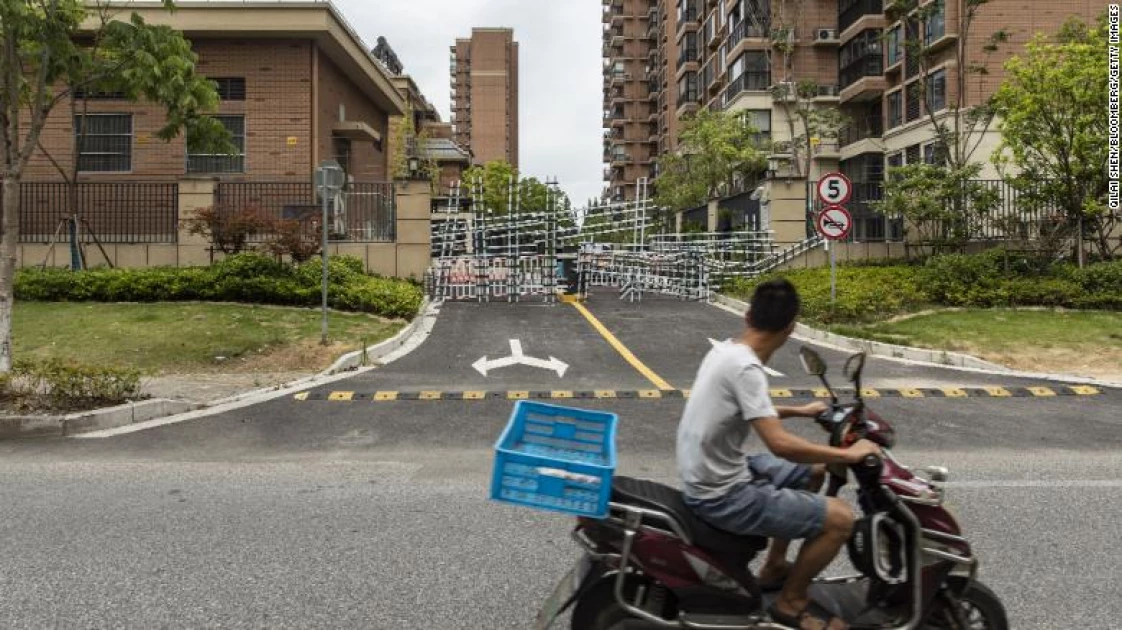
Barricades from recent Covid-related lockdowns block an entrance leading to Country Garden Holdings Co.'s Fengming Haishang residential development in Shanghai, China, on Tuesday, July 12, 2022. PHOTO/COURTESY: CNN

Audio By Vocalize
China's
economy has recorded its worst quarterly performance in over two years, after
months of harsh COVID-19 lockdowns wreaked havoc across the country.
Gross
domestic product in the world's second largest economy expanded by just 0.4
percent in the three months to June 30, compared with the same period last
year, according to the National Bureau of Statistics (NBS) on Friday.
That was
sharply lower than the 4.8 percent increase it registered in the previous
quarter and far below the 1 percent growth estimated by economists in a Reuters
poll. On a quarterly basis, GDP shrank 2.6 percent.
It was the
weakest performance since the first quarter of 2020, when China's economy came
to a near standstill as it battled to contain the initial coronavirus outbreak
that started in Wuhan. In that quarter, GDP contracted 6.8 percent.
For the first
half of this year, the economy expanded 2.5 percent, way below the 5.5 percent
annual target set by the government. Beijing admitted Friday that reaching its
GDP goals this year would be hard.
"There
are challenges to achieve our expected economic growth target for the whole
year," said Fu Linghui, a spokesperson for the NBS, at a press conference
in Beijing. But he expected the economy to rebound in the second half.
Chinese
policymakers face mounting challenges to keep growth steady, as the country
contends with a sharp slowdown in activity due to Beijing's stringent
zero-Covid policy, a bruising regulatory crackdown on the private sector, and a
real estate crisis that is causing rising bad debts at banks and growing social
protests.
Since March,
Beijing's uncompromising attitude to stamping out the virus led to months of
lockdowns in dozens of cities across the country, including Shanghai, the
nation's financial and shipping hub.
Millions of
residents were confined to their homes, shops and restaurants were closed, and
factories were shut, hammering consumer activity and disrupting supply chains.
Authorities
began reopening the economy at the start of last month, lifting restrictions in
some key cities. The manufacturing and services industries have shown signs of
improvement in recent weeks.
But Beijing's
adherence to the zero-Covid stance has caused huge uncertainty for businesses
and dampened investor sentiment.
Consumer
spending remains weak, while the job market is under significant pressure —
youth unemployment hit a new record high of 19.3 percent in June.
In the press
conference on Friday, Fu said that the economy has taken an "unexpected,
severe" hit from domestic and external factors.
Higher global
commodity prices, especially food and energy prices, have added to imported
inflation. Growing stagflation risks around the world also threaten China's
economic stability, Fu said.
The poor
performance in the second quarter "reflected the significant shocks from
the Omicron outbreak and corresponding stringent measures adopted in major
cities," said Chaoping Zhu, Shanghai-based global market strategist for JP
Morgan Asset Management.
"Looking
forward, we expect to see continued economic recovery in the second half of
this year, mainly supported by government-led infrastructure investment,"
he said, adding that if the government eases Covid restrictions further,
consumer confidence could bounce back at a faster pace.
But the
property sector may still pose a downside risk to growth, Zhu said.
Larry Hu,
chief China economist for Macquarie Group, said latest data imply that GDP
growth has to accelerate to more than 7 percent in the second half to deliver
annual growth of 5 percent for the whole year.
"It is
impossible without a significant escalation of policy stimulus from the current
level," he said.
There were
some bright spot in Friday's economic data.
Mining and manufacturing recorded growth of 0.9 percent, compared with
the second quarter last year. And retail sales in June grew 3.1 percent from a
year ago, helped by a jump in car sales boosted by pent-up demand and policy
support on electric vehicles. Industrial production also rebounded in June, up
3.9 percent from a year ago.
But the vast
real estate sector remains a major drag.
Property investment dropped 9.4 percent in June from a year ago, after
falling 7.8 percent in May, according to Macquarie Capital calculations based
on government data. Property sales by floor areas decreased 18 percent last
month, following a 32 percent plunge in May.
"Plunging
sales means that developers are facing a liquidity crunch," Hu said.
"The
property woe is causing rising social instability, evidenced by the recent
mortgage boycott," he added.
Over the last
few days, desperate homebuyers across dozens of cities have refused to pay
mortgages on unfinished homes.
The payment
boycott comes as a growing number of projects have been delayed or stalled by a
cash crunch that saw giant developer Evergrande default on its debt last year
and several other companies seek protection from creditors.
Zhu from JP
Morgan Asset management said that the increasing number of unfinished homes
pose a big risk to banks' financial health.
"Decisive
and effective regulatory measures must be taken to prevent the mortgage boycott
from developing into a systemic risk," he said.
Leave a Comment