
CS Kagwe pushes for more budget allocation in agriculture sector to safeguard food security
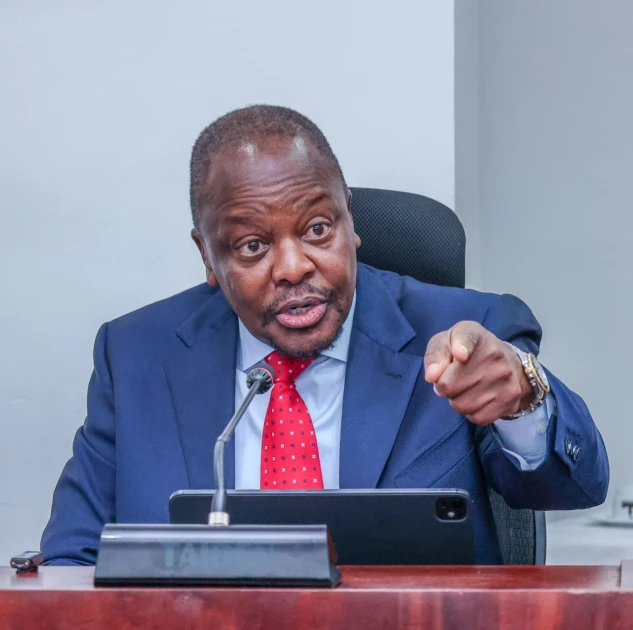
Cabinet Secretary (CS) Mutahi Kagwe speaking before the National Assembly Departmental Committee on Agriculture and Livestock on February 19, 2026.

Audio By Vocalize
Appearing before the National Assembly Departmental Committee on Agriculture and Livestock on Thursday, Kagwe presented the Ministry’s priorities under the 2026 Budget Policy Statement (BPS), warning that the current allocation falls short of both national needs and continental commitments.
Under the 2026 BPS, the Ministry has been allocated Ksh.75.49 billion — comprising Ksh.29.74 billion for recurrent expenditure and Ksh.45.74 billion for development. This represents just 2.7 percent of the Ksh2.8 trillion national budget.
CS Kagwe told the Committee that the allocation is inadequate to support a sector that contributes 22.5 percent to Kenya’s GDP and employs more than 40 percent of the country’s labour force.
“We are proposing an increase to at least five percent — approximately Ksh140 billion — of the National Government budget. This is the best practice for any industrialized nation serious about feeding its people and transforming its economy,” CS Kagwe said.
He noted that despite Kenya’s commitments under continental frameworks such as the Nairobi Declaration on Fertilizer and Soil Health, the Agriculture, Rural and Urban Development (ARUD) sector allocation has stagnated at about three percent — far below the 10 percent target pledged by African nations.
The CS warned that Kenya can no longer rely on outdated agricultural systems. With the current population at 53.5 million and projected to rise to 70.2 million by 2045, he said the country risks escalating food imports unless urgent reforms are undertaken.
“We cannot continue using the same agricultural practices that fed 35 million Kenyans to feed over 53 million today,” he stated, emphasizing the need to transition from analog to digital agricultural systems and expand irrigation to reduce overreliance on rain-fed farming.
He cited climate change, frequent droughts and floods, pest invasions such as Quelea birds and giant rats, global conflicts, currency volatility, delayed funding, high input costs and weak extension services as major threats undermining productivity.
Kagwe outlined the Ministry’s value-chain approach under the Bottom-Up Economic Transformation Agenda (BETA), focusing on three pillars: food security, reducing imports, and growing exports.
Under the food security pillar, priority commodities include maize, Irish potatoes, pulses, bananas, dairy, beef, indigenous poultry, mutton, chevon, fish and pork.
To reduce imports, the government is targeting rice, wheat, edible oils, sugarcane, sorghum, honey and textiles.
For export growth, emphasis will be placed on coffee, tea, avocado, mango, nuts, vegetables such as garden peas and African bird’s eye chilies, pyrethrum, leather, bixa and miraa.
The CS said the Ministry is prioritizing expansion of irrigation and climate-smart agriculture, sustaining the fertilizer subsidy programme, improving livestock genetics, boosting productivity, enhancing access to quality feed and water resources, and attracting targeted investment into the livestock sector.
He also underscored the need to recruit 1,450 Ward Agricultural Liaison Officers to strengthen coordination between the Ministry, county governments and farmers through a more effective Joint Agricultural Sector Steering Committee (JASCOM).
Kagwe raised concerns over what he described as a “delink” between Ministry proposals and final allocations from the National Treasury, arguing that budget ceilings often fail to reflect the Ministry’s stated priorities.
“There is need for clarity between the two State Departments — Agriculture and Livestock Development — in the budget to ensure alignment with sector priorities,” he told MPs.
The CS appealed to the Committee to support increased funding for the sector, saying agriculture remains the backbone of Kenya’s economy and the most reliable pathway to inclusive growth.
“As we look forward to allocation of funds to our unfunded projects, we appreciate the continued support of this Honourable Committee,” he said.
The Committee is expected to deliberate on the Ministry’s proposals before making recommendations to the House as Parliament considers the 2026 Budget Policy Statement.
Join the Discussion
Share your perspective with the Citizen Digital community.
No comments yet
This discussion is waiting for your voice. Be the first to share your thoughts!