
US, Israel-Iran war dominate IMF talks with Kenya during visit
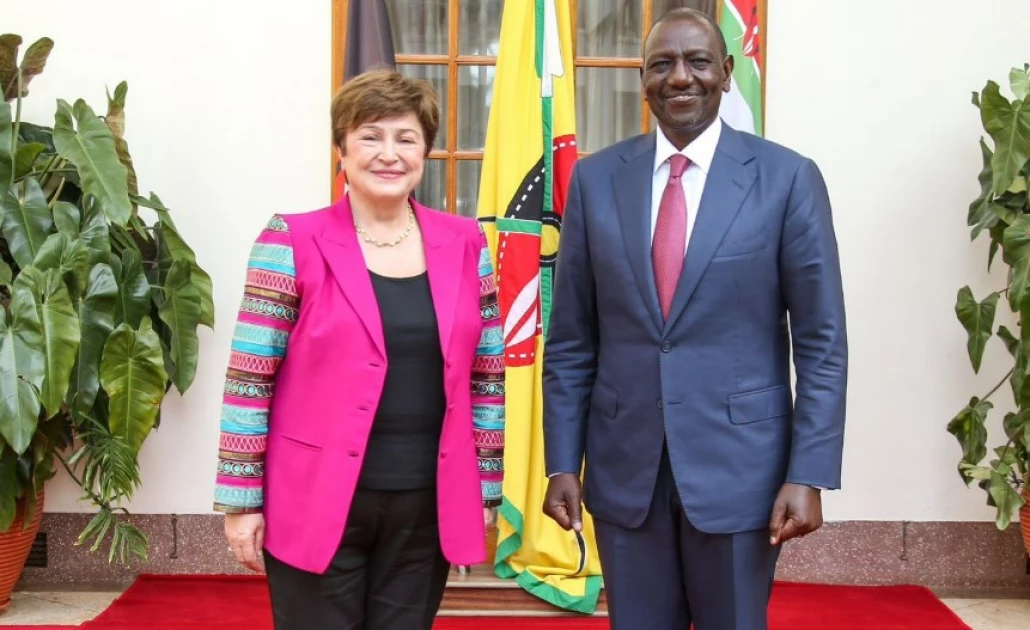
President William Ruto meets International Monetary Fund (IMF) Managing Director Kristalina Georgieva at State House on May 4, 2023. Photo/PCS

Audio By Vocalize
The team from the Fund's headquarters in Washington, led by Haimanot Teferra, arrived in Kenya last week to engage with Kenyan government officials on the recent economic developments, locally and globally.
The team discussed the potential effects of the conflict in the Middle East, pitting the United States and Israel against Iran.
The war in the Middle East continues to intensify following coordinated military action by the United States and Israel targeting Iranian sites and killing its Supreme Leader, Ayatollah Khamenei and senior government officials.
Tehran responded with retaliatory strikes, widening the scope of the confrontation and raising fears of a broader regional conflict.
Owing to the crisis, the IMF team appealed to the Kenyan government to strengthen fiscal discipline, enhance fiscal credibility and adopt ways to safeguard its citizens from external shocks.
"These efforts should be supported by strengthened governance and greater public sector efficiency," the statement read in part.
Alongside Mbadi, the Kenyan delegation comprised Governor of the Central Bank of Kenya Kamau Thugge, officials from other ministries and independent oversight bodies, and representatives from civil society organizations, the financial sector, private businesses, and development partners.
During the Ramadan period, Kenyan exporters bore the brunt of the Israel-Iran war following the closure of flights to the Middle East region. According to meat exporters, they are staring at losses worth Ksh.1 billion since the conflict began.
Other industries such as the tea sector, also raised concerns over the effect of the war, citing that the potential risks could make the country lose a quarter of its market in the Middle East.
"We will lose 20-25 per cent of our tea market in the Middle East if the war continues," stated George Ouna, Director of The East African Tea Traders Association, recently stated.
Prior to the discussions, CS Mbadi had allayed allegations that the meeting would yield a lending programme at this stage, emphasising that the talks would focus on more technical details.
The government had formally requested a new support programme after its previous Ksh.465 billion deal ended last April.
Kenya's decision to terminate the IMF's program meant that the Extended Fund Facility (EFF) and Extended Credit Facility (ECF) arrangement ceased, leaving only one active program: the Resilience and Sustainability Facility (RSF).
The EFF and ECF programs were incorporated to provide financial assistance to countries facing problems in reducing inflation levels because of structural issues and hence would require time to rebuild.
The EFF program provides a country four years to restructure, while ECF can be extended to five years.
On the other hand, the RSF program supports a country's climate agenda. In April 2021, the IMF entered into an agreement with Kenya to disburse Ksh.467.5 billion under the EFF/ECF arrangement.
Kenya accessed Ksh.404 billion, leaving out a gap of Ksh.63.4 billion that Kenya declined following the program's termination.
Join the Discussion
Share your perspective with the Citizen Digital community.
No comments yet
This discussion is waiting for your voice. Be the first to share your thoughts!