
How Samburu is quietly turning the night sky into Kenya’s next big tourist attraction

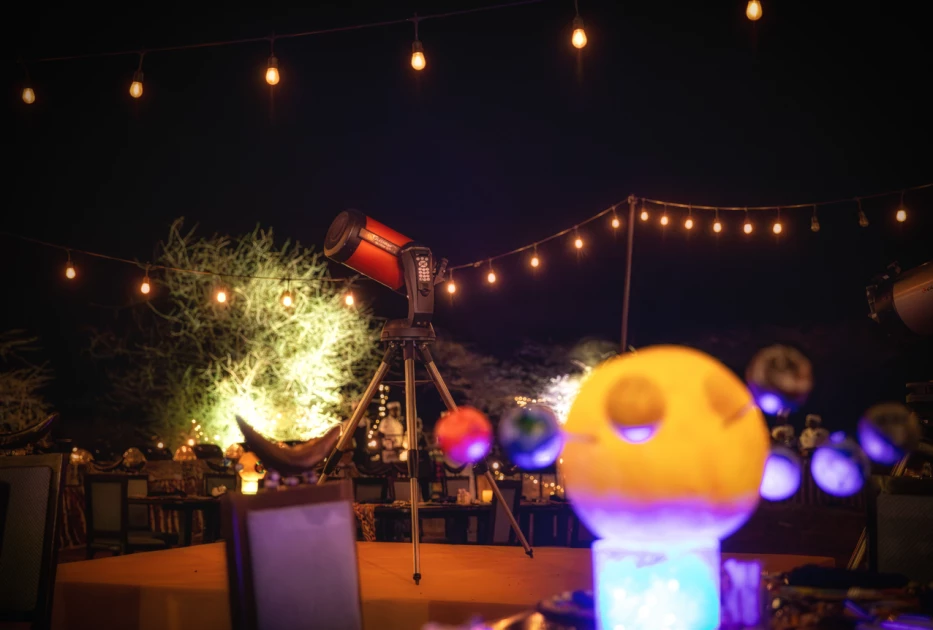
A telescope set up facing the sky during the astro-tourism launch at the Samburu Sopa Lodge on June 14, 2025. PHOTO | COURTESY | MIKE NTHEI

Audio By Vocalize
I don’t enjoy long
travels very much. I don’t romanticize long drives or pretend to enjoy the
slow, torturous unraveling of tarmac over endless kilometers. My spirit grows
weary halfway through a journey, and my patience packs up and abandons ship not
long after. Add a carful of overly chatty companions who think every turn in
the road deserves a full TED Talk, and I start fantasizing about how legally
questionable it might be to hurl someone out at the next police roadblock. But
when the call came to go stargazing in Samburu last weekend - to witness the
universe show off where the city lights can’t interrupt - I couldn’t say No.
Something about the cosmos whispering across the savannah felt... worth the
inconvenience. So I packed my bags, braced for the company, and prayed for
minimal small talk and maximum starlight.
The journey to
Samburu was a test of endurance, patience, and lower back flexibility. Over six
hours in a tour van crammed with some of the most talkative media minds in the
country; journalists with big voices and even bigger opinions. We told stories
and shared industry secrets and bad jokes. By the time we rolled into the Samburu
National Reserve, the sunset was politely waiting to show off; golden,
dramatic, smug.
We were in Samburu
to witness Kenya’s official leap into astro-tourism, unveiled by the brilliant
minds at Leo Sky Africa in partnership with the breathtaking Samburu Sopa Lodge
- a place so charming it feels like it was built straight out of a Samburu
elder’s dream. The lodge doesn’t just sit in the landscape; it belongs to it.
Warm, cozy cottages designed in the shape of traditional Samburu huts dotted
the hillside like little domes of welcome, each crowned with thatched conical
roofs and wrapped in earth-toned walls that whispered, “karibu nyumbani.”
As we stepped out
of our van, slightly dazed from the long drive, we were greeted by a vibrant
chorus of Samburu singers - all smiles, beads, and rhythm. Their voices rose
like prayer and laughter combined, echoing off the acacia trees and bouncing
straight into our tired, grateful hearts. The sun was just beginning its golden
descent, the air smelled like dust and possibility, and for a moment - just a
moment - we all stopped scrolling, filming, complaining, or tweeting. We had
arrived. And the welcome was celestial even before we saw a single star.
A journey
through the skies
Astro-tourism, in
the simplest terms, is what happens when your holiday stops at the stars - quite
literally. It’s where travel ditches the usual suspects (beaches, buffets, and
bush drives) and takes a bold, romantic detour upward. Imagine swapping the Big
Five for the Milky Way, your sunset cocktail for a constellation map, and your
lodge entertainment for tales of Orion’s misplaced belt and Andromeda’s cosmic
family drama. It’s part science, part stargazing, and a whole lot of “wow, is
that really Jupiter?” It’s tourism for people who want their minds blown gently
by the universe while still wrapped in a Maasai shuka. And in Samburu’s case,
it’s proof that the sky isn’t the limit - it’s the newest destination.
If you’re going to
chase stars, you might as well start from where the sky behaves best - and that
place, according to experts, is Samburu. Which is why gathered at the Samburu
Sopa Lodge, under the moonlit sky on Saturday, June 14, 2025, to witness the wonders
of the sky taking center stage in a new, historic and ambitious venture.
At around 10pm,
with the air cool and crisp and the Milky Way stretching lazily across the sky
like a divine brushstroke, we gathered around a glowing bonfire - the kind that
crackles not just with warmth, but with anticipation. The moment felt almost
sacred. One by one, Samburu guides and naturalists stepped forward, each taking
their turn like celestial storytellers on a stage older than time. Armed with
nothing but laser pointers and an impressive grasp of both Science and Samburu
lore, they painted the sky for us - quite literally.
With sweeping
gestures, they connected dots in the darkness, outlining constellations we’d
only ever seen in textbooks or horoscope apps. There was Leo, bold and
boastful, prowling through the stars; Orion, the eternally flexing warrior with
his glimmering belt; and Andromeda, the cosmic damsel with a dramatic backstory
and a galaxy to her name. Each tale was told with a mix of scientific precision
and cultural flair, turning astronomy into something deeply human - intimate,
enchanting, and oddly grounding. The stars were no longer just distant lights;
they became characters, stories, ancestors… reminders that long before apps
told us the weather, people here looked up and found meaning.
About an hour later, just as the fire began to mellow and our necks grew stiff from stargazing wonder, we were ushered away from the open sky and into something that looked like it belonged in a sci-fi film set; a manmade dome, Samburu’s own version of a planetarium. We filed in, twenty at a time, settling close to each other in a space that felt oddly intimate, like a cosmic confession booth. Once seated, the dome came alive with a real-time visualization of the sky; not just the stars above us now, but also how they looked earlier that morning and how they’d shift in the hours ahead. It was like watching the universe rewind and fast-forward on command.

It was a Science
class, Yes - but delivered with charm, wit, and just the right amount of
existential crisis. And somehow, being that small in the face of the universe
felt strangely comforting.
Samburu has always
been the cool cousin of Kenya’s safari circuit - a little wilder, a little less
crowded, and a whole lot more unique. Sure, you’ll still find the classic Big
Five flexing their muscles somewhere in the neighbourhood, but this region
doesn’t just recycle what the rest of Kenya offers. It boasts its own “Special
Five” - a roster of wildlife so rare and fabulous they sound like they belong
on a red carpet.
I’m talking about the
Grevy’s Zebra with its tight pinstripes; the Reticulated Giraffe with a coat
that looks hand-painted; the Beisa Oryx with its deadly elegance; the Somali Ostrich,
which is taller, darker, and sassier than the regular; as well as the Gerenuk -
that long-necked, high-jumping antelope that looks like it moonlights as a yoga
instructor. These animals are Samburu exclusives - found nowhere else in Kenya
with this kind of reliability.
But Kennedy Ayoti -
Chief Operating Officer, Sopa Lodges East Africa - is out here raising the
stakes. When we sat down with him earlier that evening, he told us; “You know,
people come to Samburu for the Special Five - but you come to Samburu Sopa
Lodges for the Special Six; nobody else has the sixth one, astro-tourism. It's
a differentiator for us, and we believe it's going to raise us in the map.”
And honestly, he’s
right. Because once the sun dips behind those rugged hills and the animals take
their bow for the night, the real show begins above - a cosmic safari of stars,
planets, constellations, and myth. Samburu has now become the only place in
Kenya where lions prowl by day and Saturn winks at you by night.
Experts, too, have
their own scientific receipts for why Samburu isn’t just a pretty face in the
Kenyan wild - it’s a legitimate VIP lounge for the cosmos. According to the passionate
Leo Sky Africa Founder and Managing Director Kimani Wa Nyoike; “Samburu is
located on the Equator - which means you’re able to see both the Northern and
Southern hemispheres’ constellations in one sitting.”
In simple terms:
it’s like having front-row seats to two completely different concerts at once.
While your friends in South Africa are busy gawking at the Southern sky alone,
Samburu lets you peek into both worlds - the celestial North and the galactic
South - without moving a muscle. Add to that the region’s high elevation,
consistently clear skies, and minimal light pollution, and what you’ve got is a
scientifically blessed viewing deck that would make even professional
astronomers shed a tear of joy.
As Nyoike cheekily
puts it: “What South Africans see, we see too – but we also see what they can’t,
like the skies in Egypt. Let's put it like this; if astro-tourism was a
concert, South Africa would be the Regular section, and Kenya would be the VVIP…we
have a clearer view.”
For those at the
back, in astro-speak, that’s the equivalent of telling the rest of the
continent, “Stay humble.”
The morning after…ruined
by Birdman
Now, you’d think a
story this magical would end with us watching a lion yawn at sunrise, or an
elephant photobombing a group selfie. But No. Enter that one annoying person in
every trip – a birdwatcher, in our case.
The morning after
the stargazing gala, we woke up at stupid o’clock for a game drive. Hopes were
high - lions, leopards, at the very least, an aloof giraffe. But this man,
camera strapped like a sniper, a mask covering half his face, hijacked our van
with one agenda: birds.
Tiny birds. Beige
birds. Birds you couldn’t even see without an aerial zoom and the Lord’s
favour. Every two minutes, he made the driver stop. “Wait! I think that’s a buff-belied
warbler!” He would squeal, and we would lean out expectantly, only to find nothing
but what seemed to us – normal human beings – as a distant pebble on a twig.
By the time we
reached the area where big game is usually spotted, the sun was high, the cats
had gone to brunch at Golden Ice, the giraffes were probably shopping in
Zanzibar, and our souls were weary. I couldn’t believe I lost sleep for that. I
went back to my room after that game drive with 67 photos of flying insects and
an unshakable grudge against birds.
Join the Discussion
Share your perspective with the Citizen Digital community.
No comments yet
This discussion is waiting for your voice. Be the first to share your thoughts!