
Humans can understand apes’ sign language, new study finds
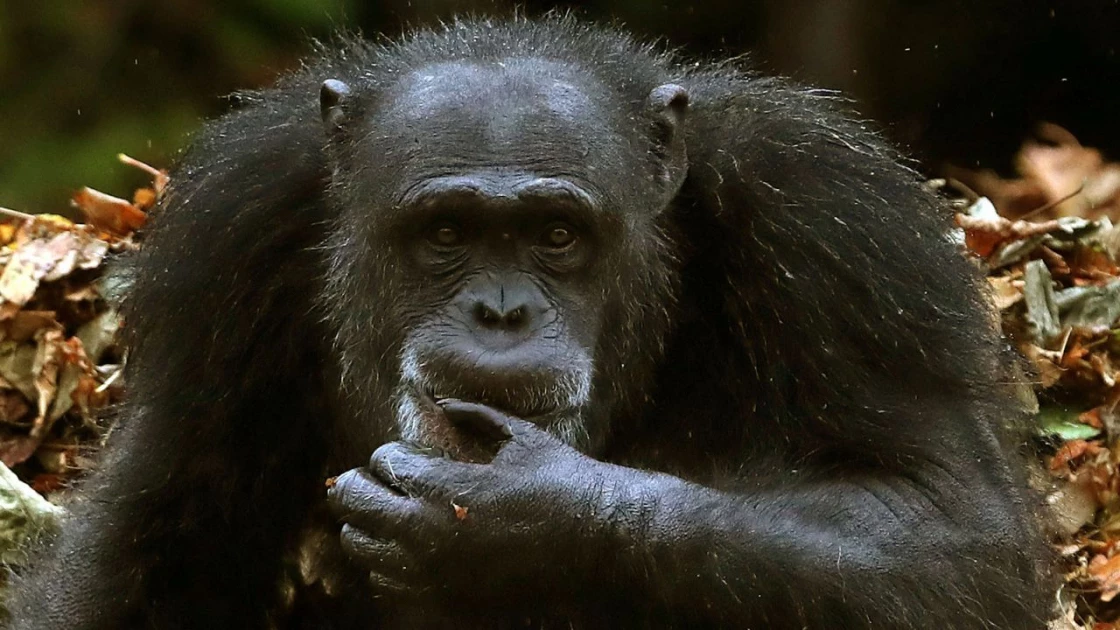
Great apes deploy more than 80 signals to communicate everyday goals, according to a new study. PHOTO/COURTESY: CNN

Audio By Vocalize
From pointing to animated arm
movements and nodding, people regularly employ gestures to accompany and create
language.
Now,
it’s been suggested that humans can also understand sign language used by apes,
meaning humans may retain an understanding of ape communication from their
ancestors.
Great
apes deploy more than 80 signals to communicate everyday goals, according to a study published Tuesday in the journal PLOS Biology.
These gestures include the “big loud scratch,” which means “groom me” — apes do this to remove insects or dirt from each other’s hair.
“Object shake” can mean “let’s have sex,” “groom me” or “move away.”
The “directed push” means “climb on my back” for bonobos or “move to a new position” for chimpanzees.
Chimpanzees and bonobos, which share more than 90% of their gestures, are humans’ closest living relatives, the study said.
Their gestures have been
suggested to be an important framework in the evolution of human language,
according to study authors Kirsty E. Graham, a research fellow at the
University of St. Andrews’ School of Psychology and Neuroscience in Scotland,
and primatologist Catherine Hobaiter, a principal investigator at the
university’s Wild Minds Lab.
Infants ages 1 to 2 have been found to use more than 50 gestures from the ape repertoire, researchers said.
It was therefore thought that
humans may have retained their understanding of core features of ape gestures.
How
does it work?
Researchers used data from 5,656 participants who watched 20 online videos that were clipped to show a gesture made by a bonobo or chimpanzee but without the response it triggered.
The participants were required
to select the correct meaning of the gesture from four possible options.
The
researchers selected 10 of the most common gesture types that were previously
found to confer meaning for both chimpanzees and bonobos to include in the
videos.
They were each accompanied by
a simple illustration of the gesture to assist inexperienced viewers in
identifying the action in the clips.
Each
participant was randomly allocated either a “video only” game or videos with
one line of context that described what the apes were doing before their
gesture.
This type of comprehension study has been employed to test nonhuman species on comprehension of human language, but the model was flipped this time.
Graham told CNN via email on Thursday that the participants were found to be able to successfully interpret the chimpanzee and bonobo gestures with just over 50% accuracy — double what is expected by chance.
There was up to 80% success
for some specific gestures, such as the “mouth stroke” (meaning “give me that
food”) and “big loud scratch.”
This
ability was still present in identifying the meaning of more ambiguous gestures
that had alternate meanings, with the “object shake” being the only gesture to
which participants failed to assign either the primary or alternate meanings.
“That
our participants were able to interpret primate signals complements recent
findings that suggest humans may be able to perceive affective cues in primate
vocalisations,” the study authors concluded.
“These
gestures are shared by all other great ape species,” Graham told CNN, “and if
humans understand them, then it seems like a great ape gesture ability that
would have been used by our last common ancestors.”
Biology
or intelligence?
However,
the underlying mechanism that allows humans to understand apes remains
unresolved, the researchers added.
Some
possible explanations for this puzzle include humans biologically inheriting
the great ape repertoire, apes and humans sharing general intelligence to
interpret signals as well as shared body plans and social goals, or the
resemblance of gestures to the actions they aim to evoke.
“We
need to examine how participants understood the gestures — do humans inherit a
vocabulary or a capacity or are we reasoning our way through it? It’s a big
question that will require a variety of approaches to tackle,” Graham said.
“But
this experiment is an important proof of concept and from here we can play
around with the information that participants receive and ask participants more
about how they are interpreting the gestures. We are also studying different
communities of great apes in the wild to get a fuller picture of their
gestures.”
The
researchers noted that gorilla and orangutan gestures could also be interpreted
by humans, although the meanings for gestures in these ape species are not yet
established.
“Dogs are interesting too, because we aren’t that closely related but we have domesticated and co-evolved with them over tens of thousands of years,” Graham added, “so how we communicate with them can be very instructive for researchers too.”
Join the Discussion
Share your perspective with the Citizen Digital community.
No comments yet
This discussion is waiting for your voice. Be the first to share your thoughts!