
The silent strength of young fathers, a growing fatherhood in Kibera
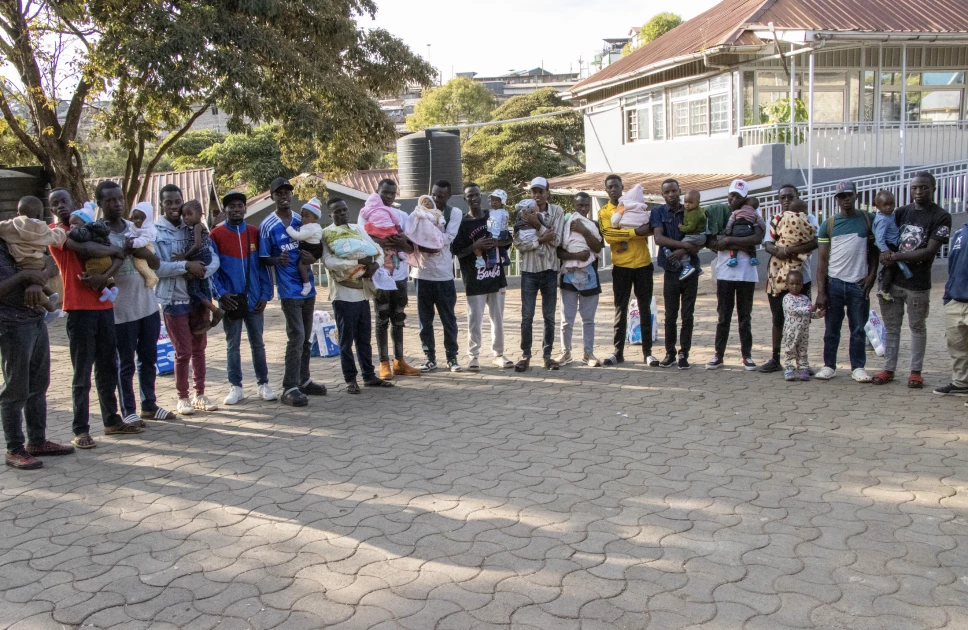
Boys to Men: Some of the 30 teenage fathers who showed up for a celebration meet up on Father's Day at St. Charles Lwanga Vocational Training Centre. Photo: Sharon Chebaibai

Audio By Vocalize
He’s one of 21 young dads who recently gathered to celebrate Father's Day. But behind the warm smiles and baby coos lies a story of resilience, rejection, and quiet courage in the face of fatherhood and poverty.
What started as a news feature by Brenda Wanga on Citizen TV about teen fathers in Kibra has now evolved into something bigger: a community, a lifeline.
When the story aired in April, it struck a chord with Gabriel Achayo. Rather than let it end as “just another story”, he rallied his friends and network to respond with action.
As Achayo would put it, “I needed to do something.”
On a dusty Saturday, May 3rd afternoon in Mashimoni, near Magoso Health Centre, Achayo and a team of 11 volunteers, in partnership with Angaza Kids Foundation, brought together 30 teenage fathers.
This was going to be the first time many of these young fathers were asked to say their names and share their stories, outside the labels society had branded them.
“The extended family has completely sidelined us," one father says. Another laments, "My boss delays my pay. It really frustrates me.”
Another tired voice adds, “We have skills, but we can’t find jobs,” as another Gen Z father says pensively, “The police are always on my neck, and I feel threatened and insecure.”
These were some of the sentiments echoed that afternoon.
Some had been kicked out of their homes, forced into fatherhood and adulthood overnight. Others spoke of depression, hunger, police harassment and the concerning fact that few had birth certificates for their children or even IDs for themselves.
Despite the struggle, however, for these fathers, their children remain their greatest motivation.
What was meant to be a one-time visit quickly became the start of something more.
The fathers expressed a strong desire for regular meetings. Not for what many might term as handouts, but for connection. They wanted a space where they could be seen, not judged. Heard, not dismissed.
That is how, on June 15, Father's Day, these young men reconvened at St. Charles Lwanga Vocational Training Centre in Kibera in the presence of older men and fathers, but this time, to share a meal and simply celebrate with their children.
Fathers like Romoro were among those in attendance, with the youngest just 18 years old and already a dad of two.
Most of them had one thing in common: they were parenting alone. Out of the 21 dads, very few of them showed up with their children’s present mothers.
I would later have a chat with Romoro, who opened up about how fatherhood changed his life. He was studying to become a plumber when he found out he was going to be a father.
“I had to drop out,” he says. “There was no way I could keep up with fees and still take care of my son.”
Like most, if not all of them, Romoro lives hand to mouth, surviving on casual work, unsure where the next meal will come from.
Hope, his now one-year-old son, was recently diagnosed with anaemia shortly after birth, adding medical concerns to an already heavy load.
Unfortunately for him, Hope’s mother isn’t as present in the child’s life as Romoro had hoped, leaving him to shoulder most of the responsibility.
But he doesn’t share his story with bitterness. Instead, he speaks with quiet resolve.
“Imenifanya nijitume zaidi,” he says, all the while keeping a keen eye on a playing Hope nearby.
Baba Hope, as I refer to him during our chat, hopes to one day go back to school, finish his plumbing training, and secure stable work so he can provide more fully for Hope.
Denver’s story echoes the sentiments of many other young fathers he’s now bonded with. While some have experience in trades like mechanics, cooking, videography, or masonry, they lack formal training and certification.
They recognise the need to complete their training and start monetising these skills to sustainably provide for their children.
With this initiative, it is safe to say that they now have hope. From that first raw conversation in Mashimoni to a joy-filled Father's Day celebration, this budding movement is proof that change doesn’t always come through grand programs or gestures. It starts with taking action and showing up, again and again.
Romoro and his fellow fathers may not have much to work with, but they make up for it in resolve.
With this newfound brotherhood, it’s encouraging to know they’re no longer going to walk the journey of fatherhood alone.
Join the Discussion
Share your perspective with the Citizen Digital community.
No comments yet
This discussion is waiting for your voice. Be the first to share your thoughts!