

A deadly volcano could erupt ‘within days or weeks’ in Colombia
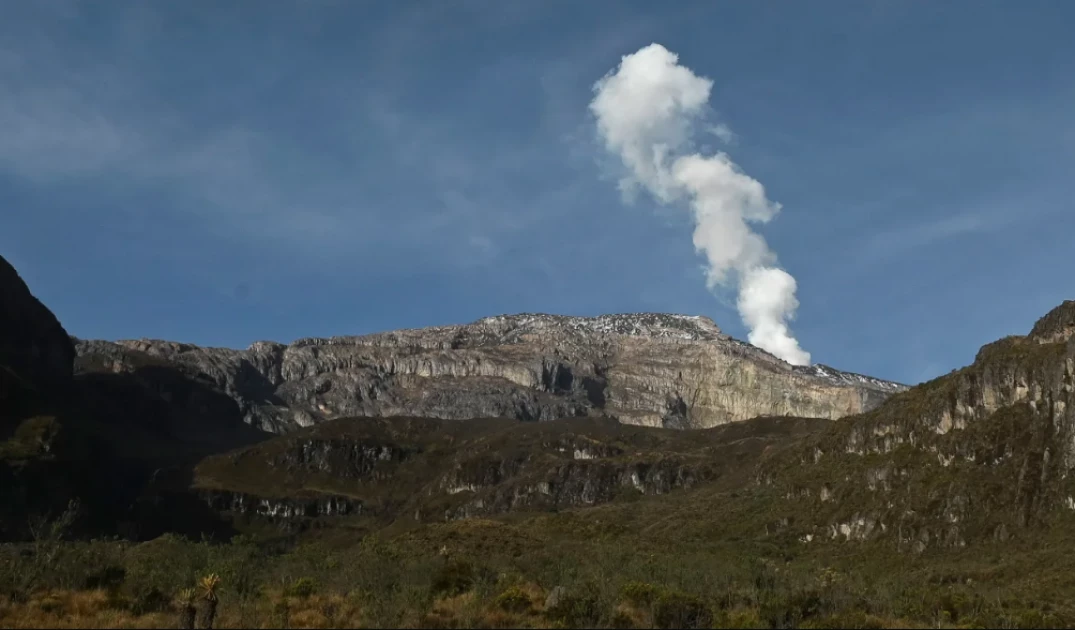
The Nevado del Ruiz volcano emits a cloud of ash in Murillo, Tolima Department, Colombia on April 7, 2023.

Audio By Vocalize
Hundreds
of families in Colombia are facing a choice: abandon
their homes and livelihoods, or face the devastation of a predicted volcanic
eruption in the coming weeks.
The Nevado
del Ruiz volcano, one of Colombia’s highest peaks, sits in a densely populated
farming area and is infamous for claiming the lives of tens of thousands of
people in a massive 1985 eruption.
Since March
30, the volcano has been on orange alert, signifying that “an eruption is
likely within days or weeks,” according to Colombia’s Geological Service.
Towns
and villages around the mountain have been asked to evacuate, with local and
national authorities declaring a state of emergency. Most nearby schools have
gone back to pandemic-era home learning plans and local municipalities are
stockpiling first aid kits.
On April 5,
Colombian President Gustavo Petro ordered the voluntary evacuation of about
2,500 families in the area as a precaution, but many locals have refused,
saying they are more worried about leaving their livelihoods and belongings
behind than about potential lava flows.
While it’s unclear how many families in total have evacuated,
Tolima’s civil protection unit director Luis Fernando Velez told local
newspaper El Tiempo on Thursday that only a small fraction – just 87 people –
had left their homes under his agencies’ watch.
The
slopes of the Nevado del Ruiz, located between the Tolima and Caldas provinces
in central Colombia, are fertile grounds for local farmers, who say leaving
their cattle behind would ruin them.
The
local government in the province of Tolima has announced plans to evacuate up
to 12,000 cattle, out of a total of over 43,000.
Omar
Valdes, Tolima’s rural development secretary and the officer in charge of the
cattle evacuation, said farmers were resisting the evacuation order because of
previous bad experiences.
“In
previous occasions they evacuated, floods [caused by the volcano] didn’t affect
their farms and when they came back the farmers found that most of their goods
and cattle had been stolen,” he explained.
Eruptions
from the Ruiz volcano can be particularly lethal, according to scientists at
the Smithsonian Institute’s Global Volcanism Program, because the top of the
peak is permanently capped by a layer of snow and ice. Once in contact with the
lava, the snow and vice would instantly melt, flood over the slopes of the
mountain in torrential mudslides called lahars.
Such
a tragedy struck on November 13, 1985, the last massive eruption of the
volcano, which is collectively known in Colombia as the Armero Tragedy. On that
occasion, just a couple hours after the Ruiz volcano began to erupt, a river of
mud, rocks, lava, and icy water swept over the small town of Armero. The flood
killed over 23,000 people in a matter of minutes.
Many local
residents still remember the trauma of that day, but few are willing to gamble
their livelihoods on geologists’ warnings alone. The same volcano erupted in
2012 without causing any deaths.
While Tolima
and Caldas are part of the relatively wealthy coffee-growing region of
Colombia, most economic activity is run by small-scale farmers who own a
limited number of animals and tend to small parcels of land and for whom the
cattle and agricultural equipment they own are their most valuable belongings.
Though the
increasingly active volcano is monitored daily by dozens of probes, it is
impossible to forecast exactly whether it will erupt, let alone when. Still,
there are troubling signs.
“Right now,
the volcano is ejecting steam, ashes, gases, and closer to the crater there’s
been a high level of seismicity,” said Luis Fernando Velasco, the Director of
Colombia’s risk management unit UNGRD, in a video statement last week.
Recently,
the ground around the volcano has been shaken by hundreds, sometimes thousands
of small tremors per day. And on Friday, a column of ashes and smoke
originating from the volcano rose onto the sky for over 1500 meters
(approximately 5000 ft), according to a report by the Colombian Geological
Service.
Leave a Comment