
A rogue house for hire: How Kenya's Parliament has sold its soul
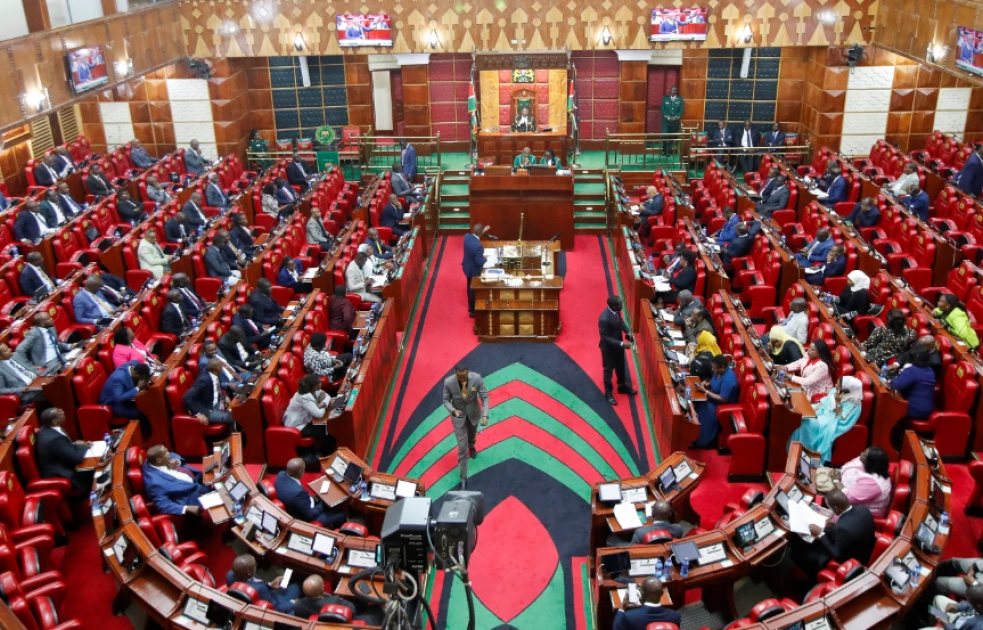
A general view shows Kenyan Members of Parliament as they discuss the impeachment of then Deputy President Rigathi Gachagua inside the Parliament buildings in Nairobi, Kenya October 8, 2024. FILE PHOTO | REUTERS

Audio By Vocalize
This week, the whispering stopped.
Sitting legislators, not activists, not opposition nonconformists, but sitting Members of Parliament with front-row seats to the events, stood before television cameras and microphones and simply confirmed what the public had long suspected: that money moved hands to remove a sitting Deputy President from office, and that some of the very people entrusted with Kenya's laws are, in effect, guns for hire.
Confessions from MPs
Suna East MP and National Assembly Minority Leader Junet Mohamed lit the fuse.
Speaking at a UDA-cum-ODM rally in Kakamega on July 26, Junet did not merely allude to impropriety, he named names.
He told the crowd that during the October 2024 impeachment of former Deputy President Rigathi Gachagua, cash was circulating in Parliament, and that a well-known Senator was the "accounting officer" managing the funds.
He went further, suggesting that some legislators who took the money had little to show for it, a throwaway line that nonetheless confirmed, from the inside, that a market for votes exists.
Langata MP Felix Odiwuor “Jalang’o” all but corroborated the claim on a podcast appearance, admitting that MPs "were paid, and they enjoyed the money," though the amounts varied depending on who was asked and when.
Then, on July 30, Makueni Senator Dan Maanzo escalated the story from allegation to something resembling a confession under duress.
Maanzo said he was approached by individuals he described as state agents and Kenya Kwanza operatives and offered between four and ten million shillings, accounts of the exact figure have varied across his interviews, on condition that he vote to impeach Gachagua.
The offer, he said, came with an unambiguous threat: “accept the money, vote yes, and be rewarded; accept the money, vote no, and you would not get to your house."
Maanzo declined to name the individuals involved, citing fear for his safety, and has not indicated whether he formally reported the threat to investigators.
These admissions did not emerge in a vacuum.
Gachagua himself alleged during his own legal battle that MPs were paid to facilitate his removal.
In June 2026, the High Court upheld the impeachment as lawful but awarded Gachagua Ksh.50 million in damages, finding that his rights had been violated when the Senate refused his legal team's request for an adjournment. Gachagua's lawyers have since asked the courts to take the Junet and Jalang'o admissions seriously as evidence that the process was compromised from the outset.
Not an isolated affair
What makes the Gachagua revelations so damaging is not that they are shocking, but that they are utterly familiar. Since 2022, allegations of cash-for-votes have trailed nearly every consequential decision to pass through Kenya's two chambers.
The most explosive came during the Finance Bill 2024 saga, whose rejection under street pressure left dozens dead and Parliament's own building scorched by protesters.
Juja MP George Koimburi told a church congregation that MPs who voted "yes" had each pocketed Ksh.2 million; he was later hauled before the House and pressured into a public apology, insisting he had no evidence and had merely repeated hearsay.
Whether or not Koimburi could prove his claim, the allegation stuck in the public mind precisely because it matched the pattern Kenyans already recognized.
President William Ruto himself, addressing private-sector leaders in August 2025, accused parliamentary committees of demanding bribes to pass "favorable" laws, and claimed members of the Kenya Private Sector Alliance routinely bribe committees to shape legislation in their favor.
It was a remarkable admission from the head of state, effectively conceding that the legislature he depends on to pass his government's agenda operates, by his own account, as a marketplace.
The most recent scandal before the Gachagua revelations involved the Anti-Money Laundering Bill, which Ruto signed into law in June 2026 to help Kenya exit the Financial Action Task Force's "grey list." Allegations surfaced that MPs had been paid as much as Ksh.10 million each to back the bill.
Justice and Legal Affairs Committee members denied any wrongdoing, while other MPs complained that the repeated bribery accusations from senior government figures were exposing ordinary legislators to public suspicion regardless of guilt.
Gachagua, before his own impeachment, had accused his political rivals of attempting to bribe Kirinyaga Woman Representative Njeri Maina and a serving senator in a bid to secure numbers against him, suggesting that the culture of purchased votes long predates his own downfall, and that he was, at different moments, both an alleged victim and beneficiary of it.
Seen end to end, the record does not describe scattered lapses. It describes a functioning, semi-institutionalized system in which a "yes" or a "no" vote has a market price, whether the matter at hand is a tax bill, an anti-corruption law, a top civil service appointment, or the removal of a Deputy President.
An institution without independence
The deeper problem exposed by these episodes is not merely venality but capture. Kenya's Constitution imagines Parliament as a co-equal branch of government, exercising independent oversight over the Executive on behalf of citizens.
What the events in parliament reveal instead is a legislature whose voting blocs can apparently be assembled and dissolved by whoever controls the largest checkbook, frequently, if the legislators' own testimony is believed, the Executive itself.
This is corrosive in a specific way. When the National Assembly rubber-stamps a Finance Bill under alleged financial inducement rather than genuine deliberation, ordinary Kenyans absorb the consequences directly: higher taxes, unworkable levies, and, as happened in June 2024, deadly street confrontations when citizens feel Parliament will not check the Executive through any other means. When the Senate can allegedly be moved to remove a Deputy President for a price, the constitutional threshold protecting high office from casual, politically expedient removal is rendered meaningless; impeachment ceases to be a solemn check on power and becomes another transaction.
The damage compounds because the two chambers exist precisely to counterbalance one another and to counterbalance the presidency. A Senate that can be bought defeats devolution's promise of county-level protection. A National Assembly that can be bought defeats the promise that taxation and expenditure require genuine representative consent. And a citizenry that comes to believe both chambers are for sale loses any incentive to engage with Parliament through legitimate channels, petitions, memoranda, public participation, among others, because the outcome, they conclude, was decided in advance by whoever paid the most.
What options remain?
Kenya is not without tools to arrest this drift, although none is easy.
The Ethics and Anti-Corruption Commission (EACC) and the Directorate of Criminal Investigations have a direct entry point: sitting legislators have now made public statements amounting to admissions of bribery, or of receiving bribe offers.
Kenyan law obliges public officers to report bribery attempts; failure to do so is itself an offence. Formal investigations, including summoning Junet Mohamed, Jalang'o, and Dan Maanzo to give sworn statements naming the "accounting officers" and financiers they have referenced, would test whether these admissions were merely political theatre or the basis for actual prosecutions.
The Powers and Privileges Committee and the Speaker's office have also historically responded to bribery claims by demanding apologies and retractions from the accusers, as happened to Koimburi in 2024, rather than investigating the underlying claims. A credible response would invert this instinct: treat the admissions as leads to be investigated, not embarrassments to be silenced.
On the ot he hand, courts have already shown a willingness to scrutinize the Gachagua impeachment process, awarding him damages for procedural violations even while upholding the substantive outcome.
Should credible evidence of bribery emerge, litigants have a plausible avenue to argue that the vote itself was procured through corruption, which could reopen the legal question of its validity.
Much of this money reportedly flows because Kenya lacks robust, enforced rules on political financing and lobbying disclosure. Requiring MPs to declare gifts, meetings with financiers, and sources of campaign funding, and empowering an independent body to audit these disclosures, would not eliminate bribery but would raise its cost and visibility.
Kenya's Gen Z-led protests in 2024 demonstrated that public mobilization can force reversals even when Parliament will not act on its own. Sustained media follow-up following the admission by Junet and Maanzo on bribery cases within parliament, rather than simply reporting their sound bites is a strong mechanisms capable of turning admissions into consequences.
Ultimately, voters retain the power to punish legislators credibly linked to bribery at the ballot box in 2027.
But this requires that allegations be documented, verified, and kept in public memory long enough to matter at election time, a task complicated by Kenya's fast news cycle and the tendency of scandals to be overtaken by the next one before consequences catch up.
The bottom line
None of these options offers a quick fix, and Kenya's recent history suggests a pattern in which explosive bribery claims generate a news cycle, an apology or two, perhaps a committee inquiry, and then quietly recede without prosecutions or reform.
What is different this time is the source: it is not activists or opposition figures alleging Parliament is for sale, but the legislators themselves.
That should make the claims harder to dismiss, and harder for institutions meant to guard the public interest, the EACC, the Judiciary, and the electorate to ignore.
Whether it does will say a great deal about whether Kenya's Parliament can still be reformed from within, or whether the "House of Bribes" is now simply an accurate name for the institution Kenyans built to represent them. Kenya’s parliament is indeed gone rogue!
Join the Discussion
Share your perspective with the Citizen Digital community.
No comments yet
This discussion is waiting for your voice. Be the first to share your thoughts!