
A shrew-like creature that lived 225 million years ago is the oldest mammal ever identified
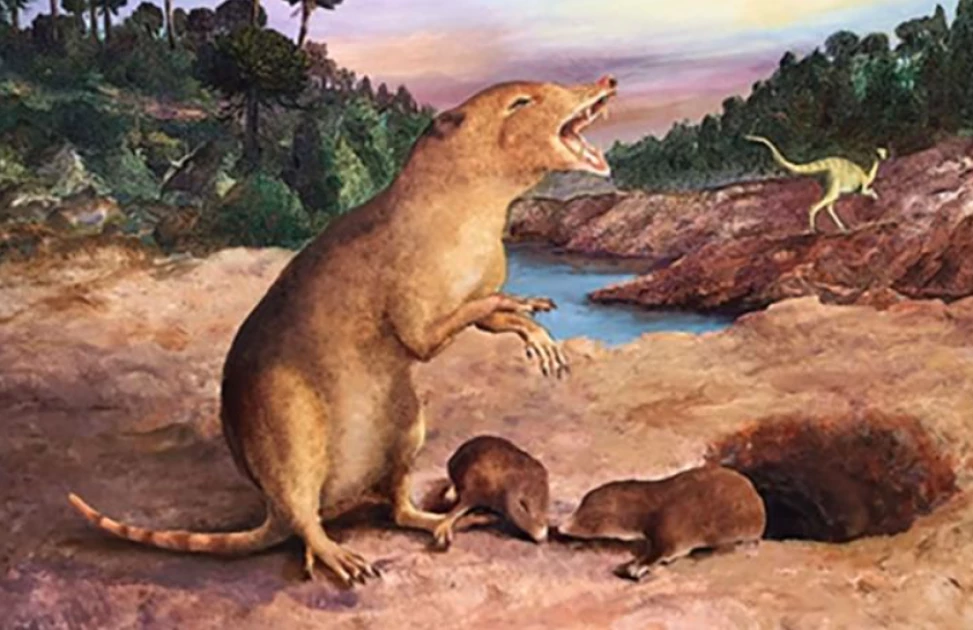
Illustration of Brasilodon quadrangularis, the 225 million-year-old mammal.

Audio By Vocalize
The
world's oldest mammal has been identified using fossil dental records --
predating the previously confirmed earliest mammal by about 20 million years --
in a new discovery hailed as "very significant" by researchers.
Brasilodon
quadrangularis was a small shrew-like creature, around 20 centimeters (8
inches) long, that walked the earth 225 million years ago at the
same time as some of the oldest dinosaurs and sheds light on the evolution of
modern mammals, according to a team of Brazilian and British scientists.
The
discovery was made by researchers from the Natural History Museum in London,
King's College London and the Federal University of Rio Grande do Sul in Porto
Alegre.
Scientists
relied on clues provided by fossils of hard tissues such as bones and teeth.
This is because mammalian glands, which produce milk, have not been preserved
in any fossils found to date.
Until
now, the Morganucodon had been considered the first mammal, with isolated teeth
showing that it dated back around 205 million years. The Morganucodon had a
small gerbil-like body and a long face similar to those of shrews or civets.
The
dental records in the study published Tuesday in the Journal of Anatomy date
Brasilodon quadrangularis to 225 million years ago -- 25 million years after
the Permian-Triassic mass extinction event -- the third and biggest mass extinction, when more than 90% of
species in the ocean disappeared and 70% of land animals died out.
Mistaken
identity
Martha
Richter, a scientific associate at the museum and senior author on the paper,
told CNN that the Brasilodon quadrangularis was previously believed to be an
"advanced reptile," but examination of its teeth show
"definitively" that it was a mammal.
"If
you think about reptiles, they have many, many different replacement teeth
throughout their lives but we mammals only have two. Firstly, the milk teeth
and then the second dentition which replaces the original set. This is what
defines mammals," Richter said.
Brasilodon
is the oldest extinct vertebrate with two successive sets of teeth -- baby
teeth and one permanent set -- also known as a diphyodonty, the news release
said.
The
first set starts developing during the embryonic stage and the second set develops
after birth.
Richter
and her colleagues examined three lower jaws of the species, which lived in the
region covered today by the southern-most section of Brazil. Under the
microscope they discovered "the type of replacement teeth that are only
present in mammals," she said.
Richter
added: "This was a very, very small mammal that was probably a burrowing
animal living in the shadows of the oldest dinosaurs that we know from that
period."
She
said the team had been working on the project for more than five years and
described their discovery as "very significant."
In
the news release, Richter said the findings contributed "to our
understanding of the ecological landscape of this period and the evolution of
modern mammals."
Moya
Meredith Smith, contributing author and professor of evolutionary dentoskeletal
biology at King's College London, said in the release: "Our paper raises
the level of debate about what defines a mammal and shows that it was a much
earlier time of origin in the fossil record than previously known."
Join the Discussion
Share your perspective with the Citizen Digital community.
No comments yet
This discussion is waiting for your voice. Be the first to share your thoughts!