
At Davos, global south leaders call time on dependency via the Accra Reset Initiative
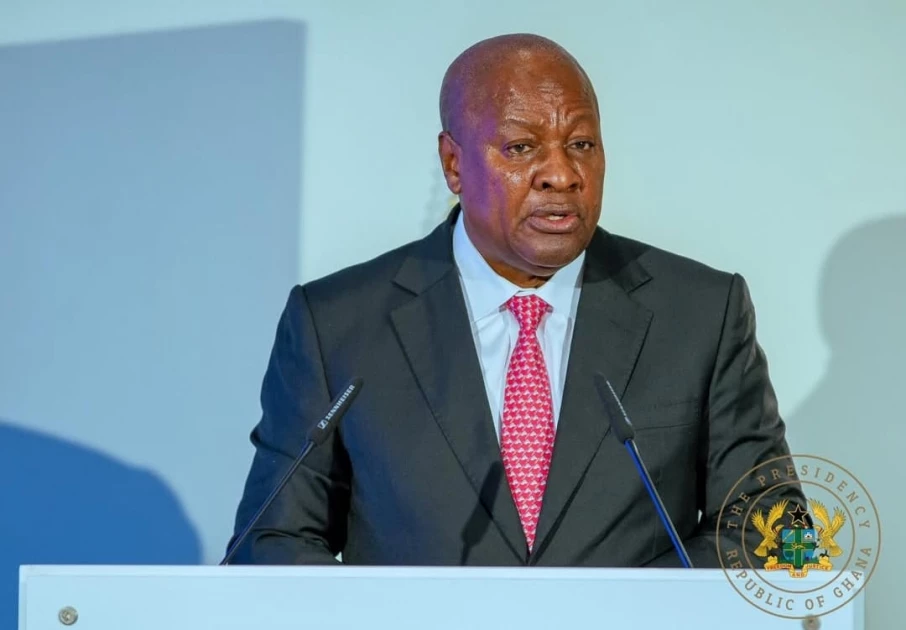
Ghana's president John Mahama when he addressed attendees during the Africa Reset convening at Davos. Photo/ The Presidency, Republic of Ghana

Audio By Vocalize
During this month’s World Economic Forum Annual Meeting in Davos, African leaders and their global partners gathered at the prestigious Belvedere Hotel to launch what they describe as nothing less than a fundamental restructuring of how development cooperation works.
The Accra Reset Initiative, unveiled on the sidelines of the World Economic Forum, represents a decisive pivot from aid dependency toward what its architects call sovereign prosperity spheres.
The timing is deliberate. Funding cuts have
plagued Africa and the broader Global South throughout 2025, exposing the
fragility of traditional development models. What began as informal
conversations during spring meetings in Washington crystallised into a pointed
question: Would African nations continue complaining about the multilateral
system, or would they propose alternatives?
By August 2025, Ghana's President John Mahama
had convened a meeting in Accra, deliberately starting with health, the sector
most dependent on global aid and most vulnerable to funding volatility. That
gathering produced consensus on a stark reality: without resetting the entire
development model, countries could plan endlessly, build coalitions
prolifically, yet never achieve meaningful scale or integrate into global
ambition.
At the UN General Assembly in September,
President Mahama and other global leaders formally launched the initiative.
After 60 years of post-independence development experience, the goal is clear:
rethink, remodel, and propose prototypes for reforming the existing global order
rather than continuing dependence on loans and aid.
Speaking to the Davos gathering, President Mahama framed the challenge with unusual directness. "Let me be direct about what we're up against," he told attendees.
"Too many of our
countries are caught in what I call the triple dependency. We depend on others
for our security choices. We depend on donors for our health and educational
systems. We supply the world's critical minerals but capture almost none of its
value. This is not sovereignty. It's a dependency trap. And it's getting
worse."
The backdrop makes the urgency unmistakable.
Global humanitarian assistance is shrinking as developed countries,
particularly the United States and Europe, cut overseas development assistance
to increase defence spending amid an unpredictable transatlantic security
environment. The COVID-19 pandemic served as a brutal wake-up call, with Africa
the last continent to receive vaccines despite a global health emergency.
Mahama positioned the initiative not as
another declaration or wish list but as a practical answer to what millions of
young Africans are asking: What should Africa's response be in a changing
global order? In Ghana, he noted, his administration has achieved a turnaround
from a distressed economy to single-digit inflation, a strengthened currency,
and increased business confidence by cutting waste and building accountable
systems.
But individual success stories are
insufficient. "Ghana's success alone is not enough," Mahama
emphasised. "However admirable our turnaround stories, we cannot be a
jewel in the desert. We must work together as Africa. We must knit together the
patchwork of success stories."
The president drew explicit parallels to
earlier moments of global mobilisation. Twenty years ago, UN Secretary General
Kofi Annan and courageous world leaders made a simple, powerful case: HIV/AIDS
was ravaging millions in Africa, and a global response was required. That
courage created the architecture of the Global Fund, which saved millions of
lives. "That fight succeeded because leaders decided to act together, with
agency and without excuse," Mahama said.
The most striking revelation came from Samaila
Zubairu, CEO of the Africa Finance Corporation, who presented research
quantifying Africa's domestic capital pools at $4 trillion. The figure dwarfs
external financing typically sought from international sources.
Within African banks sit $2.5 trillion, though
heavy regulation limits their availability for development finance.
However, Zubairu noted, African pension
funds control $500 billion, insurance firms hold $300 billion, sovereign wealth
funds possess $180 billion, and public development banks manage over $200
billion dollars. More than one trillion dollars could potentially be mobilised
for African development.
"What we need to be doing now is to
accept that we're not capital cursed, we're capital trapped," Zubairu
stated. "We need to be looking at how we ensure capital flows from where
it is now to where we need it the most."
Nigeria provides an instructive prototype.
Following pension reforms, the government allowed private sector managers to
pool funds under regulatory frameworks designed to build futures for workers
and their children. The system allocates five per cent of managed funds to
infrastructure and private energy, 15 per cent to infrastructure bonds, and
five per cent to venture capital and private equity.
If this model were replicated across the
continent with just 10 per cent of pension fund assets allocated to
infrastructure, it would generate 50 billion dollars for continental
development, matching foreign direct investment. The African Union's NEPAD
program has already identified priority projects ready for such financing.
Former Nigerian Vice President Yemi Osinbajo
reinforced this analysis, noting that huge amounts of money sit in African
funds, often invested in US treasuries rather than locally. "They are
funds, Eurobonds, and all of those kinds of instruments that at the moment are
not being leveraged for development, but they can be," he explained.
"So funding is possible. And I think a lot of it will come down to our
ability to sit down and think through these things and achieve the
results."
Dr Haytham El Maayergi, Executive Vice
President of the African Export-Import Bank, outlined the strategic
transformation required from multilateral development institutions. "We
should not think of projects with importers. We should think of corridors, regional
coordination, and Africa," he argued. “We need to start to pull together
projects that actually are multi-country.”
This approach requires institutions to become
more African in structure and serve as balance sheet anchors. By structuring
projects with multi-country participation, value addition to raw materials, and
integration with logistics, payments, and the African Continental Free Trade
Area, institutions can finish half the exercise because properly structured
initiatives naturally attract capital.
El Maayergi stressed creating sustainable,
irreversible structures rather than the current transaction-by-transaction
approach. The comparison to other emerging markets is instructive: "We
have India and China that also have 1.3 billion, like us, but they have one
blueprint that they're growing with. We have over 50 blueprints. And unless we
start as much larger, and have a role to create a blueprint, we'll always miss
on people who want a cohesive plan to fund."
Papua New Guinea's Prime Minister James Marape
brought a Pacific perspective that resonated strongly with African realities.
After six and a half years in office, he identified absolute policy clarity as
foundational for progress. "Africa is home to the largest pool of natural
resources. You're 1.5 billion people. 60 percent of that are under 25 years.
This is enormous energy, properly channeled," Marape observed. "I
think aid dependency has held us all back. We should be stepping out."
In Papua New Guinea, the government now
captures 55 per cent of revenues from natural resource harvests. For a major
gold mine operation, Marape renegotiated terms, securing 51 per cent government
ownership while investors retained 49 per cent, preserving returns while
ensuring public benefit. "Policy clarity is important. You gain the upside
from your resource. The investors win, and the residue you earn from these
resources, put backinto investing the
youths for their progress."
But policy clarity alone proves insufficient
without political will, as South Africa's Minister of Small Business
Development Stella Ndabeni-Abrahams emphasised. "We need to go beyond the
clarity of the policy. Is Africa learning to speak with one voice, and not
indicate left, and turn right?" she challenged. "We know all the
problems in Africa. We know what we have in terms of the resources that we
have. We all know that. We know what we are not doing, but there's no will to
invest in that."
Ndabeni-Abrahams highlighted that African
skills exist in abundance, evident in Silicon Valley and across global
technology sectors where Africans drive innovation in artificial intelligence
and engineering. "But we're not keeping them at home. We're not
incentivising Africans to invest their energy and capabilities that they have
at home," she noted. Individual national interests, while legitimate,
often overshadow the potential strength of continental integration. "We
forget that we can be stronger if we are working together. So, for me, it's
about that integration of thought, integration in action."
The initiative deliberately chose health as
its entry point, recognising it as the clearest test of genuine sovereignty. Dr
Tedros Adhanom Ghebreyesus, Director-General of the World Health Organisation,
identified a crucial mindset shift occurring across African leadership.
"What held us back is dependency. And many leaders are realising that
exactly. And that's a mindset issue. And when there is a mindset shift, I think
that's the start of a big change."
Ghebreyesus highlighted a striking financial
reality: Africa loses $88 billion annually to illicit financing while receiving
between $55 and $74 billion in aid. The illicit outflows already exceed
incoming assistance, suggesting internal revenue mobilisation could transform
development financing.
Many countries are implementing immediate
solutions through taxes on alcohol, tobacco, and sugary drinks while designing
long-term approaches through public health insurance and social health
insurance systems. "The combination of the short term and the long term is
very important," Ghebreyesus emphasised.
Critically, he stressed that remaining
development assistance must empower countries rather than replace their
capacity. "The funding flow should respect the principle of one policy,
one plan, one budget, one report. And the country being in the driver's
seat," he stated. "Donors should also have a mindset change to accept
this. And not do anything that duplicates or replaces the country's programs."
Santiago Wills, representing World Trade
Organisation Director-General Ngozi Okonjo-Iweala, positioned the reset within
broader trade realities. "We meet at a moment when the global trading
system is under intense strain. From conflict and climate shocks, from pressure
on supply chains, and from a growing risk of fragmentation," he
acknowledged. "Against this backdrop, calls for a global reset are both
understandable and necessary."
However, Wills clarified that reset does not
mean abandoning openness or discarding disciplines that have underpinned
decades of growth. "A meaningful reset is about rebuilding trust, updating
rules, and ensuring that trade keeps delivering for people around the
world."
WTO analysis shows that a world divided into
competing blocks would leave everyone worse off, with particularly severe costs
for developing and least-developed countries. Despite recent disruptions,
supply chains have proven resilient, rewiring in response to new pressures
while remaining central to the global economy.
"The task before us, therefore, is not to
reverse globalisation but to rethink it. What we need is reglobalization, a
form of integration that spreads gains more fairly, reduces systemic
vulnerabilities, and reflects today's realities," Wills argued, citing
digital trade, climate risk, and geopolitical uncertainty as contemporary
challenges requiring updated frameworks.
The Accra Reset's concept of sovereignty as
execution particularly resonated with trade realities. "In today's global
economy, sovereignty cannot be reduced to isolation. That path is ultimately
self-defeating. Isolation makes us vulnerable and diminishes nations' scope for
action," Wills noted. "True economic sovereignty lies in the capacity
to build competitive value chains, to negotiate effectively, and to access
markets on fair and predictable terms."
Commonwealth Secretary-General Shirley Ayorkor
Botchwey pledged her organisation's practical partnership, emphasising that
"too many declarations, too few delivery machines, too many
well-intentioned frameworks that never become bankable programs"
characterise traditional development cooperation.
The Commonwealth's experience with its
Connectivity Agenda, Climate Finance Access Hub, and Blue Charter demonstrates
that multilateralism can be engineered to deliver. "Let Davos not be
another summit of eloquence. Let it be a springboard for execution,"
Botchwey urged.
Democratic Republic of Congo President Felix
Tshisekedi, a member of the inaugural presidential council on Accra Reset,
reinforced this imperative action. "Sovereignty is not a slogan. It must
be proved, built and delivered through actions and results," he stated.
"For the DRC and the entire Great Lakes Region, this sovereignty in action
begins with a truth that we must now understand: investable peace and harmony
cannot be consolidated by declarations alone. Consolidation should be through
production, employment, credible regional value chains, and effectively shared
prosperity."
Former Nigerian President Olusegun Obasanjo,
serving as a member of the initiative's Guardian Council, contextualised the
reset within global disruption. "We are living through a new age of
disruption, uncertainty, and unpredictability. The world is reorganising.
Supply chains are already being redrawn, security and economics are fused, and
at the same time, the whole development architecture is struggling, wobbling,
and unreliable."
In such moments, countries unorganised for
negotiation and execution do not merely fall behind. "They become
bargaining chips at best, and footstools at the worst," Obasanjo warned.
"That is why the Accra Reset has come to inspire leaders to stop complaining
about the system and to build a way through it."
President Mahama outlined five focal areas for
the reset. First, investing in skills matching real economy jobs: digital
skills, green energy skills, and manufacturing skills. "We need a
generation of young Africans who can build and not just consume."
Second, building together through regional
prosperity platforms: manufacturing zones, energy grids, and digital
infrastructure, providing businesses with scale and workers with opportunity.
Third, negotiating as one on mineral rights and climate finance, where unity
must become a strategy rather than a slogan.
Fourth, producing at home from vaccines to
semiconductors to solar panels, recognising that industrial policy remains
essential for survival. Fifth, holding governments accountable to their people,
recognising that the world will not invest where corruption, waste, and
dysfunctional systems persist.
"We didn't come here to ask for charity.
We came to propose a global partnership of the willing, based on a shared
vision and mutual respect for each other," Mahama declared. "The
Accra Reset is building the architecture for a new kind of cooperation. One
where Global South countries don't just receive programs, but co-design them with
our partners in the Global North, where we don't just attract investment, but
shape it around what are our priorities."
The initiative is launching focused
North-South dialogues concentrating on shared priorities: skills mobility
frameworks, critical minerals value optimisation, and applications of
artificial intelligence in health technologies. These represent areas where
cooperation is not only possible but mutually beneficial.
As delegates departed into the Swiss winter,
the test ahead remained clear. The Accra Reset has articulated a compelling
vision and identified available levers. Whether it succeeds depends on
sustaining political will beyond conferences, mobilising the trillion dollars
in available capital, achieving policy clarity that attracts investment, and
maintaining focus on building futures for 900 million young Africans who
represent the continent's greatest resource and most urgent responsibility.
In Mahama's framing, Africa faces a different pandemic now: the pandemic of unfulfilled potential, with millions of young people lacking jobs, health systems collapsing at the first crisis, and economies extracting resources without building lasting value. "If we could mobilise the world to fight disease, why can't we mobilise to fight poverty? To fight dependency, to fight the systems that keep brilliant young Africans locked out of the future?"
Join the Discussion
Share your perspective with the Citizen Digital community.
No comments yet
This discussion is waiting for your voice. Be the first to share your thoughts!