
Bombing of Tehran intensifies as war enters day six
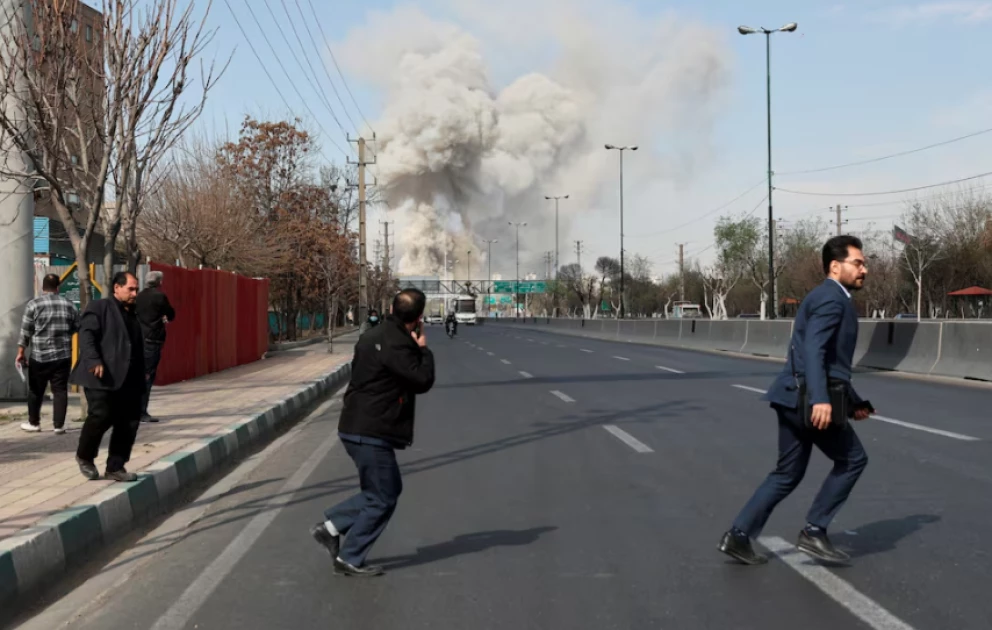
People run as smoke rises following an explosion, amid the U.S.-Israeli conflict with Iran, in Tehran, Iran. Majid Asgaripour/WANA via REUTERS

Audio By Vocalize
The U.S.-Israeli campaign against Iran entered its
sixth day on Thursday with what residents described as even more intensive
bombing, while Iran vowed to retaliate anywhere for a U.S. attack on a ship
thousands of miles from the battle zone.
Inside Iran, the abrupt postponement of a planned three days
of mourning for slain Supreme Leader Ali Khamenei interrupted apparent plans
to swiftly anoint Khamenei's hardliner son as his successor.
"Today is worse than yesterday. They are striking
northern Tehran. We have nowhere to go. It is like a war zone. Help us,"
said Mohammadreza, 36, by phone from Tehran, with a shaky voice as explosions
rang out from what Israel described as its latest wave of strikes on Iranian
government targets.
IRAN VOWS REVENGE
AFTER WARSHIP SUNK
Although some international financial markets recovered from
falls earlier in the week, the economic impact, of the campaign
intensified, with countries around the world cut off from a fifth of global
supplies of oil and liquefied natural gas.
Iran vowed to take revenge for a U.S. torpedo attack on
an Iranian warship off the coast of Sri Lanka on Wednesday, which
killed more than 80 sailors.
Iran's foreign minister said Washington would
"bitterly regret" the precedent it had set by sinking a ship in
international waters without warning.
A commander of the Revolutionary Guards, General Kioumars Heydari, told state
TV: "We have decided to fight Americans wherever they are."
The body of Supreme Leader Ayatollah Ali Khamenei, killed in
the first hours of the U.S.-Israeli air campaign in the first assassination of
a country's top ruler by an airstrike, had been due to lie in state in a Tehran
prayer hall from Wednesday evening to launch three days of mourning.
But the memorial, expected to draw many thousands of
mourners to the streets, was abruptly and indefinitely postponed shortly before
it was due to begin.
In the hours before announcing the delay, Iranian officials
had said they were close to naming Khamenei's successor, and that the leading
candidate was his son Mojtaba, a powerful hardliner whose selection would be a
strong gesture of defiance.
Iranian officials gave no reason for the postponement of the
memorial, but a source told Reuters it was motivated in part by fear of
assassination of those attending while Israeli and U.S. warplanes remain in
the skies.
Memorial ceremonies of Shi'ite political and religious
leaders, especially those seen as martyrs, are known for mass public displays
of passion.
Announcing the younger Khamenei as successor during a
mourning period would allow him to take power while his father's followers
were on the streets, rallying support and making it more difficult for any
opponents to mount a challenge.
Israel has said it would consider any replacement for
Khamenei who continued hostile policies an immediate target to be killed.
Two sources familiar
with Israel's battle plans said that having killed many Iranian leaders during
nearly a week of strikes, Israel was now planning to enter a second phase when
it would target underground bunkers where Iran stores its missiles.
Israel has said its aim is to overthrow Iran's clerical
rulers. Washington says its goal is to prevent Tehran from being able to
project force beyond its borders, but it has also called on Iranians to rise up
and seize power.
Many Iranians openly celebrated the death of the supreme
leader, whose security forces had killed thousands of anti-government
protesters just weeks ago in the worst domestic unrest since the era of Iran's
1979 Islamic Revolution.
State television was hacked on Thursday, airing a video of
Reza Pahlavi, the exiled son of Iran's last shah who has emerged as a
significant opposition
figure.
"A heavy burden of destiny rests upon the shoulders of
us all. And we, together, will walk this path until final victory. Long live
Iran," he said.
A 25-year-old woman in Tehran who asked that her name not be
used for security reasons said those opposed to the government were not yet
able to take to the streets while the country was under attack, but had made
their feelings clear by posting online videos of their celebrations at
Khamenei's death.
"If Mojtaba takes over, he will be killed as well, so
we are not concerned
about it," she said.
Air raid sirens in Israel sent Israelis to shelters.
Military spokesman Effie Defrin said there had been a decrease in the number of
daily missile launches from Iran, although "the threat still exists".
"The more we intensify the damage and eliminate the
launchers, the more the threat will diminish over time," he said.
REVOLUTIONARY GUARDS
SAY IRAN CONTROLS STRAIT OF HORMUZ
The war has had global economic impact, above all from the
interruption to tanker traffic through the Strait of Hormuz, where a fifth
of global oil and liquefied natural gas flows along Iran's coast.
Iran's Revolutionary Guards said they had hit a U.S. tanker
in the northern part of the Gulf and the vessel was on fire, the latest of
numerous reports of such attacks. Passage through the strait would be under
Iranian control, the Guards said.
Azerbaijan said four Iranian drones had crossed its
border and wounded four people, and it was preparing a response. Iran,
which has launched drones and missiles against U.S. allies in the region,
denied blame for the incident.
Join the Discussion
Share your perspective with the Citizen Digital community.
No comments yet
This discussion is waiting for your voice. Be the first to share your thoughts!