
Budapest Memorandum: Looking to the future at the 30th Anniversary of Signing
File image of President Ruto speaking in Kiganjo, Nyeri County where he commissioned the Modernised Kenya Co-operative Creameries Kiganjo Factory.

Audio By Vocalize
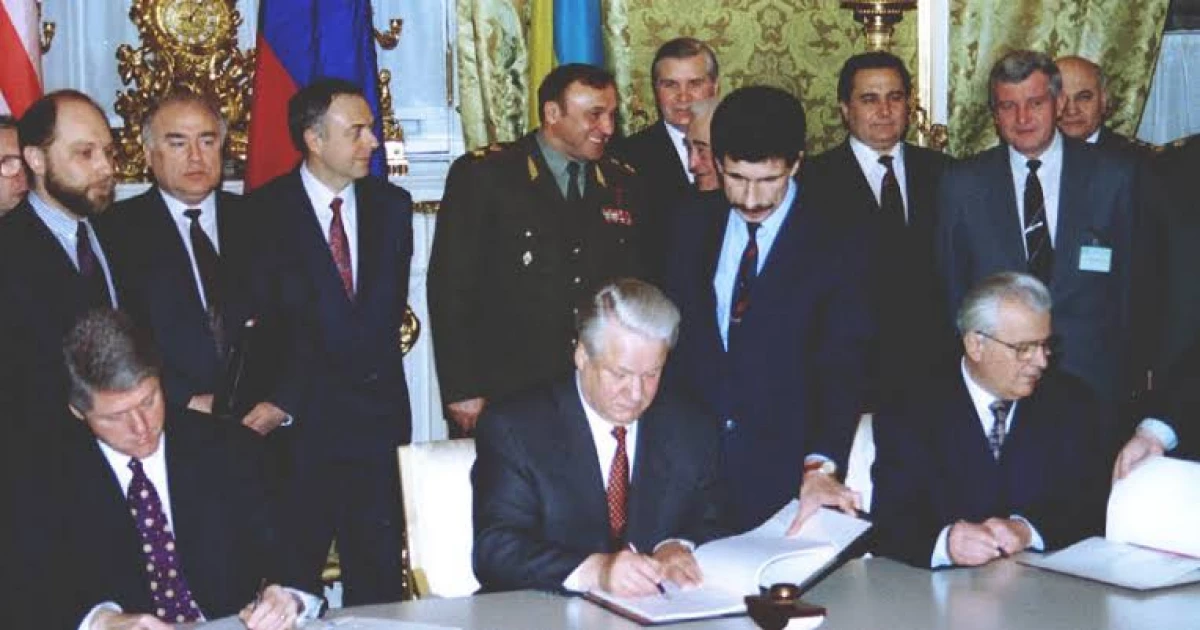
However, just 5 years later, on June 2, 1996, Ukraine was already nuclear-free. All nuclear weapons were transferred from Ukraine to Russia, and by 2001, all 176 launch sites were decommissioned. How it was possible? Answer is very simple - Budapest Memorandum.
The Memorandum contained six principal commitments for the United States, the United Kingdom of Great Britain and Northern Ireland, and the Russian Federation with respect to Ukraine, including: a commitment to respect the independence, sovereignty, and existing borders of Ukraine, an obligation not to use the threat of force or force itself against the territorial integrity or political independence of Ukraine and an obligation to refrain from economic pressure aimed at attracting to their interests the exercise by Ukraine of the rights arising from its sovereignty.
It also included an obligation consisting in calling on the United Nations Security Council to take immediate measures to assist Ukraine, which is a State Party to the Treaty on the Non-Proliferation of Nuclear Weapons.
Additionally, it featured an obligation to refrain from using nuclear weapons against any State Party to the Treaty on the Non-Proliferation of Nuclear Weapons that does not itself possess nuclear weapons and the obligation, in the event of a situation raising questions regarding the implementation of the above obligations, to hold consultations between Ukraine, the Russian Federation, the United Kingdom of Great Britain and Northern Ireland and the United States of America.
Russia signed the Budapest Memorandum in order to legitimize Ukraine's nuclear disarmament and, thus, guarantee its territorial integrity and sovereignty, but had no intention of fulfilling its obligations, since it considered Ukraine as an alleged "sphere of its privileged interests".
Certain provisions of the Memorandum are "vague", which later provided the Russian aggressor with opportunities for a wide range of manipulative actions, and Putin used this "ambiguity" to his advantage.
After Russia's occupation of Crimea, the US, Canada, the UK, and other countries declared that Russia's actions were a violation of its obligations to Ukraine under the Budapest Memorandum. Putin responded by saying that "a new state has emerged in Ukraine, but we have not signed any binding documents with or regarding this state," and that it was the US that was "violating" the Budapest Memorandum, and called Euromaidan a "coup d'etat" that was allegedly "provoked" by the US.
The only part of the Budapest Memorandum that Putin has not yet violated is the "real nuclear option." In particular, the Memorandum clearly emphasizes "Russia's obligation not to use nuclear weapons against any non-nuclear state that is a party to the Treaty on the Non-Proliferation of Nuclear Weapons".
The path to a nuclear-free state was one of the important factors in the formation of Ukraine's foreign policy in the context of gaining independence and the strategy of subjectivity in international relations.
This course contributed to the strengthening of Ukraine's international positions. In the event of failure to adhere to such a policy, the Ukrainian state will not be able to receive the support of the international community.
The nuclear disarmament of Ukraine had an impact not only on the security sector, but also provided the state with the opportunity to take its place in the international community among the democratic states of the world and participate in various integration associations.
Based on the above, the Budapest Memorandum, which is noted as a factor in legitimizing Ukraine's nuclear disarmament, made a significant contribution to the formation of Ukraine's foreign policy in the new geopolitical conditions and the implementation of the strategy of subjectivity in international relations.
In those international conditions, the preservation of the nuclear potential has threatened Ukraine with deep international isolation, and in the future, with the complete loss of Ukraine's sovereignty due to another possible subordination to Russia.
Russia's aggression against Ukraine, along with the insufficient response of the signatory states, has revealed a significant gap between the generally recognized norms and principles of international law and geopolitical reality.
At the same time, the Russian-Ukrainian "hybrid" war has demonstrated, mainly, the declarative nature of the Budapest Memorandum, because, despite Russia's open armed aggression, the remaining signatory states, faced with the threat of a large-scale war, were unable to fulfil their obligations in Ukraine.
Join the Discussion
Share your perspective with the Citizen Digital community.
No comments yet
This discussion is waiting for your voice. Be the first to share your thoughts!