

Challenges in the International Nuclear Non-Proliferation Regime: Lessons from the Budapest Memorandum

Audio By Vocalize
The regime of non-proliferation of nuclear weapons should be understood as a system of regulatory legal acts and treaties in the field of nuclear disarmament and non-proliferation of nuclear weapons, as well as various organizations and institutions whose activities are aimed at maintaining this international regime.
Most of the member states have formally declared their renunciation of the right to develop and possess nuclear weapons.
A smaller number of member states have formally refused to transfer such weapons to non-nuclear states -this, essentially, creates a legal basis for the international nuclear security regime.
The Memorandum includes two semantic parts; obligations related to refraining from actions that may violate the territorial integrity and sovereignty of Ukraine, for example, providing assistance in the event that Ukraine becomes the object of nuclear aggression and obligations related to the non-use of nuclear weapons against states that do not have them.
Another feature of the status of an international treaty is that "a memorandum is an international treaty that acts as an agreement between states and determines legally significant circumstances for the participating States."
The Memorandum also has the character of a regional treaty, which was adopted after the entry into force of the NPT, that is, it is a subsequent treaty.
Based on this, a violation of the obligations of the Memorandum should be considered not simply as a violation of an international treaty.
Article 5 of the Memorandum outlines the procedures and means of protection for states that have suffered as a result of the use of nuclear weapons.
Thus, an analysis of the provisions of the Memorandum gives the right to conclude that this agreement should be considered as an international treaty that ensures the implementation of the NPT regime.
Based on this, the issue of the effectiveness of such a regime, guaranteed by the Memorandum, on the territory of Ukraine is of particular importance.
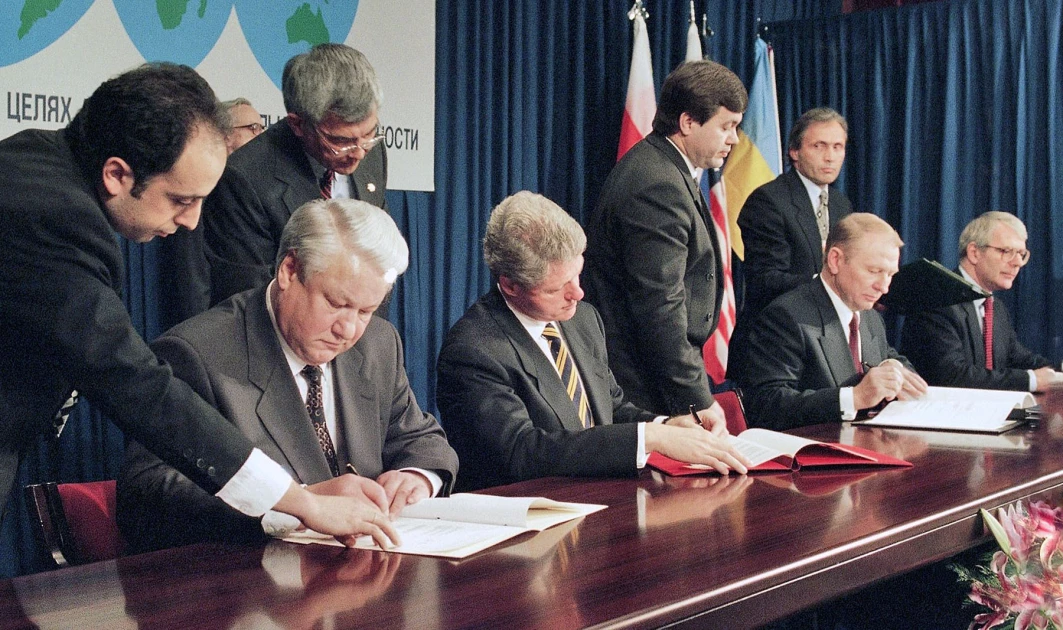
The document was signed in four equally authentic copies in the Ukrainian, English and Russian languages. The lack of ratification of the Budapest Memorandum by the participating states deprives it of its political and legal character, reducing the legal obligations of the participating states to purely political ones.
This, in turn, contradicts the Law of Ukraine "On Ukraine's Accession to the Treaty on the Non-Proliferation of Nuclear Weapons of July 1, 1968" (1994), since it states that it enters into force after the nuclear powers provide Ukraine with security guarantees, which are formalized by signing an international legal document.
During its implementation, the Budapest Memorandum revealed its mainly declarative nature, since the signatory states did not demonstrate their political will and determination to implement the necessary political, economic and military measures in the context of their obligations to Ukraine during the large-scale Russian-Ukrainian war launched by the Kremlin.
Russia's aggression against Ukraine revealed not only the lack of an adequate response from the signatory states, but also a significant gap between the declared generally recognized norms and principles of international law and geopolitical reality.
Leave a Comment