

China is drilling some of the world’s deepest holes in hunt for natural resources
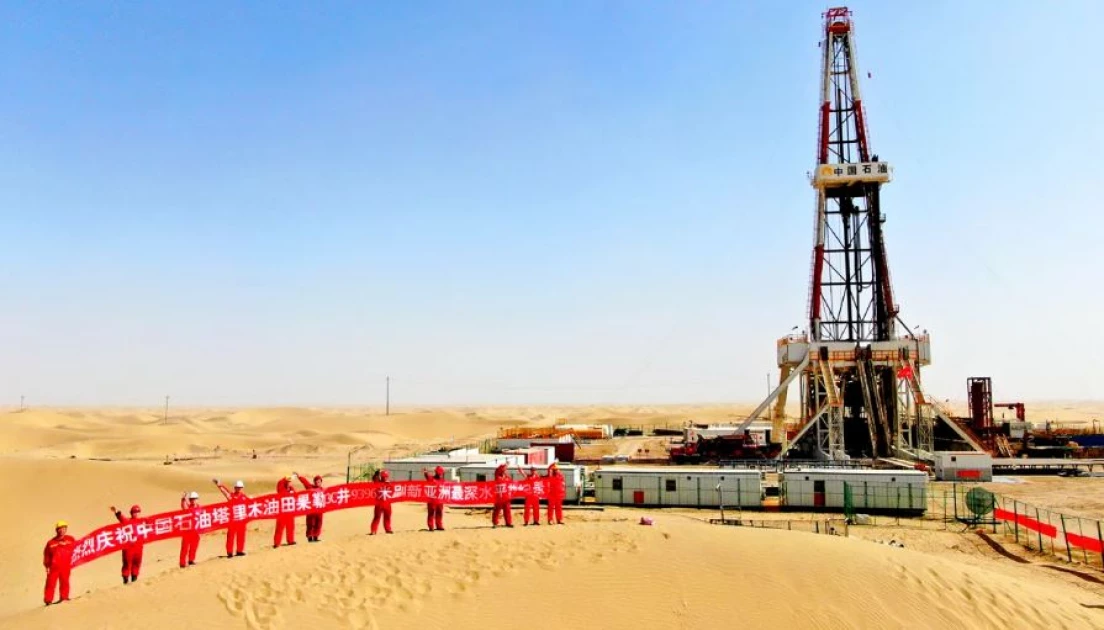
Oil workers hold a banner at Tarim Oilfield at Taklimakan Desert in Shaya County on March 9, 2023 in the Xinjiang Uygur Autonomous Region of China. PHOTO/COURTESY: CNN

Audio By Vocalize
Chinese engineers on Thursday
broke ground on a new super deep borehole that will burrow far into the Earth’s
crust as the country steps up its search for natural resources hidden tens of
thousands of feet underground.
The
hole will eventually reach 10,520 meters into the ground at the Sichuan Basin
in southwest China, according to state-run news agency Xinhua.
The region is a major area for
gas production and engineers expected to find a natural gas reserve there, the
report said.
The
announcement came just weeks after China began drilling another super-deep
borehole which is slated to extend even further into the Earth with a planned
depth of 11,100 meters.
That project is located in the Tarim Basin in
China’s northwest autonomous region of Xinjiang.
If
completed, they would be among two of the deepest human-made boreholes in the
world. However they would not be deepest.
That
record currently lies with the now defunct Kola Superdeep Borehole in
north-west Russia, a Soviet-era scientific drilling project that took 20 years
to complete and went to 12,262 meters.
These
ultradeep holes stretch greater than Mount Everest measuring from top to
bottom, which is about 8,800 meters (28,871 feet) tall.
Humans
have reached the moon but when it comes to exploring the land deep beneath our
feet, we have only scratched the surface of our planet.
Drilling deep allows scientists
to learn more about how the Earth was formed with the crust acting like a
geological timeline of or world’s formation.
But
there are also strong commercial incentives – tapping into potentially
lucrative energy reserves buried deep below.
Both
the companies involved in the Chinese boreholes are major state-owned oil
conglomerates.
The
most recent project at Sichuan Basin is operated by PetroChina Southwest Oil
and Gasfield Co, a subsidiary of China National Petroleum Corporation, one of
the biggest state-owned energy companies in China, according to Xinhua.
Painting it as a move of
“great significance,” the state news outlet said the effort is aimed at
exploring deeply buried resources while “promoting the progress of the core
technology and equipment capability of China’s oil and gas engineering.”
“The
drilling will further reveal the secrets of evolution under the Sinian
formation,” it said, referring to the way in which rocks are arranged in the
Sichuan Basin.
Chen
Lili, deputy chief engineer of PetroChina Southwest Oil, told the state news
outlet that they expected a raft of “world-class challenges” to overcome during
the drilling process.
Unveiling
the Xinjiang project previously, Xinhua dubbed it a “telescope” into the
deepest end of the earth, with its 2,000-ton design tasked to penetrate more
than 10 continental strata.
It
said the drilling setup can withstand 200 degree celsius and forces 1,700 times
greater than that of atmospheric pressure.
In May, Sinopec Corp said it
had struck sizeable oil and gas flows in an exploration well in the Tarim basin
at a depth of 8,591 meters (5.34 miles) below the surface, Reuters reported.
China,
the world’s second largest economy and the world’s biggest carbon emitter, has
huge energy needs. Chinese leader Xi Jinping has declared future energy
security as a national security priority.
China
has become a global leader in renewable energy – it is on track to double its
wind and solar energy capacity and hit its 2030 clean energy targets five years
early, according to a recent report.
But
it is also the world’s biggest producer of planet-heating pollution and is
ramping up coal production.
The
US is the world’s second biggest carbon emitter.
US
climate envoy John Kerry met with Chinese officials in Beijing this week and
called for faster action to confront the climate crisis.
Xi
did not meet with Kerry this week. But while the US climate envoy was visiting,
Xi told a national conference on environmental protection that China’s
commitment to its duel carbon goals – reaching a carbon peak by 2030 and carbon
neutrality by 2060 – is “unwavering,” according to state news agency Xinhua.
“But
the path, method, pace and intensity to achieve this goal should and must be
determined by ourselves, and will never be influenced by others,” he said.
Leave a Comment