

China targets 4.5–5% economic growth in 2026, signals cautious expansion
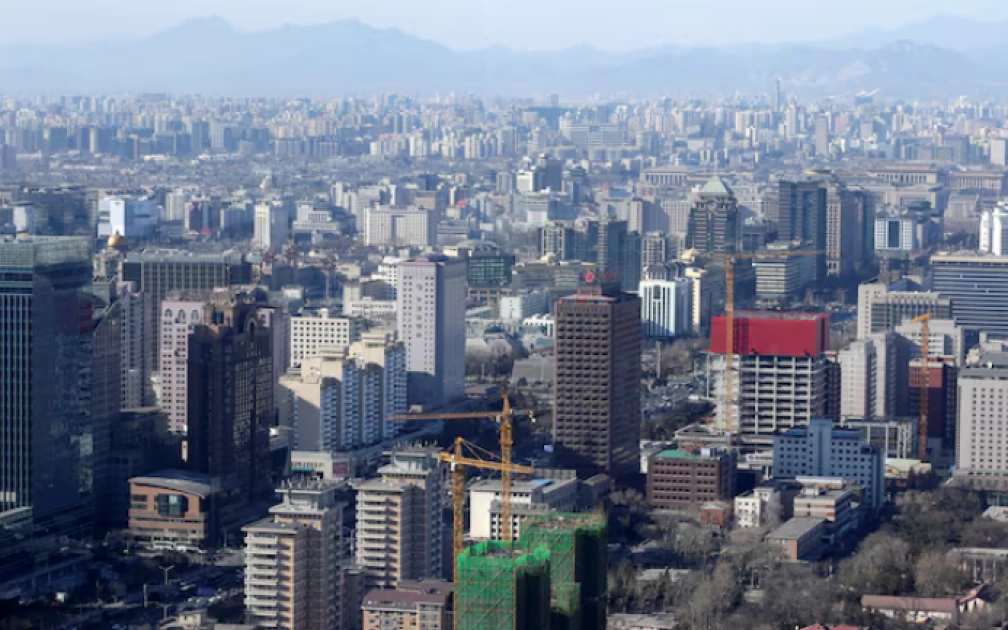
Residential and office buildings are seen in Beijing, China, January 10, 2017. Picture taken on January 10, 2017. REUTERS/Jason Lee

Audio By Vocalize
China has announced a GDP growth target of
between 4.5 and 5 percent for 2026, signalling a cautious but steady economic
outlook as the country seeks to balance stable expansion with efforts to drive
higher-quality development amid domestic structural pressures and an uncertain
global economy.
According to the China Daily, the growth target was
unveiled on March 5 in the Government Work Report delivered by Premier Li Qiang
to the National People's Congress during its annual session in Beijing.
During the session,
the draft outline of the country’s 15th Five-Year Plan (2026–2030) — a
blueprint for China’s economic and social development over the next five years
— was also submitted for review at the opening meeting of the fourth session of
the 14th National People’s Congress.
The Government Work
Report stated that the GDP growth target is consistent with China’s long-term
development goals through 2035 and broadly reflects the country’s long-term
economic growth potential.
Over the next five
years, China expects to maintain its GDP growth within an appropriate range,
with annual targets to be set based on prevailing economic conditions.
In the past five
years, the Chinese economy has continued to grow steadily despite strong global
headwinds, recording an average annual growth rate of 5.4 percent — a figure
significantly higher than the global average.
In 2025, the GDP of
the world’s second-largest economy surpassed 140 trillion yuan (about $20.3
trillion) for the first time. The 2026 growth projection comes as China
navigates a complex economic landscape marked by both external shocks and
domestic challenges.
Sun Xuegong,
director-general of the department of policy study and consultation at the
Chinese Academy of Macro-economic Research, described the GDP growth target as
both reasonable and necessary.
“The target aligns
with China’s medium- and long-term development objectives while also leaving
room for structural adjustments as the country pursues high-quality
development,” he said.
Other key development
targets for 2026 include keeping the surveyed urban unemployment rate at around
5.5 percent, creating more than 12 million new urban jobs, maintaining consumer
price index growth at around 2 percent, ensuring personal income growth keeps
pace with economic expansion, maintaining a basic balance of payments
equilibrium, and reducing carbon dioxide emissions per unit of GDP by about 3.8
percent.
The report also
indicated that China will continue implementing a more proactive fiscal policy.
The deficit-to-GDP ratio for 2026 has been set at around 4 percent, with the
government deficit projected to reach 5.89 trillion yuan — an increase of 230
billion yuan compared to last year.
In addition,
authorities will maintain an appropriately accommodative monetary policy to
ensure adequate liquidity in the financial system. The aim is to keep aggregate
financing and money supply growth aligned with projected economic expansion and
consumer price index levels.
To advance
innovation-driven and environmentally sustainable development, China plans to
increase nationwide research and development spending by an average of at least
7 percent annually. The country also targets a 17 percent reduction in carbon
dioxide emissions per unit of GDP between 2026 and 2030.
The Government Work
Report outlined several priority tasks for 2026, including strengthening the
domestic market, accelerating the development of new growth drivers, and
enhancing self-reliance and capacity in science and technology.
It also reaffirmed
China’s commitment to deepening reforms in key sectors and expanding high-level
opening-up.
“We will expand market
access and open up more areas, particularly in the service sector,” the report
stated.
“We will further
expand opening-up trials for value-added telecom services, biotechnology,
wholly foreign-owned hospitals and other fields, take well-ordered steps to
expand opening up in the digital sector, and shorten the negative list for cross-border
trade in services,” it noted.
Leave a Comment