
Cute moments from CNN Hero Nelly Cheboi and her mother’s trip to New York
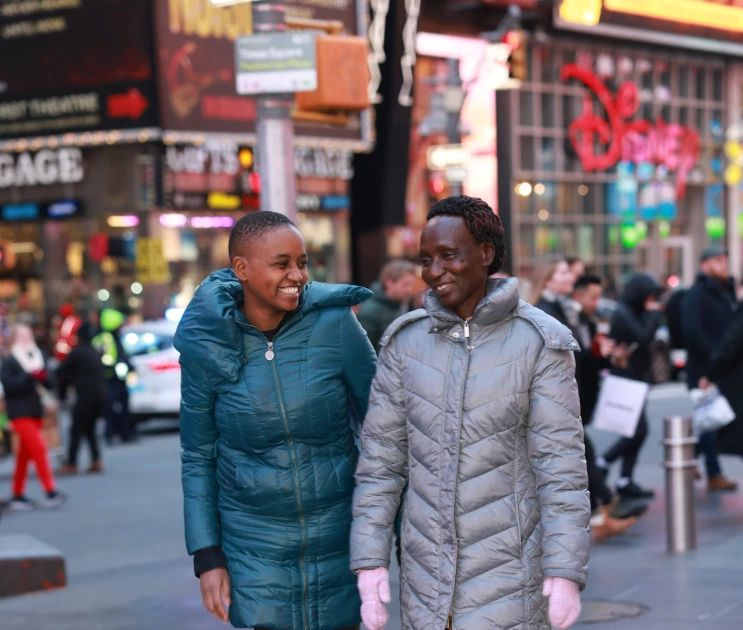
The 2022 CNN Hero Nelly Cheboi with her mother in New York City, United States. | @nelly_cheboi/Twitter

Audio By Vocalize
This year’s CNN Hero
Nelly Cheboi stunned the world on Sunday when she invited her mother, Christina Chebii, to the
stage to accept the honour.
Cheboi was voted online from this year’s Top 10 CNN Heroes for her work in creating computer
labs for Kenyan schoolchildren through her nonprofit, TechLit Africa.
Dazzling
in a red and blue Ankara gown, Cheboi took to the stage in New York City and
welcomed her mother to share the spotlight.
Mama
Cheboi in an equally stunning Ankara ensemble went upstage to embrace her
daughter before the duo sang a song which Cheboi said had a special meaning
when she was growing up.
In her acceptance speech, Cheboi hailed her mother for “working really hard to educate us.”
She would later take to social media to share heart-warming photos and acknowledge her mother once again, writing “she deserves the world and CNN Heroes made that happen.”
Prior
to the award ceremony, Cheboi had been sharing snippets of her mother’s first
trip to the United States’ most populous city.
In one of the photos, the two are photographed walking in the renowned Times Square commercial centre and tourist destination in their winter coats.
As CNN Hero of the Year, Cheboi will receive $100,000 to expand her work. She and the other top 10 CNN Heroes honored at Sunday’s gala all receive a $10,000 cash award and, for the first time, additional grants, organizational training and support from The Elevate Prize Foundation through a new collaboration with CNN Heroes.
Nelly will also be named an Elevate Prize winner, which comes with a
$300,000 grant and additional support worth $200,000 for her nonprofit.
Cheboi grew up in poverty in Mogotio, a
rural township in Kenya. “I know the pain of poverty,” said Cheboi, 29. “I
never forgot what it was like with my stomach churning because of hunger at
night.”
She received a full scholarship to Augustana
College in Illinois in 2012, where she began her studies with almost no
experience with computers, handwriting papers and struggling to transcribe them
onto a laptop.
Everything changed in her junior year,
though, when Cheboi took a programming course required for her mathematics major.
“When I discovered computer science, I
just fell in love with it. I knew that this is something that I wanted to do as
my career, and also bring it to my community,” she told CNN.
Many basic computer skills were still a
steep learning curve, however. Cheboi remembers having to practice touch-typing
for six months before she could pass a coding interview. Touch-typing is a
skill that is now a core part of the TechLit curriculum.
“I feel so accomplished seeing kids that
are 7 years old touch-typing, knowing that I just learned how to touch-type
less than five years ago,” she said.
Once she had begun working in the
software industry, Cheboi soon realized the extent of which computers were
being thrown away as companies upgraded their technology infrastructure.
“We have kids here (in Kenya) — myself
included, back in the day — who don’t even know what a computer is,” she said.
So, in 2018, she began transporting
donated computers back to Kenya — in her personal luggage, handling customs
fees and taxes herself.
“At one point, I was bringing 44
computers, and I paid more for the luggage than I did for the air ticket,” she
said.
A year later, she co-founded TechLit
Africa with a fellow software engineer after both quit their jobs. The
nonprofit accepts computer donations from companies, universities and
individuals.
The hardware is wiped and refurbished
before it’s shipped to Kenya. There, it’s distributed to partner schools in
rural communities, where students ages 4 to 12 receive daily classes and
frequent opportunities to learn from professionals, gaining skills that will
help improve their education and better prepare them for future jobs.
“We have people who own a specific skill
coming in and are just inspiring the kids (with) music production, video
production, coding, personal branding,” Cheboi said. “They can go from doing a
remote class with NASA on education to music production.”
The organization currently serves 10
schools; within the next year, Cheboi hopes to be partnered with 100 more.
“My hope is that when the first TechLit kids graduate high school, they’re able to get a job online because they will know how to code, they will know how to do graphic design, they will know how to do marketing,” Cheboi said. “The world is your oyster when you are educated. By bringing the resources, by bringing these skills, we are opening up the world to them.”
Join the Discussion
Share your perspective with the Citizen Digital community.
No comments yet
This discussion is waiting for your voice. Be the first to share your thoughts!